Aerospace & Aviation
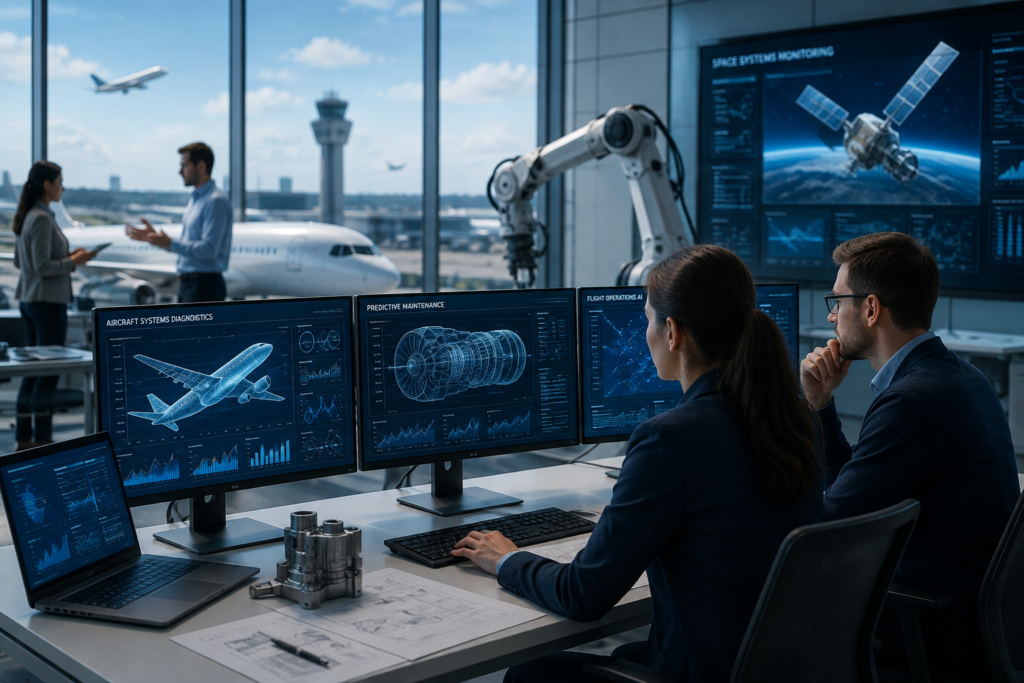
AI in Aerospace and Aviation is changing how aircraft and spacecraft are designed, manufactured, operated, maintained, and managed. AI is increasingly being used for predictive maintenance, autonomous systems, flight operations, air traffic management, engineering analysis, manufacturing, safety monitoring, and the analysis of large amounts of aerospace data.
For aerospace and aviation professionals, AI creates opportunities to combine specialized industry knowledge with skills in data analysis, automation, machine learning, robotics, computer vision, and intelligent systems. Engineers, pilots, maintenance professionals, manufacturing specialists, operations teams, analysts, and other aviation professionals may increasingly work alongside AI-enabled technologies.
Aerospace and aviation are highly safety-critical industries. AI can assist professionals with complex information and repetitive tasks, but reliability, testing, regulation, cybersecurity, human oversight, and professional judgment remain essential. The most valuable applications of AI will need to improve capability or efficiency without compromising safety.
Table of Contents
- How AI in Aerospace and Aviation Is Changing the Industry
- Where AI Is Being Used in Aerospace and Aviation
- AI Careers and Emerging Roles in Aerospace and Aviation
- AI Skills for Aerospace and Aviation Professionals
- Education and Certifications for AI Aerospace Careers
- Opportunities for Aerospace and Aviation Professionals
- Challenges and Responsible AI Use in Aerospace and Aviation
- How to Prepare for an AI-Enabled Aerospace or Aviation Career
- Explore Related AI Careers and Skills
How AI in Aerospace and Aviation Is Changing the Industry
AI is becoming integrated into systems used throughout the aerospace and aviation lifecycle—from aircraft design and manufacturing to flight operations, maintenance, airports, and air traffic management. These technologies can analyze large amounts of sensor and operational data, identify patterns, support predictions, and assist professionals with complex decisions.
Where AI Is Being Used in Aerospace and Aviation
AI is being applied across aircraft development, manufacturing, maintenance, flight operations, airports, air traffic systems, and space programs. Some applications help professionals analyze complex information and predict problems, while others support automation, autonomous systems, computer vision, and increasingly sophisticated decision-support tools.
Aircraft Design and Engineering
AI can help aerospace engineers analyze design alternatives, optimize components, evaluate aerodynamic or structural information, and assist with simulation. These tools can accelerate portions of engineering work, while qualified professionals remain responsible for validating designs and meeting safety and certification requirements.
Predictive Maintenance
Modern aircraft generate large amounts of information from engines, avionics, sensors, and other systems. AI can help identify patterns that may indicate developing problems, allowing maintenance organizations to investigate issues and schedule appropriate service before failures occur.
Autonomous and Uncrewed Aircraft
AI is an important technology in autonomous aircraft, drones, and other uncrewed aerial systems. Computer vision, sensors, navigation systems, machine learning, and automated controls can help these aircraft interpret their surroundings and perform increasingly complex missions.
Aerospace Manufacturing and Robotics
Aircraft and spacecraft manufacturing can use robotics, computer vision, automation, and AI for assembly, inspection, quality control, material handling, and production planning. Aerospace manufacturing still requires extremely high standards for precision, documentation, traceability, and quality.
Air Traffic Management
AI can help analyze traffic patterns, weather, aircraft positions, congestion, and other information relevant to managing airspace. These technologies may assist controllers and planners, but safety-critical decisions require reliable systems, established procedures, and appropriate human oversight.
Flight Operations
Airlines and aviation organizations can use AI to assist with flight planning, fuel optimization, scheduling, disruption management, weather analysis, and operational decision-making. Pilots, dispatchers, and operations professionals remain essential when conditions change or unusual situations occur.
Airports and Ground Operations
Airports can use AI for passenger-flow analysis, baggage handling, equipment monitoring, security support, gate planning, ground operations, and resource scheduling. These applications can help improve efficiency while supporting the complex coordination required around aircraft and passengers.
Space Systems and Exploration
AI can support spacecraft operations, satellite imagery analysis, autonomous navigation, scientific research, mission planning, and the analysis of large amounts of space-related data. Greater autonomy can be particularly valuable when spacecraft operate far from Earth and communication delays make continuous human control impractical.
AI Careers and Emerging Roles in Aerospace and Aviation
As aerospace and aviation organizations adopt artificial intelligence, career opportunities are developing for professionals who can combine industry knowledge with AI, data, automation, robotics, and intelligent systems. Some roles focus directly on developing AI technology, while others apply these capabilities to aircraft, spacecraft, maintenance, manufacturing, flight operations, airports, and air traffic systems.
Aerospace AI Engineer
Aerospace AI Engineers develop and apply machine learning and intelligent systems to aerospace problems. Their work may involve aircraft performance, autonomous systems, sensor data, engineering analysis, maintenance, manufacturing, mission planning, or other specialized applications.
Autonomous Systems Engineer
Autonomous Systems Engineers develop technologies that allow aircraft, drones, spacecraft, and other vehicles to operate with varying degrees of independence. These roles can involve robotics, navigation, sensors, computer vision, controls, software, and machine learning.
Aviation Data Scientist
Aviation Data Scientists analyze information from aircraft, flights, maintenance systems, airports, passengers, weather, and operations. They may use statistics, programming, and machine learning to identify patterns, develop predictions, and support operational decisions.
Predictive Maintenance Specialist
Predictive Maintenance Specialists combine aircraft or equipment knowledge with sensor information, maintenance records, analytics, and AI. Their work can help organizations identify developing problems, improve reliability, and plan maintenance more effectively.
Aerospace Robotics and Automation Engineer
These professionals develop or integrate robotics and automated systems used in aerospace manufacturing, inspection, testing, material handling, and other operations. Aerospace applications often require exceptional precision, reliability, and quality control.
Computer Vision Engineer
Computer Vision Engineers develop systems that interpret images and video. Aerospace and aviation applications can include manufacturing inspection, aircraft maintenance, autonomous navigation, satellite imagery, airport operations, and safety monitoring.
Air Traffic Technology Specialist
Air Traffic Technology Specialists work with systems that support airspace management, communications, surveillance, navigation, traffic analysis, and controller decision support. AI may increasingly assist these systems as airspace becomes more complex.
Space Systems AI Specialist
Space Systems AI Specialists apply artificial intelligence to satellites, spacecraft, mission operations, autonomous navigation, scientific data, remote sensing, and space exploration. These roles can combine aerospace engineering, software, data science, robotics, and AI.
AI Aviation Consultant
AI Aviation Consultants can help airlines, airports, manufacturers, maintenance organizations, and other aviation businesses evaluate AI applications, select technologies, redesign workflows, and introduce new systems while considering safety, regulation, cybersecurity, and operational requirements.
AI Skills for Aerospace and Aviation Professionals
Aerospace and aviation professionals do not necessarily need to become AI developers to benefit from artificial intelligence. The most useful skills depend on the role, but combining specialized aerospace or aviation knowledge with AI literacy, data analysis, programming, digital platforms, communication, and strong technical judgment can provide a valuable foundation.
AI Fundamentals
Understanding how artificial intelligence, machine learning, generative AI, computer vision, and autonomous systems work at a practical level can help aerospace and aviation professionals evaluate new technologies and understand where AI-generated results require additional verification.
Data Analysis
Aircraft, spacecraft, airports, maintenance systems, manufacturing operations, and flight networks generate large amounts of information. Professionals who can analyze and interpret this data can use AI-enabled systems more effectively and make better-informed decisions.
Programming
Programming can be particularly valuable for aerospace engineers, data scientists, autonomous-systems specialists, simulation professionals, and people working with robotics or AI. Python is widely useful for data and AI applications, while other languages may be important for specialized aerospace systems.
Prompt Engineering
Generative AI can assist with research, technical explanations, documentation, coding, brainstorming, and other appropriate professional tasks. Clear prompting can improve results, but safety-critical or technical information should always receive appropriate independent verification.
Cloud & AI Platforms
Cloud and AI platforms can support aerospace data analysis, machine learning, simulation workflows, operational applications, and large-scale information processing. Familiarity with these platforms can be useful for professionals working with modern aerospace technology and data systems.
Communication & Leadership
Aerospace projects often involve engineers, pilots, maintenance professionals, manufacturing teams, software developers, regulators, operations personnel, suppliers, and management. Professionals who can explain AI clearly and coordinate across these groups can help organizations introduce technology more effectively.
Autonomous Systems and Robotics
Professionals working with advanced aerospace systems may benefit from knowledge of robotics, sensors, navigation, control systems, computer vision, and autonomous technologies. These skills are particularly relevant to drones, uncrewed aircraft, spacecraft, manufacturing, and advanced flight systems.
Safety, Reliability, and Systems Thinking
Aerospace professionals need to understand how individual technologies interact within larger systems. AI capabilities must be considered alongside safety requirements, reliability, redundancy, human factors, cybersecurity, certification, and the consequences of system failure.
Education and Certifications for AI Aerospace Careers
There is no single educational path into an AI-enabled aerospace or aviation career. Requirements vary considerably depending on the occupation. Engineering, flight operations, aircraft maintenance, air traffic, manufacturing, software, and data careers can each require different combinations of education, training, experience, licensing, and professional qualifications.
Education
Degrees in aerospace, aeronautical, mechanical, electrical, computer, systems, or other engineering disciplines can provide strong foundations for many technical aerospace careers. Computer science, data science, mathematics, robotics, and related fields can also lead to opportunities involving AI and autonomous systems.
Other aviation careers may rely on specialized technical schools, employer training, military experience, flight training, apprenticeships, or other career-specific preparation rather than a traditional four-year engineering degree.
Professionals who already have aerospace or aviation experience may not need another degree simply to begin developing AI skills. Targeted education in data analysis, programming, machine learning, autonomous systems, robotics, or cloud technology may complement expertise they already possess.
Licenses and Professional Qualifications
Some aviation occupations require specific licenses, certificates, ratings, medical qualifications, or other regulatory credentials. AI training does not replace these requirements.
Depending on the career, professionals should determine which qualifications are required by employers, regulatory agencies, or professional standards before choosing an educational path.
AI and Technology Certifications
Technology certifications can be useful when they demonstrate skills relevant to a particular aerospace role. Depending on the career path, useful credentials may involve cloud platforms, data analytics, cybersecurity, project management, robotics, software, or artificial intelligence.
When evaluating a certification, consider:
- Whether employers in your target aerospace or aviation field recognize it.
- Whether it supports skills actually used in the role you want.
- Whether the program includes practical projects or hands-on work.
- Whether it complements required industry licenses or professional qualifications.
- Whether the technology is widely used or highly specialized.
- The total time and financial commitment.
- Whether continuing education is required to maintain the credential.
What Matters More Than an AI Certificate?
An AI credential can demonstrate training, but aerospace employers also need evidence that professionals can apply technology carefully within complex, safety-conscious environments.
Useful projects or work samples might demonstrate your ability to:
- Analyze aircraft or flight data using public or simulated datasets.
- Develop a predictive-maintenance example.
- Analyze satellite or remote-sensing data.
- Create a computer-vision demonstration.
- Develop a basic autonomous-systems or robotics project.
- Analyze airport or transportation operations data.
- Build an aerospace-related data dashboard.
- Use AI to assist with a technical workflow while independently validating the results.
- Document assumptions, limitations, safety considerations, and results.
- Explain a technical project clearly to both technical and nontechnical audiences.
Career Tip: Specialized aerospace or aviation experience can be extremely valuable. AI skills are often most useful when they strengthen your existing knowledge of aircraft, engineering, maintenance, manufacturing, operations, safety, or other industry systems.
Opportunities for Aerospace and Aviation Professionals
AI does not necessarily mean aerospace and aviation professionals need to leave their current careers. For many people, the strongest opportunity may be to combine specialized industry experience with new capabilities in AI, data, automation, and intelligent systems.
Enhance Your Current Aerospace Role
Engineers, analysts, maintenance professionals, operations teams, and other aerospace workers can use AI to assist with research, documentation, data analysis, troubleshooting, planning, and other appropriate tasks. Professionals with industry expertise are well positioned to determine when AI-generated information is useful and when it requires additional verification.
Become the AI Resource on Your Team
Professionals who develop practical AI knowledge can help coworkers evaluate tools, identify useful applications, establish appropriate workflows, and recognize limitations. This can create leadership opportunities without requiring a move into a dedicated AI position.
Develop Aerospace Data and Analytics Skills
Aerospace and aviation organizations generate large amounts of information involving aircraft, maintenance, flights, manufacturing, weather, airports, and operations. Professionals who combine industry knowledge with analytics skills can help organizations turn this information into useful insights.
Move Into Predictive Maintenance and Reliability
Aircraft maintenance professionals, engineers, and technicians understand how equipment behaves in real operating environments. Adding skills in sensor data, analytics, condition monitoring, and AI can create opportunities involving predictive maintenance and reliability.
Explore Autonomous Systems
Professionals with backgrounds in engineering, avionics, software, controls, robotics, navigation, or flight systems can develop additional expertise in autonomous technologies. Opportunities may involve drones, uncrewed aircraft, spacecraft, advanced flight systems, or autonomous ground equipment.
Develop Aerospace Manufacturing Technology Skills
Manufacturing engineers, technicians, quality professionals, and production specialists can build expertise in robotics, automation, computer vision, digital manufacturing, and AI-assisted inspection. Existing knowledge of aerospace production and quality requirements can provide an important advantage.
Apply AI to Aviation Operations
Pilots, dispatchers, airport professionals, airline operations teams, and other aviation specialists can develop skills in AI-assisted planning, forecasting, disruption management, scheduling, and operational analysis. Industry experience remains essential when interpreting recommendations in changing real-world conditions.
Explore Space and Satellite Applications
Professionals interested in the space sector can develop skills involving satellite data, autonomous spacecraft, remote sensing, robotics, mission planning, and AI-assisted scientific analysis. These areas can combine aerospace expertise with software, data science, and machine learning.
Challenges and Responsible AI Use in Aerospace and Aviation
AI can provide valuable capabilities in aerospace and aviation, but errors in safety-critical systems can have serious consequences. Organizations need rigorous approaches to safety, reliability, testing, cybersecurity, certification, human factors, and accountability when AI influences aircraft, spacecraft, equipment, or operational decisions.
Safety
Aerospace and aviation organizations should evaluate AI-enabled technologies within established safety-management practices. Automated recommendations should not override required procedures, operating limitations, regulations, or qualified professional judgment.
Reliability and System Failure
AI systems can produce incorrect predictions or behave unexpectedly when they encounter conditions that differ from their training or testing. Safety-critical applications require appropriate testing, monitoring, redundancy, fallback procedures, and methods for responding when systems do not perform as expected.
Certification and Regulation
Aircraft, aviation systems, maintenance activities, and many aerospace technologies operate within extensive regulatory and certification frameworks. Introducing AI does not eliminate these requirements. Organizations need to determine how new technologies fit within applicable standards, approval processes, and operational rules.
AI-Generated Technical Information
Generative AI can produce calculations, code, procedures, technical explanations, or engineering suggestions that appear convincing but contain errors. Aerospace professionals should independently verify important technical information before using it in engineering, maintenance, manufacturing, flight operations, or other consequential work.
Cybersecurity
Modern aircraft, airports, manufacturing facilities, ground systems, and spacecraft depend on interconnected digital technologies. AI can provide new capabilities but can also introduce additional security risks. Organizations need to protect systems, communications, operational data, credentials, and connected equipment.
Autonomous Systems
Autonomous aircraft, drones, spacecraft, and other systems need clearly defined operating limits and appropriate human oversight. Developers and operators should understand how these systems respond to unusual situations, degraded sensors, communication problems, unexpected environments, and other conditions outside normal operations.
Human Factors
Introducing AI can change how pilots, controllers, maintenance personnel, engineers, and other professionals interact with technology. Systems should be designed so people understand important information, recognize when automation may be unreliable, and can intervene appropriately when necessary.
Human Oversight and Accountability
Organizations need clear responsibility for AI-enabled aerospace and aviation systems. Qualified professionals should remain involved when decisions affect safety, aircraft operation, maintenance, engineering, passengers, employees, regulatory compliance, or other consequential outcomes.
Professionals working with AI in Aerospace and Aviation can also use resources from the Federal Aviation Administration to follow aviation safety, regulations, certification, emerging technologies, and developments affecting the National Airspace System.
How to Prepare for an AI-Enabled Aerospace or Aviation Career
You do not need to master every area of artificial intelligence to prepare for changes in aerospace and aviation. A practical approach is to build on your existing technical or operational expertise while developing AI, data, and digital skills that complement the career you want to pursue.
- Strengthen your aerospace or aviation foundation. Continue developing the engineering, maintenance, flight, manufacturing, operations, or other specialized knowledge relevant to your career.
- Build AI literacy. Learn the fundamentals of machine learning, generative AI, computer vision, autonomous systems, and common aerospace applications.
- Develop data skills. Practice analyzing aircraft, maintenance, manufacturing, flight, satellite, or other aerospace-related information.
- Learn relevant technology. Depending on your career, this may include programming, simulation, robotics, sensors, avionics, cloud platforms, computer vision, or autonomous systems.
- Build practical projects. Use public, simulated, or appropriate non-confidential data to explore predictive maintenance, aerospace analytics, computer vision, autonomous systems, or other applications.
- Understand safety and cybersecurity. Learn how reliability, certification, regulation, security, human factors, and professional responsibility affect AI-enabled aerospace systems.
- Strengthen communication and teamwork. Practice explaining technical information and working across engineering, operations, maintenance, software, management, and other teams.
- Choose a direction. Decide whether you want to strengthen your current role or move toward aerospace AI, analytics, autonomous systems, predictive maintenance, robotics, manufacturing technology, aviation operations, or space applications.
Explore Related AI Careers and Skills
AI opportunities in aerospace and aviation connect with careers and skills across AiCareerTrack. Continue exploring the areas that best match your aerospace experience, technical interests, operational knowledge, and career goals.
- Machine Learning Engineer — explore a career focused on developing, deploying, and maintaining machine learning systems.
- AI Solutions Architect — learn how professionals design AI solutions that connect applications, data, cloud platforms, and organizational systems.
- Data Analysis — explore careers that use data, statistics, programming, and machine learning to identify patterns and develop useful insights.
- AI Fundamentals — build a practical understanding of artificial intelligence and how it is being used in the workplace.
- Data Analysis — develop skills for analyzing information, identifying patterns, and communicating useful insights.
- Programming — strengthen coding skills that can support aerospace analytics, autonomous systems, simulation, robotics, and AI development.
- Prompt Engineering — learn techniques for working more effectively with generative AI systems.
- Cloud & AI Platforms — learn how cloud technologies support aerospace data, analytics, applications, simulation workflows, and artificial intelligence.
- Communication & Leadership — strengthen the human skills needed to explain technology, coordinate across specialized teams, and guide organizational change.
AI is likely to continue changing how aircraft and spacecraft are designed, manufactured, operated, maintained, and managed. Professionals who combine aerospace or aviation expertise with practical AI skills, strong technical judgment, and a commitment to safety and responsible technology use can help shape how these systems develop.