
AI Agents for Work & Business
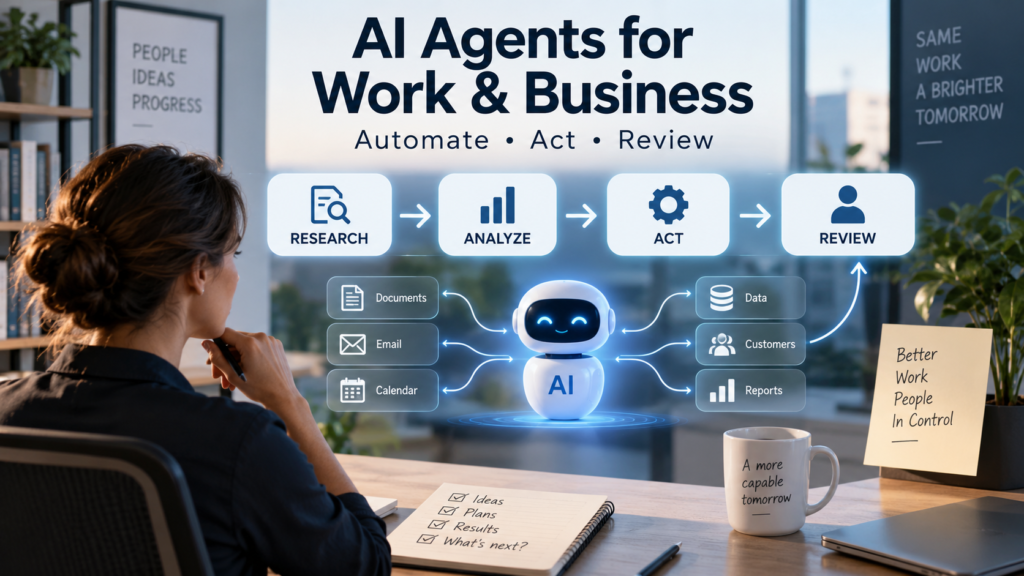
AI agents for work are becoming capable of doing more than answering questions or generating content. Depending on how they are designed and what systems they can access, they may be able to gather information, use tools, complete multiple steps, make limited decisions, and take actions on a person’s or organization’s behalf.
That can make agents useful. It can also make them more complicated—and potentially more consequential—than ordinary AI assistance.
The important question is therefore not simply:
“Which AI agent should I use?”
A better question is:
“Do I actually need an AI agent, or would a simpler AI workflow do the job?”
For many tasks, an AI assistant or well-designed workflow may be easier to understand, less expensive, and easier to supervise. For other tasks, an agent may provide meaningful value because the work requires multiple steps, changing conditions, tool use, or decisions about what to do next.
This guide will help you understand the difference, identify situations where agents may be useful, recognize situations where they may add unnecessary complexity, and evaluate the access, oversight, and safeguards an agent may require before you allow it to act.
The goal is not to use the most advanced form of AI. The goal is to use the simplest approach that can perform the work effectively and responsibly.
What Is an AI Agent?
An AI agent is a software system that can pursue a goal with some ability to determine what steps to take along the way.
Instead of responding to a single request and stopping, an agent may be able to break a task into steps, gather information, choose among available tools, respond to what happens, and continue working until it reaches a stopping point or requires human input.
Exactly what counts as an “AI agent” is not perfectly standardized. Companies and researchers sometimes use the term differently, and products described as agents can vary substantially in how much independence they actually have.
A useful way to think about an agent is to ask how much control the AI has over the process.
An ordinary AI interaction might look like this:
You ask → AI responds → You decide what happens next.
A more agentic process might look like this:
You provide a goal → AI determines several steps → AI uses permitted tools or information → AI evaluates what happened → AI chooses a next step → Human review occurs when required.
The amount of independence can vary. One agent might only research information and prepare a recommendation. Another might be permitted to update records, interact with software, send communications, or initiate other actions.
That distinction matters because an AI system that can act creates different benefits and risks from one that can only advise.
The more authority an AI system has to act, the more carefully you should consider its access, limits, monitoring, and human oversight.
AI Assistant vs. AI Workflow vs. AI Agent
The terms AI assistant, AI workflow, and AI agent are sometimes used loosely, but separating them can help you decide how much automation you actually need.
AI Assistant
An AI assistant primarily helps a person complete work.
You might ask it to summarize information, brainstorm ideas, explain a topic, analyze text, draft a document, compare alternatives, or help solve a problem. The person generally remains responsible for deciding what happens next.
A simple pattern is:
Person → AI assistance → Person reviews and acts
This may be enough for many professional tasks.
AI Workflow
An AI workflow connects AI to a repeatable process whose major steps are largely determined in advance.
For example, a workflow might:
- receive a document,
- extract specified information,
- classify the information,
- draft a summary,
- send the result to a person for review.
AI may perform important work within the process, but the overall path is substantially defined beforehand.
Workflows can be especially useful when the task is repeated frequently and the desired process is reasonably predictable.
AI Agent
An AI agent has greater ability to determine how to pursue a goal.
Instead of following only a fixed sequence, it may decide which information it needs, which permitted tool to use, whether an intermediate result is sufficient, and what step should come next.
For example, an agent asked to investigate a customer-service problem might review available records, identify missing information, consult permitted knowledge sources, determine possible solutions, and prepare or carry out an appropriate next action within the authority it has been given.
That flexibility can be valuable when the path cannot be completely specified beforehand.
It also means there may be more decisions for the AI to make.
The Practical Difference
A useful rule of thumb is:
Assistant: helps you perform the work.
Workflow: follows a process you substantially define.
Agent: can make some decisions about how to pursue the goal within the authority you give it.
These categories can overlap, and different products may use the terminology differently. What matters most is not the label attached to the software.
What matters is what the system can access, what decisions it can make, what actions it can take, and where a human remains responsible.
Why AI Agents Are Becoming Important
AI systems have increasingly moved beyond generating text, images, and answers. Some can now interact with tools, business applications, databases, websites, files, APIs, and other software systems.
That changes the role AI can play in work.
An AI assistant may help you write an email. An agent with appropriate access might be able to gather the information needed for the email, prepare it, determine who should receive it, and place it into a workflow for review or delivery.
An AI assistant may help analyze a customer problem. An agent might be able to retrieve permitted customer information, consult support documentation, identify possible solutions, update a case, and recommend or initiate a next action.
The important change is not simply that AI is becoming better at answering questions.
It is that some AI systems are becoming capable of participating in processes.
That creates potential benefits for employees, professionals, freelancers, and businesses. Repetitive work may require less manual coordination. Information may move between systems more efficiently. Multi-step tasks may be completed with fewer interruptions.
But increased capability does not automatically mean increased value.
An agent that requires extensive configuration, access to sensitive systems, frequent correction, or constant supervision may create more work than it saves.
The value of an AI agent should be measured by the problem it solves—not by how autonomous or technologically impressive it appears.
What Can AI Agents Actually Do?
What an AI agent can do depends on the model behind it, the tools and information it can access, the permissions it receives, and the safeguards placed around its actions.
Some agents may primarily gather and organize information. Others may interact with software or carry out parts of a business process.
Common capabilities can include:
Research and Information Gathering
An agent may search permitted information sources, review documents, collect relevant facts, compare findings, and organize the results around a goal.
This can be useful when research requires several steps rather than a single search or question.
Monitoring and Follow-Up
An agent may check for changes or new information and respond according to defined conditions.
Examples might include monitoring the status of a project, identifying new support requests, checking whether specified information has changed, or flagging situations that require human attention.
Working Across Multiple Steps
Some tasks require a sequence of related activities rather than one AI response.
An agent may be able to complete one step, evaluate the result, and determine what needs to happen next.
This ability becomes particularly relevant when the correct next step depends on information discovered during the previous step.
Using Tools and Connected Systems
When appropriately configured, an agent may be able to use external tools or connected systems rather than only generate an answer.
Depending on its permissions, this could include retrieving records, working with files, interacting with business applications, using APIs, or initiating approved actions.
Access should not be treated casually. Giving an agent access to a system can also give it the ability to make mistakes within that system.
Preparing or Taking Actions
Some agents may prepare actions for human approval. Others may be authorized to perform certain actions automatically.
For example, a system might prepare a response, recommendation, transaction, update, or other action and then require a person to approve it.
In a more autonomous arrangement, the system may be allowed to carry out limited low-risk actions without approval.
The distinction is important.
An agent that recommends an action is not the same risk as an agent that is authorized to take that action.
Coordinating Work
Agents may also help coordinate information and activities across a process.
For example, an agent could gather information from several approved sources, identify missing items, prepare a status summary, and direct exceptions to the appropriate person.
The benefit in cases like these may come less from replacing an individual task and more from reducing the manual effort required to keep a process moving.
Capability Does Not Mean Permission
An AI agent may technically be capable of performing an action without being an appropriate system to authorize to perform it.
Before giving an agent access or authority, ask:
- What information can it see?
- What systems can it use?
- What actions can it take?
- Could an incorrect action cause financial, legal, privacy, security, safety, employment, or reputational harm?
- Can its actions be reviewed?
- Can an action be reversed?
- What happens when the agent is uncertain?
- When must a person approve the next step?
The answers should affect how much independence the system receives.
A useful principle is:
Give an AI system enough access and authority to perform the intended task—but no more than the task actually requires.
When an AI Workflow May Be Better Than an Agent
AI agents can be useful when a system genuinely needs flexibility in deciding how to pursue a goal. But many tasks do not require that level of independence.
If the work follows a reasonably predictable process, a simpler AI workflow may be easier to build, understand, test, supervise, and improve.
Consider a recurring task such as reviewing incoming information, extracting several fields, preparing a summary, and sending the result to a person for approval.
If those steps are known in advance, there may be little benefit in giving an AI system broad freedom to decide how the process should operate.
A workflow may be the better choice when:
- the major steps are known in advance,
- the task follows a repeatable pattern,
- there are relatively few exceptions,
- important decisions should remain with a person,
- predictable behavior matters more than flexibility,
- the process can be improved without giving AI additional authority, or
- greater autonomy would introduce risk without creating enough additional value.
This does not make a workflow less sophisticated or less useful than an agent.
It simply means the technology matches the problem.
Start With the Simplest Useful Approach
Suppose you want AI to help prepare a weekly business report.
You might begin by asking an AI assistant to analyze the information and draft the report.
If the task repeats regularly, you might create a workflow that gathers the required information, applies the same analysis steps, prepares the report, and sends it to you for review.
Only if the process genuinely requires the system to determine what information to obtain, choose among different approaches, handle changing circumstances, or take additional actions might greater agent autonomy provide enough value to justify the added complexity.
This creates a useful progression:
AI Assistant → AI Workflow → AI Agent
But that progression should not be treated as a maturity ladder where everyone eventually needs to reach the final stage.
Sometimes the assistant is the right solution.
Sometimes the workflow is the right solution.
Sometimes an agent is justified.
More autonomy is not automatically better automation.
When an AI Agent May Be Worth Considering
An AI agent becomes more interesting when the work cannot be handled effectively through a simple request or a completely predetermined sequence.
An agent may be worth considering when several of the following conditions are present.
The Correct Next Step Can Change
Some processes cannot be fully mapped in advance because what should happen next depends on what the system discovers.
An agent may be able to evaluate the situation and select an appropriate next step within defined boundaries.
The Work Requires Several Tools or Information Sources
A task may require gathering information from one source, comparing it with another, using a tool to perform an analysis, and then deciding what to do next.
If a person must manually coordinate every transition, an appropriately designed agent may reduce that coordination work.
The Task Requires Repeated Decisions
Some work involves many small decisions rather than one major decision.
If those decisions can be bounded, evaluated, and safely delegated, an agent may be able to handle part of the process while directing exceptions to a person.
Conditions Change During the Task
A fixed workflow works best when the expected path is reasonably stable.
An agent may be more useful when new information can materially change what should happen next.
The Work Is Frequent Enough to Justify the Setup
An agent that saves five minutes on a task performed once a year may not justify the effort required to configure, test, secure, monitor, and maintain it.
The same capability applied to a high-volume recurring process may have substantially more value.
Frequency matters because the benefits of automation often accumulate through repeated use.
The Potential Benefit Exceeds the Added Complexity
Agents may require additional configuration, permissions, testing, monitoring, security controls, and human oversight.
Those costs should be part of the decision.
The question is not:
“Could an agent do this?”
The better question is:
“Would giving an agent greater independence make this process meaningfully better than a simpler alternative?”
The AI Agent Decision Test
Before choosing an agent, evaluate the work itself.
Ask:
- Is this task repeated often enough to justify automation?
- Are the steps predictable, or does the correct path genuinely change?
- Does the system need to make decisions between steps?
- Does it need access to other tools, files, applications, or information sources?
- Would a simpler AI assistant or workflow accomplish most of the same value?
- What happens if the system makes a mistake?
- Can important actions be reviewed before they occur?
- Can incorrect actions be reversed?
- Will the system encounter confidential, personal, financial, proprietary, or otherwise sensitive information?
- Can you clearly define what the agent is and is not authorized to do?
- Who will monitor its performance and handle exceptions?
- Is the expected benefit large enough to justify the setup, oversight, and risk?
You do not need every answer to favor an agent.
In fact, several answers may point toward a simpler solution.
For example, if the steps are predictable, the consequences of an error are significant, and a person should approve every important action anyway, a structured workflow may provide most of the benefit with less complexity.
On the other hand, if the task occurs frequently, the appropriate next step changes based on new information, several tools must be coordinated, errors can be contained, and meaningful human checkpoints can be established, an agent may deserve further evaluation.
Choose an agent because the work requires greater flexibility—not because “agentic” is the newest label attached to AI software.
What Should You Avoid Handing Completely to an AI Agent?
An AI agent can be useful without being given unlimited authority.
The more consequential an action becomes, the stronger the case for human review, restricted permissions, or another safeguard before the action is completed.
This is especially important when an error could be difficult to reverse or could significantly affect another person, a business, money, confidential information, or an important decision.
High-Impact Decisions
Be cautious about allowing an agent to make important decisions about people without meaningful human review.
Examples could involve hiring, firing, employee discipline, promotion, access to important services, or other decisions that materially affect someone’s opportunities or livelihood.
AI may sometimes help gather information, organize evidence, or identify issues for consideration. That is different from allowing the system to make the final decision.
Significant Financial Actions
An agent that can prepare an invoice or identify an unusual transaction has different authority from one that can independently transfer money, approve a large purchase, change financial accounts, or enter a financial commitment.
For higher-impact financial actions, consider approval thresholds and human authorization before anything becomes final.
Legal or Contractual Commitments
AI may help review information, organize documents, or prepare drafts, but allowing an agent to independently create binding commitments can introduce substantial risk.
A system should not receive contractual authority simply because it is technically capable of interacting with the software where contracts or agreements are managed.
Sensitive or Confidential Information
An agent may need information to perform its job, but that does not mean it should have access to every available file, account, database, or communication.
Consider whether the task involves:
- personal information,
- employee or customer records,
- financial information,
- confidential business information,
- intellectual property,
- passwords or security credentials,
- private communications, or
- other information whose exposure could cause harm.
Access should be limited to what the agent actually needs.
Irreversible or Difficult-to-Reverse Actions
The ability to undo a mistake can substantially change the risk of automation.
Drafting an email for review is relatively easy to reverse because nothing has been sent.
Sending thousands of messages, deleting records, publishing information, changing production systems, or completing transactions can be much harder to undo.
As the consequences become harder to reverse, human approval becomes more important.
Situations the Agent Does Not Understand
No system will handle every situation correctly.
A useful agent therefore needs more than instructions about what to do. It also needs boundaries around when not to proceed.
When information is missing, conflicting, unusual, or outside the expected situation, the appropriate action may be to stop and ask a person.
A well-designed agent should know when the next step belongs to a human.
Security, Privacy and Human Oversight
Giving an AI system the ability to use tools creates possibilities that an ordinary chatbot may not have.
It may also create additional security and privacy considerations.
An agent that can read information, interact with applications, or perform actions could potentially make a mistake using those capabilities. It may also encounter malicious or misleading information intended to influence its behavior.
For that reason, security should be part of the agent design from the beginning rather than something added after the system has already been given broad access.
Limit Permissions
An agent should generally receive the minimum access needed to perform its intended work.
If an agent only needs to read a particular set of documents, it may not need permission to modify or delete them.
If it needs access to one business application, that does not automatically justify access to every application used by the organization.
This principle reduces the potential consequences of both mistakes and misuse.
Separate Reading From Acting
There can be an important difference between permission to obtain information and permission to change something.
For example, an agent might be allowed to:
Read a customer record → analyze the situation → recommend an action
without automatically receiving permission to:
Change the customer record → issue a refund → send a message
Separating these capabilities can preserve much of the benefit while keeping consequential actions under tighter control.
Use Approval Checkpoints
Human approval does not need to occur after every minor step.
Instead, checkpoints can be placed where the consequences become more significant.
An agent might gather information and prepare a recommendation independently but require approval before sending an external communication, making a purchase, changing an important record, or performing another consequential action.
Plan for Unexpected Inputs
Agents may work with information from emails, documents, websites, messages, databases, and other sources.
Those inputs should not automatically be assumed to be trustworthy instructions.
For example, malicious instructions hidden in information an agent is processing could attempt to influence what the system does. This type of threat is one reason agent security requires attention to both the AI model and the environment in which it operates.
The practical lesson for most readers is straightforward:
Do not give an agent broad access merely because you trust the AI to behave correctly. Design the system so that a mistake has limited room to cause harm.
Monitor What the Agent Does
Automation should not mean losing visibility.
Depending on the importance of the process, useful monitoring may include records of:
- what information the agent accessed,
- which tools it used,
- what decisions it made,
- what actions it attempted,
- which actions required approval,
- where errors occurred, and
- when the system stopped or escalated to a person.
These records can help identify problems and improve the process over time.
Keep Accountability Human
An organization may delegate tasks to software, but responsibility for how that software is used does not disappear.
Someone should remain responsible for determining what the agent is allowed to do, reviewing its performance, responding to problems, and deciding whether continued use remains appropriate.
For an individual professional or small-business owner, that person may simply be you.
For a larger organization, responsibilities may be divided among business owners, technology teams, security personnel, managers, and other appropriate specialists.
The principle remains the same:
AI can perform parts of the work. People remain responsible for deciding where and how that authority should be used.
AI Agents for Work: Employees and Professionals
For employees and professionals, the most useful agent may not be one that tries to replace an entire job.
It may be one that takes responsibility for a bounded part of a larger process.
Many professional roles include work that requires gathering information, checking multiple sources, preparing recurring reports, coordinating routine activities, monitoring changes, or moving information between systems.
Those activities may create opportunities for carefully designed agents.
Research and Information Preparation
A professional might use an agent to gather information from approved sources, compare findings, identify relevant changes, and prepare a summary for review.
The professional still evaluates the information and makes the important decision, but spends less time collecting and organizing the material.
Recurring Reports
An agent might gather permitted information from several systems, identify changes since the previous reporting period, prepare a draft report, and flag unusual results for human attention.
This could reduce repetitive preparation while keeping interpretation and important decisions with the professional.
Project Coordination
Agents may help monitor project information, identify missing items, summarize progress, track routine follow-ups, or bring exceptions to the attention of the appropriate person.
The goal does not have to be removing people from project management.
It may simply be reducing the administrative work required to keep people informed.
Internal Knowledge and Support
An agent with access to approved organizational information might help employees locate policies, procedures, technical documentation, or other internal knowledge.
More advanced systems might gather information from several sources and prepare a response or next-step recommendation.
This can be useful when employees spend significant time locating information that already exists somewhere in the organization.
Preparing Work for Human Approval
One of the most practical uses of agents may be completing the preparation that occurs before a human decision.
An agent might gather records, check whether required information is present, identify inconsistencies, prepare a recommendation, and place the work in front of the appropriate person.
This creates a useful division of labor:
AI handles appropriate preparation. A person retains important judgment and authority.
Think in Tasks, Not Entire Jobs
When evaluating agents at work, avoid beginning with:
“Can an AI agent do my job?”
Instead ask:
“Which parts of my work involve repeatable processes, information gathering, coordination, or routine decisions that an agent might help perform?”
A job is usually a collection of different tasks. Some may be appropriate for AI assistance, some for workflows or agents, and others may depend heavily on human judgment, relationships, responsibility, physical activity, creativity, or expertise.
This is also why learning to work effectively with AI may become more important than trying to predict whether an entire occupation will be “automated.”
AI Agents for Small Businesses
Small businesses may have particularly interesting opportunities for agents because owners and employees often perform many different roles.
A business owner might handle customer inquiries, scheduling, marketing, purchasing, bookkeeping preparation, research, sales follow-up, operations, and administrative work—sometimes within the same day.
AI agents may help with portions of that workload, but small businesses also need to be careful about complexity.
A sophisticated system that requires substantial setup, monitoring, integration work, and troubleshooting may not be worthwhile for a small operation.
The same principle we use throughout this guide applies:
Start with the business problem, not the AI agent.
Customer Inquiry Preparation
An agent might review an incoming inquiry, gather relevant information from approved business sources, classify the request, and prepare a response for review.
Routine low-risk inquiries might eventually be handled with greater automation, while unusual or sensitive situations are directed to a person.
Scheduling and Administrative Coordination
An agent may help collect scheduling information, identify available options, prepare reminders, organize requests, or coordinate routine administrative steps.
If a simpler scheduling tool already performs the job reliably, however, adding an AI agent may provide little additional value.
Sales Follow-Up
An agent might organize incoming leads, gather relevant background information, identify missing details, prepare personalized follow-up material, or flag promising opportunities.
That does not mean the agent should automatically contact every prospect or make commitments on behalf of the business.
The appropriate level of authority depends on the process and the consequences of mistakes.
Business Monitoring
A small-business agent might monitor selected information and bring important changes to the owner’s attention.
For example, it might identify overdue items, unusual activity, new customer requests, inventory conditions, or other situations defined by the business.
In many cases, the greatest value may come from helping the owner notice what requires attention rather than independently deciding how the business should respond.
Routine Operations
Businesses often have processes that involve collecting information, checking conditions, updating records, and moving work to the next stage.
Some of these processes may be candidates for agents—especially when the correct path varies enough that fixed automation becomes cumbersome.
But if the process consists of straightforward rules such as:
When X happens → perform Y
traditional automation may remain the simpler and more reliable choice.
Start With One Business Process
A small business does not need an “AI transformation” before it can experiment with agents.
Choose one process that:
- happens frequently,
- consumes meaningful time,
- has a reasonably clear objective,
- can be tested without exposing the business to excessive risk,
- produces results you can evaluate, and
- can initially operate with human review.
Then determine whether an assistant, workflow, or agent is actually the best tool for improving it.
The goal is not to make the business more autonomous. The goal is to make the business work better.
AI Agents for Freelancers and Consultants
Freelancers and consultants face a different challenge.
Their expertise and judgment may be the product clients are paying for, so indiscriminate automation could reduce rather than increase the value they provide.
The better opportunity may be using agents around the professional’s expertise rather than trying to replace it.
Research and Preparation
An agent might gather background information, organize source material, identify questions that require investigation, or prepare materials before the freelancer or consultant begins higher-value work.
This can reduce preparation time while leaving interpretation and professional judgment with the person providing the service.
Client and Project Administration
Independent professionals may spend substantial time on work surrounding the client engagement rather than the engagement itself.
Depending on the systems being used, agents or workflows may help organize inquiries, prepare meeting information, track routine project steps, identify outstanding items, or prepare follow-up materials.
Monitoring for Clients
Some consultants provide value by helping clients stay informed about changing information.
An agent may be able to monitor approved sources, identify relevant developments, and prepare a preliminary summary.
The consultant then evaluates what matters and explains its significance to the client.
That distinction can be important.
Finding information may become easier. Knowing what the information means for a particular client can remain highly valuable.
Scaling a Repeatable Service
A freelancer or consultant who performs a similar process for many clients may eventually identify portions that can be standardized.
For example:
Collect information → organize it → perform preliminary analysis → identify exceptions → prepare material for expert review
Parts of that process might be handled by a workflow or agent, allowing the professional to spend more time on interpretation, strategy, communication, and other higher-value work.
Protect Client Trust
Independent professionals should be particularly careful when agents interact with client information.
Before connecting an agent to client documents, communications, accounts, or systems, consider:
- whether you are authorized to provide that access,
- what information the AI service may receive,
- how the information is handled,
- whether access can be limited,
- whether the client should be informed,
- what actions the system can take, and
- how you will verify the resulting work.
Saving time is not worth compromising a client’s confidentiality or trust.
Use AI to Extend Your Expertise
The strongest opportunity may not be turning your expertise over to an agent.
It may be using an agent to remove some of the surrounding work so you can apply that expertise more effectively.
This reflects a broader AiCareerTrack principle:
Your existing experience can be the foundation that makes AI useful.
How Much Technical Skill Do You Need?
You do not necessarily need to be a programmer to begin using AI agents.
Some agent tools are designed for people who work through visual interfaces, instructions, templates, and connections to common business applications. More advanced agents may require knowledge of APIs, software development, data systems, security, cloud platforms, or other technical areas.
The important question is not whether you can call yourself an AI developer.
It is whether you have enough knowledge to design, test, supervise, and evaluate the system you are using.
Start With the Work You Understand
Domain knowledge can be extremely valuable when building or configuring an agent.
A salesperson may understand what makes a lead worth pursuing.
An accountant may understand which financial exceptions require investigation.
A project manager may know which delays require escalation.
A small-business owner may understand which customer situations can be handled routinely and which require personal attention.
That knowledge helps define what an agent should do, what information it needs, where it should stop, and when a person should become involved.
You may understand the work better than someone who understands the AI technology but does not understand your business or profession.
No-Code and Low-Code Options
Some platforms allow users to create workflows and agents with little or no traditional programming.
These tools may let you:
- describe instructions in ordinary language,
- connect approved applications,
- select actions an agent can perform,
- provide reference information,
- define conditions or rules,
- create approval steps, and
- test the resulting process.
This can make experimentation accessible to people who are not software developers.
But “no-code” does not mean “no knowledge required.”
You still need to understand the process well enough to recognize whether the system is behaving correctly.
When Technical Expertise Becomes More Important
Technical skills become increasingly important when an agent needs to:
- connect to custom software,
- use APIs,
- access databases,
- handle sensitive information,
- authenticate into important systems,
- perform complex actions,
- operate at substantial scale,
- meet organizational security requirements, or
- become part of a production business process.
At that point, software developers, IT professionals, security specialists, data professionals, or other technical experts may need to participate.
Agent Skills Are Not Only Programming Skills
As agents become more common, valuable skills may include more than writing code.
People may need to learn how to:
- identify appropriate tasks for delegation,
- describe goals and constraints clearly,
- design workflows,
- determine appropriate permissions,
- create useful human checkpoints,
- test unusual situations,
- evaluate output quality,
- recognize failures,
- measure results, and
- improve the process over time.
These are partly technical skills, but they are also process, analytical, communication, and professional judgment skills.
Knowing what should be delegated—and what should remain human—may become as important as knowing how to configure the technology.
How to Test an AI Agent Without Taking Unnecessary Risk
The safest way to begin experimenting with an agent is usually not to give it broad authority over an important process.
Start with a small, bounded experiment.
The purpose of the experiment is to answer a practical question:
Does giving AI greater independence actually improve this work?
Step 1 — Choose One Specific Process
Avoid beginning with a broad goal such as:
“Use AI to automate my business.”
Instead choose something specific:
“Help prepare the weekly project-status report.”
or:
“Review incoming requests and organize them for my approval.”
or:
“Monitor these approved sources and prepare a summary when something important changes.”
A narrow objective makes performance easier to evaluate.
Step 2 — Document How the Work Happens Now
Before automating the process, understand the existing process.
Write down:
- what starts the work,
- what information is required,
- which steps are normally followed,
- what decisions occur,
- what tools are used,
- what exceptions arise,
- what a successful result looks like, and
- where mistakes could cause problems.
This also helps determine whether you need an agent at all.
You may discover that the process is predictable enough for a simpler workflow.
Step 3 — Identify the Smallest Useful Delegation
Do not begin by asking how much of the process the agent could theoretically perform.
Ask:
“What is the smallest useful part of this process I could safely delegate?”
For example, instead of allowing an agent to respond independently to customers, begin by having it organize requests and draft responses for review.
Instead of allowing it to update important records, begin by having it recommend the updates.
This gives you evidence before you increase its authority.
Step 4 — Limit Access and Permissions
Provide only the information and tools required for the experiment.
Avoid connecting unnecessary accounts, databases, files, or applications merely because the platform makes those connections available.
If the agent only needs to read information, consider whether it needs permission to modify that information.
If it only needs to prepare an action, consider whether a person can approve the action before execution.
Step 5 — Define Success Before Testing
Decide what improvement would make the experiment worthwhile.
Possible measures include:
- time saved,
- fewer repetitive steps,
- accuracy,
- completeness,
- response time,
- number of corrections required,
- number of exceptions requiring human attention,
- cost per completed task, or
- quality of the final result.
Without a definition of success, it is easy to mistake technological novelty for business value.
Step 6 — Test Normal and Unusual Situations
Do not test only the easiest examples.
Try cases involving:
- missing information,
- conflicting information,
- unusual requests,
- ambiguous instructions,
- unexpected inputs, and
- situations where the correct action is to stop and ask a person.
An agent that performs well only when everything happens exactly as expected may not be ready for real work.
Step 7 — Keep Human Approval Where Consequences Matter
During early testing, require human review before consequential actions.
This gives you an opportunity to observe how the agent behaves without allowing every error to become a real-world action.
As evidence accumulates, some low-risk actions might eventually require less supervision.
Higher-impact decisions may continue to require human approval permanently.
Step 8 — Compare It With the Simpler Alternative
This step is easy to overlook.
Do not compare the agent only with doing everything manually.
Also compare it with:
- an ordinary AI assistant,
- a reusable prompt,
- a template,
- traditional automation, or
- a fixed AI workflow.
If a simpler approach produces nearly the same benefit with lower cost, lower risk, and less maintenance, the simpler approach may be the better solution.
An agent should earn its additional complexity.
How to Measure Whether an AI Agent Is Working
A successful demonstration is not the same as a successful working system.
An agent may look impressive during a few examples and still fail to create meaningful value when used repeatedly.
Evaluate the experiment over enough real or realistically simulated cases to identify patterns.
Measure the Benefit
Ask whether the agent actually improved the process.
Did it save meaningful time?
Did it reduce repetitive work?
Did it improve response speed?
Did it help people focus on more valuable work?
Did it perform something that was difficult to accomplish with a simpler workflow?
Measure the Human Work That Remains
Automation can sometimes move work rather than eliminate it.
An agent may save 30 minutes performing a task but create 20 minutes of reviewing, correcting, troubleshooting, or maintaining its work.
Measure that effort too.
Measure Errors and Exceptions
Track situations where the agent:
- produced an incorrect result,
- selected the wrong action,
- required correction,
- failed to complete the task,
- needed human intervention, or
- behaved differently from what you expected.
A useful agent does not need to be perfect.
But you need to understand how often it fails and what happens when it does.
Measure the Full Cost
The cost of an agent is not necessarily just the subscription price.
Consider:
- software subscriptions,
- usage charges,
- integration costs,
- setup time,
- employee or owner time,
- monitoring,
- corrections,
- maintenance,
- technical support, and
- the potential cost of errors.
A relatively inexpensive tool can become expensive if it requires constant attention.
Decide Whether to Expand, Improve, Simplify or Stop
After the experiment, there are at least four reasonable outcomes.
Expand: The agent provides clear value and may deserve carefully increased responsibility.
Improve: The idea appears useful, but the instructions, tools, safeguards, or workflow need refinement.
Simplify: The experiment reveals that an ordinary workflow or AI assistant can provide most of the benefit.
Stop: The benefit does not justify the cost, complexity, risk, or supervision required.
Stopping an agent experiment is not a failure.
It is a useful result if the experiment prevented you from investing further in technology that did not solve the problem well.
Adopt greater AI autonomy only when the evidence shows that it creates enough additional value to justify the additional responsibility.
AI Agent Platform Snapshot
The AI agent market is changing quickly. Platforms differ in what they can access, how much autonomy they provide, the technical knowledge required to configure them, and the environments in which they are most useful.
The examples below are not rankings or endorsements. They illustrate several different approaches to AI agents so you can better understand what type of platform might fit a particular situation.
Features, availability, integrations, and pricing can change. Verify current information with the provider before choosing a platform.
ChatGPT Workspace Agents
ChatGPT Workspace Agents are designed to help organizations create repeatable AI-powered workflows that can gather information, use connected tools, and take permitted actions.
They may be useful for teams that already work extensively with ChatGPT and want to move from individual conversations toward repeatable processes involving research, information gathering, reporting, documents, messages, or other connected work.
The important consideration is not simply whether an agent can perform a task. Organizations should determine which information and systems it can access, what actions require approval, and how its activity will be monitored.
May be worth considering if: your organization already uses ChatGPT for substantial work and has a repeatable process that could benefit from tool use and greater automation.
May be unnecessary if: your needs are primarily occasional research, writing, analysis, or other tasks that an ordinary AI assistant already handles effectively.
Microsoft Copilot Studio
Microsoft Copilot Studio provides tools for creating and managing agents, particularly within organizations that use Microsoft 365, Power Platform, Azure, and related Microsoft business systems.
Microsoft 365 Copilot includes capabilities for creating internal agents, while standalone Copilot Studio supports broader scenarios, including autonomous agents and agents that can be published to external channels.
The platform can be particularly relevant when the information, workflows, and applications an organization wants an agent to use already exist within the Microsoft ecosystem. Microsoft offers both subscription-related and usage-based approaches, so costs can depend on how the agent is deployed and used.
May be worth considering if: your organization already relies heavily on Microsoft 365 or Power Platform and wants agents integrated with those systems.
May be unnecessary if: you only need a straightforward personal AI assistant or a small automation that can be handled with a simpler tool.
Google Gemini Enterprise Agents
Google’s Gemini Enterprise environment supports agents that can work with enterprise information and applications. Organizations can use Google-provided agents, create their own, and work with agents from outside partners while managing them through a centralized environment.
This approach may be particularly relevant to organizations already using Google Workspace or Google Cloud and looking for agents that operate within a governed enterprise environment.
As with other enterprise platforms, the potential value depends heavily on the systems being connected, the work being delegated, and the organization’s ability to manage access and oversight.
May be worth considering if: your organization uses Google’s business and cloud ecosystem and wants centrally managed agents working with enterprise information and processes.
May be unnecessary if: your needs are limited to individual AI assistance or simple workflows that do not require an enterprise agent platform.
Zapier Agents
Zapier combines AI with an established automation ecosystem that connects thousands of applications. Its agent offering can use connected information and applications to perform multi-step activities, while its broader automation platform can also create more predictable workflows.
That combination makes Zapier useful for understanding an important distinction in this guide: sometimes you may need an agent, while other times an ordinary automated workflow is sufficient.
Zapier currently offers a free level for experimenting with agents as well as paid plans with higher usage allowances. Its pricing is tied partly to agent activity and usage, so readers should evaluate expected volume rather than looking only at an advertised monthly price.
May be worth considering if: you want a relatively approachable way to experiment with workflows or agents across applications you already use.
May be unnecessary if: the process occurs entirely within one application or can be handled with a simple built-in automation.
Salesforce Agentforce
Salesforce Agentforce is oriented toward organizations that use Salesforce for customer, sales, service, and related business processes.
Agents can work with Salesforce data and actions to support customer-facing and employee-facing processes. This can make the platform relevant when an organization’s important workflows already live inside Salesforce.
Salesforce offers several consumption and licensing approaches, including usage measured through actions or conversations. This makes expected volume and the existing Salesforce environment important parts of evaluating total cost.
May be worth considering if: Salesforce is already a central business system and there is a well-defined sales, service, customer, or employee process that could benefit from agent capabilities.
May be unnecessary if: you do not already operate substantially within the Salesforce ecosystem or your needs can be met by a simpler and less specialized tool.
How Should You Compare Agent Platforms?
Do not choose an agent platform primarily because it appears to have the longest feature list.
Compare the platform with the work you actually need to accomplish.
Consider:
- Purpose: What specific problem will the agent solve?
- Existing systems: Does it work with the applications and information you already use?
- Setup difficulty: Can you configure and maintain it appropriately?
- Permissions: Can you restrict what the agent can see and do?
- Human review: Can you require approval before consequential actions?
- Monitoring: Can you understand what the agent did and why intervention was required?
- Security and privacy: Is the platform appropriate for the information involved?
- Cost: How are subscriptions, usage, integrations, and other expenses calculated?
- Portability: How dependent will the process become on one provider?
- Results: Does it actually perform the work better than a simpler alternative?
The platform should come after the problem has been defined.
A powerful enterprise agent platform may be a poor choice for a small, predictable task. A relatively simple automation tool may be inadequate for a complicated process involving multiple systems and changing decisions.
Choose the level of technology that fits the work—not the platform with the greatest amount of autonomy.
What Should You Do Next?
You do not need to begin by choosing an AI agent.
Begin by choosing a problem worth solving.
Look at the work you do regularly and identify a process that consumes meaningful time, involves several steps, or requires information to move between people or systems.
Then ask what level of AI involvement the problem actually requires.
If You Mainly Need Help With Individual Tasks
Start with an AI assistant.
Use it to help research, analyze, summarize, draft, compare, organize, or think through work while you remain responsible for deciding what happens next.
You may discover that this provides all the assistance you need.
If the Process Repeats Predictably
Consider a workflow.
Document the steps, determine where AI might contribute, and keep the process as predictable as practical.
A well-designed workflow can create substantial value without requiring an agent to determine what happens next.
If the Process Requires Changing Decisions
An agent may deserve consideration when the work genuinely requires the system to respond to changing information, select among different actions, use multiple tools, and determine how to continue toward a goal.
Even then, begin with limited authority.
Allow the system to demonstrate that it can perform a bounded part of the process reliably before expanding what it can access or do.
If the Consequences of Error Are High
Keep meaningful human control.
The greater the potential financial, legal, privacy, security, safety, employment, customer, or reputational consequences, the stronger the case for restrictive permissions and human approval.
Some activities may remain inappropriate for unsupervised delegation even if the technology becomes capable of performing them.
If You Are Not Sure Whether You Need an Agent
That uncertainty is useful.
It means you should probably begin with the simpler alternative and learn from it.
Try the task with an AI assistant.
If it repeats, turn it into a structured workflow.
Observe where human intervention is repeatedly required.
If the process would benefit substantially from AI deciding what to do next—and you can establish appropriate boundaries, permissions, monitoring, and human escalation—then test an agent.
This creates a practical delegation path:
Ask AI → Structure the Task → Build a Workflow → Add AI Judgment Where Useful → Test an Agent → Expand Autonomy Only When the Evidence Supports It
You do not have to move through every stage.
Stop at the level that solves the problem well.
Building AI-Ready Work Does Not Mean Automating Everything
The growth of AI agents may change how some work is organized.
People may increasingly supervise AI-supported processes, determine what work should be delegated, design boundaries, evaluate results, handle exceptions, and apply judgment where automated systems should not act independently.
That can make understanding AI agents valuable even if you never build one yourself.
The important skill is not simply knowing how to operate the newest AI product.
It is learning how to evaluate work and decide:
What should a person do?
What should AI assist with?
What should follow a defined workflow?
What, if anything, should an agent be allowed to handle more independently?
Those decisions require knowledge of the work itself—not just knowledge of AI.
Your professional experience, business knowledge, understanding of customers, judgment, and ability to recognize when something does not look right can all become important parts of working effectively with more capable AI systems.
The goal is not to give AI as much autonomy as possible. The goal is to create a better way of working.
Continue Your AI Learning
AI agents are only one part of learning how to work effectively with AI. Your next step depends on what you are trying to accomplish.
If you want to strengthen the underlying skills needed to use AI effectively, explore the AI Skills Path.
If you are deciding where to learn AI and whether a course, certificate, or certification is worth your time and money, read Where Should I Learn AI?
If you want realistic expectations about the time required to develop different AI capabilities, read How Long Does It Take to Learn AI Skills?
If you want to evaluate how prepared you are to use AI in your work, take the AI Readiness Self-Assessment.
Sources and Further Reading
OpenAI — A Practical Guide to Building AI Agents
Anthropic — Building Effective AI Agents
NIST — AI Agent Standards Initiative
NIST — Security Considerations for AI Agent Systems
OpenAI Academy — ChatGPT Work: Reimagine Guide for Agent Activators
Last reviewed: September 2026