Education and Certifications
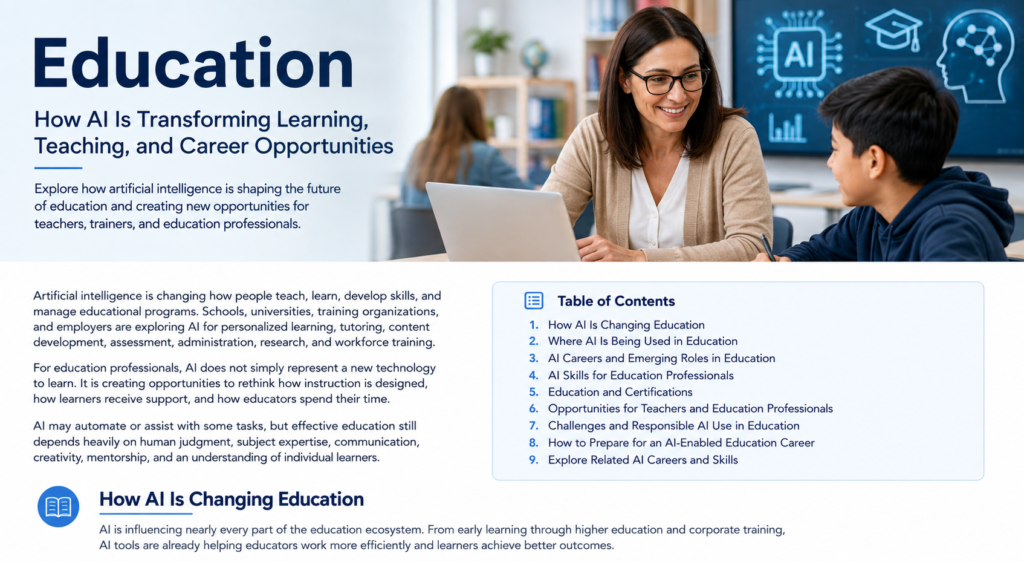
AI in Education is changing how people teach, learn, develop skills, and manage educational programs. Schools, universities, training organizations, and employers are exploring AI for personalized learning, tutoring, content development, assessment, administration, research, and workforce training.
Table of Contents
- How AI Is Changing Education
- Where AI Is Being Used in Education
- AI Careers and Emerging Roles in Education
- AI Skills for Education Professionals
- Education and Certifications
- Opportunities for Teachers and Education Professionals
- Challenges and Responsible AI Use in Education
- How to Prepare for an AI-Enabled Education Career
- Explore Related AI Careers and Skills
How AI Is Changing Education
For education professionals, AI does not simply represent a new technology to learn. It is creating opportunities to rethink how instruction is designed, how learners receive support, and how educators spend their time.
AI may automate or assist with some tasks, but effective education still depends heavily on human judgment, subject expertise, communication, creativity, mentorship, and an understanding of individual learners.
Where AI Is Being Used in Education
AI is being introduced across education in many different ways. Some applications directly support students and learners, while others help teachers, administrators, instructional designers, and training professionals work more effectively.
Personalized Learning
AI-powered learning systems can adjust lessons, exercises, and recommendations based on a learner’s progress, strengths, and areas that need improvement. This can help provide more individualized learning experiences while allowing educators to focus attention where human support is most valuable.
AI Tutoring and Learning Assistance
Generative AI and intelligent tutoring systems can help learners ask questions, review concepts, practice skills, and receive explanations outside traditional classroom hours. Educators still play an important role in evaluating accuracy, setting appropriate boundaries, and helping students learn how to use these tools responsibly.
Lesson and Training Development
Teachers, instructional designers, and corporate trainers can use AI to brainstorm lessons, develop examples, create practice activities, organize training materials, and adapt information for different audiences or skill levels.
Assessment and Feedback
AI can assist with creating assessments, identifying learning patterns, and providing preliminary feedback. Human oversight remains important, particularly when assessments affect grades, credentials, admissions, employment, or other significant decisions.
Administrative Support
Educational institutions can use AI to assist with scheduling, communications, information retrieval, student support, document processing, and other administrative tasks. Automating routine work may allow education professionals to devote more time to students and higher-value responsibilities.
Research and Knowledge Discovery
Students, faculty members, researchers, and education professionals can use AI to organize information, explore research questions, summarize large amounts of material, and identify possible connections. Important sources and AI-generated claims should still be independently verified.
Workforce Training and Professional Development
AI is also changing education outside traditional schools. Businesses and organizations need training programs that help employees develop new skills, understand AI tools, and adapt as job responsibilities change. This creates opportunities for educators, trainers, instructional designers, and subject-matter experts.
AI Careers and Emerging Roles in Education
As artificial intelligence becomes more common in schools, universities, training programs, and workplaces, new career opportunities are emerging at the intersection of education, technology, and AI. Many of these roles do not require someone to become a machine learning engineer or AI researcher. They often combine education experience, communication skills, instructional design, data literacy, and practical knowledge of AI tools.
AI Education & Training Specialist
AI Education & Training Specialists help individuals and organizations understand and use artificial intelligence effectively. They may develop training programs, teach AI concepts, create learning materials, evaluate educational tools, and help employees or students develop practical AI skills.
Later, we will make AI Education & Training Specialist a clickable internal link to the separate career guide when that placeholder page is developed.
Instructional Designer
Instructional designers create learning experiences for schools, universities, businesses, and online education providers. AI can help them develop content, personalize learning materials, analyze learner needs, and create interactive training experiences.
Learning Technology Specialist
Learning technology specialists help educational organizations select, implement, and support digital learning tools. As AI becomes integrated into learning platforms, these professionals may increasingly evaluate AI capabilities, train users, and help institutions adopt technology responsibly.
AI Curriculum Developer
AI curriculum developers create courses, lessons, exercises, and educational programs that teach people about artificial intelligence or incorporate AI into existing subjects. Opportunities may exist in schools, universities, workforce-development programs, corporate training, and online learning.
Education Data and Analytics Specialist
Education organizations generate large amounts of information about enrollment, learning progress, program effectiveness, and student outcomes. Professionals with data-analysis and education knowledge can help organizations interpret this information and use it to improve programs and decision-making.
AI-Enabled Teacher or Trainer
Teachers and trainers do not necessarily need to move into entirely new occupations to benefit from AI. Professionals who learn to use AI effectively may improve lesson preparation, create individualized learning materials, develop exercises, and spend more time on mentoring and direct learner support.
Corporate Learning and Development Professional
Businesses need employees who can learn new technologies and adapt to changing responsibilities. Learning and development professionals can use AI to create training programs, identify skill gaps, personalize professional development, and help organizations prepare their workforce for technological change.
AI Skills for Education Professionals
Education professionals do not need to master every technical aspect of artificial intelligence. The most useful skills depend on the role, but a combination of AI literacy, communication, data skills, responsible AI practices, and the ability to evaluate AI-generated information can provide a strong foundation.
AI Fundamentals
Understanding what AI can and cannot do helps education professionals make better decisions about when to use it. Learn the basic concepts behind generative AI, machine learning, automation, and other AI technologies.
Prompt Engineering
Clear instructions can improve the usefulness of generative AI tools. Educators and trainers can use prompting techniques to develop lesson ideas, explanations, exercises, examples, training materials, and other learning resources.
Make Prompt Engineering an internal link to our completed Prompt Engineering guide.
Data Analysis
Education professionals increasingly work with information about learning outcomes, participation, program effectiveness, and student or employee progress. Data-analysis skills can help turn this information into useful insights while maintaining appropriate privacy and ethical safeguards.
Communication and Leadership
Introducing AI into education requires more than technical knowledge. Educators, administrators, and training professionals need to explain changes clearly, listen to concerns, establish appropriate expectations, and help learners and colleagues adapt.
Evaluating AI-Generated Information
AI-generated answers can be incomplete, inaccurate, biased, or fabricated. Education professionals should learn to verify important claims, examine sources, recognize uncertainty, and teach learners not to treat AI output automatically as authoritative.
Responsible AI Use
Privacy, academic integrity, accessibility, fairness, transparency, intellectual property, and appropriate human oversight are important considerations when AI is used in education. Policies and practices should reflect the needs of learners as well as the requirements of the institution or organization.
Education and Certifications
AI-related opportunities in education can draw on many different backgrounds. Some professionals begin with experience in teaching, instructional design, training, administration, or educational technology, while others enter from technical fields. The education and credentials that matter most will depend on the type of role you want to pursue.
Certifications
There is no single certification required for most AI-related careers in education. The right credential depends on your role, experience, and career goals. Teachers, instructional designers, administrators, corporate trainers, and education-technology professionals may benefit from different combinations of AI, instructional design, technology, and data skills.
Before enrolling in a program, consider whether it teaches practical skills you can apply in your current or desired role. Short courses and professional certificates can be useful for developing specific capabilities, while more technical positions may require deeper study in data analysis, programming, cloud platforms, or artificial intelligence.
When evaluating a course or certification, consider:
- Whether the provider is credible and recognized.
- Whether the curriculum reflects current AI technologies and practices.
- How much hands-on practice is included.
- Whether the program addresses responsible and ethical AI use.
- Whether the skills match the type of education or training work you want to pursue.
- The total cost and time commitment.
- Whether employers in your target field actually value the credential.
What Matters More Than a Certificate?
A certificate can demonstrate that you completed a program, but employers will often be interested in what you can actually do with what you learned.
For education professionals, practical evidence might include:
- An AI-assisted lesson or training program you designed.
- Examples of learning materials created or improved with AI.
- A responsible-AI guideline for students or employees.
- A demonstration of how AI could personalize a learning experience.
- A training workshop that teaches others to use an AI tool.
- A project using data to identify learning needs or evaluate outcomes.
- An evaluation comparing AI tools for a particular educational purpose.
- A portfolio explaining your process, decisions, results, and lessons learned.
Career Tip: Don’t pursue certifications simply to collect credentials. Choose learning opportunities that develop useful skills, and create examples showing how you can apply those skills to real education or training challenges.
Opportunities for Teachers and Education Professionals
AI does not necessarily mean educators need to leave education or change careers completely. For many teachers, trainers, administrators, and education professionals, the opportunity may be to combine existing expertise with new AI capabilities.
Enhance Your Current Role
Teachers and trainers can use AI to assist with lesson planning, examples, exercises, explanations, research, and administrative tasks. The goal is not simply to automate work, but to identify where AI can save time or improve learning while preserving professional judgment and meaningful interaction with learners.
Become an AI Resource for Others
Professionals who develop practical AI knowledge can help colleagues understand new tools and use them responsibly. This might involve leading workshops, developing guidelines, demonstrating useful applications, or helping an organization evaluate AI products.
Move Into Instructional Design or Learning Technology
Education experience can provide a strong foundation for careers in instructional design, educational technology, online learning, and corporate training. Adding AI literacy and digital-learning skills may expand the range of roles available in these areas.
Develop AI Training Programs
Organizations across many industries need employees who understand how to use AI effectively. Educators and trainers can apply their teaching skills to develop AI literacy programs, workplace training, workshops, courses, and professional-development materials.
Create Educational Content and Resources
AI can help education professionals develop courses, tutorials, study materials, presentations, videos, assessments, and other learning resources. This can create opportunities within educational organizations as well as for independent educators, consultants, and content creators.
Transition Into AI Education and Training
Professionals who combine teaching ability with practical AI knowledge may eventually pursue specialized roles such as AI Education & Training Specialist.
Challenges and Responsible AI Use in Education
AI can create meaningful opportunities in education, but its use also raises important questions about accuracy, privacy, fairness, academic integrity, accessibility, and the appropriate role of human judgment. Education professionals need to understand both the benefits and limitations of these technologies.
Accuracy and AI-Generated Information
Generative AI can produce incorrect, incomplete, or fabricated information. Educators and learners should verify important claims and use reliable sources rather than assuming AI-generated answers are accurate.
Academic Integrity
AI can assist students with brainstorming, explanations, research, writing, and problem-solving, but institutions need clear expectations about acceptable use. Policies should distinguish between appropriate AI assistance and work that learners are expected to complete independently.
Student and Learner Privacy
Education can involve sensitive personal information. Before entering student records, assignments, assessments, or other private information into an AI system, educators should understand their institution’s policies and the privacy practices of the technology being used.
Bias and Fairness
AI systems can reflect biases or limitations in their training data and design. This becomes particularly important when technology influences assessment, recommendations, admissions, student support, or other decisions affecting learners.
Human Oversight
AI can support educational decisions, but important decisions should not automatically be delegated to technology. Educators and administrators remain responsible for applying professional judgment and considering the individual circumstances of learners.
For additional guidance on AI in Education, educators and administrators can review resources from the U.S. Department of Education on artificial intelligence and the future of teaching and learning
Accessibility and Inclusion
AI may improve accessibility through capabilities such as transcription, translation, alternative explanations, and personalized support. At the same time, organizations should consider whether AI tools are equally accessible and effective for different groups of learners.
How to Prepare for an AI-Enabled Education Career
You do not need to transform your career overnight. A practical approach is to build AI knowledge gradually while applying new skills to education or training problems you already understand.
- Build AI literacy. Learn the fundamentals of generative AI, machine learning, and common workplace AI applications.
- Experiment with AI tools. Practice using AI for lesson planning, training development, research, communication, and other low-risk tasks.
- Learn responsible AI practices. Understand privacy, accuracy, bias, academic integrity, and appropriate human oversight.
- Develop complementary skills. Communication, instructional design, data analysis, leadership, and technology skills can increase the value of your AI knowledge.
- Create practical examples. Build a small portfolio showing how you have used AI to improve a lesson, training program, learning resource, or educational process.
- Follow developments in education. AI tools and institutional policies are changing rapidly, so continuing education will be important.
- Identify your direction. Decide whether you want to use AI to strengthen your existing education role or move toward instructional design, learning technology, corporate training, AI education, or another specialized career.
Explore Related AI Careers and Skills
AI in Education creates opportunities that connect with careers and skills across AiCareerTrack. Continue exploring the areas that best match your experience and career goals.
- AI Education & Training Specialist — explore a career focused on helping people and organizations understand, learn, and apply artificial intelligence.
- AI Fundamentals — build a practical understanding of artificial intelligence and how it is being used in the workplace.
- Prompt Engineering — learn techniques for communicating more effectively with generative AI systems.
- Data Analysis — develop skills for interpreting information and turning data into useful insights.
- Communication & Leadership — strengthen the human skills needed to introduce AI, guide change, and work effectively with others.
- Explore AI Careers — discover additional career paths being created or transformed by artificial intelligence.
AI is likely to continue changing how people learn, teach, train, and develop new skills. Education professionals who combine subject expertise and an understanding of learners with practical AI capabilities can play an important role in shaping how these technologies are used.