Will AI Replace My Job? How to Evaluate Your Career and Prepare for What Comes Next
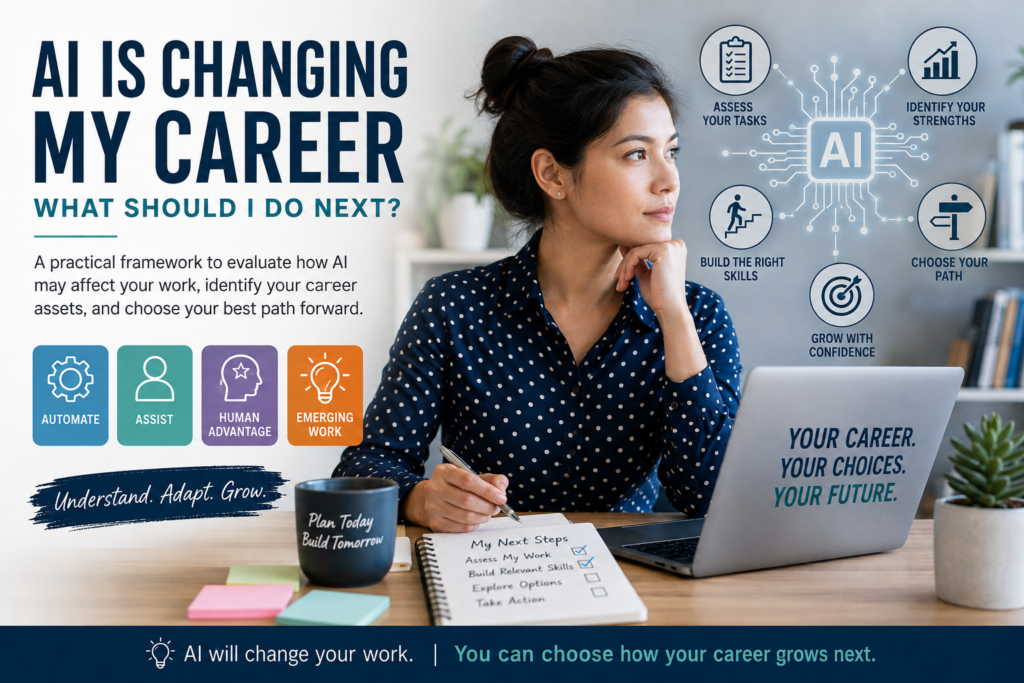
Artificial intelligence is changing the workplace, and it is understandable to wonder what those changes could mean for your career. Some tasks are becoming easier to automate, others can be completed faster with AI assistance, and entirely new responsibilities are emerging as organizations adopt artificial intelligence.
But asking “Will AI replace my job?” may not be the most useful question.
A better starting point is to ask how AI could change the work you actually do. A job is made up of many different tasks. Some may be highly susceptible to automation, some may become easier with AI assistance, and others may continue to depend heavily on human judgment, experience, relationships, accountability, creativity, or physical skills.
That distinction matters. Research from the International Labour Organization has found that although many occupations have some exposure to generative AI, most occupations still contain tasks requiring human involvement. The more likely outcome for many workers is therefore job transformation rather than complete job replacement.
Table of Contents
- Start With Your Tasks, Not Your Job Title
- Four Ways AI Could Change Your Work
- The AiCareerTrack 10-Task AI Job Change Assessment
- Which Tasks Matter Most to Your Career?
- Identify Your Career Assets
- What Does Your AI Job Change Assessment Tell You?
- Which Skills Should You Build?
- Do You Need to Become a Programmer?
- Should You Change Careers Because of AI?
- Your 30-Day AI Career Preparation Plan
- How to Keep Evaluating Your Career as AI Changes
- Questions to Ask Before Paying for AI Training
- Explore Your Next Path
- Sources and Further Reading
Start With Your Tasks, Not Your Job Title
Two people can have the same job title and perform very different work. An accountant working primarily with routine transactions may experience AI differently from an accountant who advises business owners. A nurse, engineer, teacher, marketer, manager, or software developer may likewise perform a combination of tasks with very different levels of exposure to artificial intelligence.
Instead of trying to predict whether an entire occupation will disappear, begin by examining what you actually do during a normal week.
For each important task, ask:
- Could AI perform much of this task without me?
- Could AI help me perform this task faster or better?
- Does the task require professional judgment or accountability?
- Does it depend on relationships, trust, empathy, leadership, or communication?
- Does it require physical work or interaction with the real world?
- Would an AI-generated result need to be checked by someone with my expertise?
- Could AI create new responsibilities connected with this task?
Four Ways AI Could Change Your Work
When evaluating your career, it can help to sort your work into four broad categories. These categories are not predictions about whether you will keep or lose your job. Instead, they are a practical way to identify where AI may change your work and where you may want to develop new skills.
1. Automate
Some tasks may increasingly be completed by AI or automation with relatively little human involvement. These are often structured, repetitive, information-based tasks where the desired output can be clearly defined.
Examples might include:
- Summarizing routine information
- Classifying or organizing documents
- Formatting standardized reports
- Processing certain types of data
- Producing first drafts of routine communications
- Performing repetitive administrative work
A task being automatable does not necessarily mean the entire job will disappear. The important question is how much of the job’s value comes from those tasks and what other responsibilities remain.
2. Assist
For many tasks, AI may function more like an assistant than a replacement.
AI can help professionals research information, generate ideas, analyze data, prepare drafts, summarize documents, write or review code, organize information, and explore possible solutions. The professional still provides context, judgment, verification, and responsibility for the result.
For many workers, learning to use AI effectively in this category may represent one of the most immediate career opportunities.
3. Human Advantage
Some work continues to depend heavily on capabilities that are difficult to separate from the person performing it.
These may include:
- Professional judgment
- Accountability
- Leadership
- Trust and relationship building
- Empathy and interpersonal understanding
- Negotiation
- Complex decision-making
- Knowledge of a particular organization or situation
- Skilled physical work
- Responsibility for safety or consequential outcomes
AI may still assist with parts of this work, but the human contribution can remain central to its value.
4. Emerging Work
AI can also create work that previously did not exist or make certain responsibilities more important.
Examples can include:
- Reviewing and verifying AI-generated work
- Choosing appropriate AI tools
- Designing AI-assisted workflows
- Protecting confidential information
- Monitoring AI systems for errors or bias
- Establishing responsible-use policies
- Training coworkers to use AI effectively
- Combining AI capabilities with specialized industry knowledge
This category is easy to overlook. When evaluating AI’s effect on your career, don’t look only for tasks that might disappear. Also look for new problems someone will need to solve because AI is being introduced.
The AiCareerTrack 10-Task AI Job Change Assessment
Now apply the four categories to your own work.
Write down the 10 tasks that consume the most time or create the most value in your typical workweek. Don’t worry about making the list perfect. The goal is to break your job into pieces that are easier to evaluate.
For each task, consider whether AI is most likely to Automate it, Assist you with it, leave a strong Human Advantage, or create Emerging Work around it. A task may belong in more than one category.
Then create this table:
| My Work Task | Automate | Assist | Human Advantage | Emerging Work |
|---|---|---|---|---|
| Task 1 | ||||
| Task 2 | ||||
| Task 3 | ||||
| Task 4 | ||||
| Task 5 | ||||
| Task 6 | ||||
| Task 7 | ||||
| Task 8 | ||||
| Task 9 | ||||
| Task 10 |
Important: Don’t treat this assessment as a scientific prediction of whether your job will disappear. AI-exposure measures themselves have important limitations and should be interpreted as signals of possible change rather than forecasts of individual job loss.
Which Tasks Matter Most to Your Career?
Not every task contributes equally to your value as a professional. You may spend several hours each week on routine administrative work but only a small amount of time making decisions, solving difficult problems, working with customers, managing people, or applying specialized knowledge.
If AI reduces the time required for routine work, that does not automatically reduce your value. In some situations, it may allow you to spend more time on higher-value responsibilities.
Recent research supports making this distinction. The International Labour Organization notes that whether AI complements workers or contributes to job loss depends partly on how central the automated tasks are to the occupation and how organizations integrate AI into work.
Add a Value Question to Your Assessment
Return to the 10 tasks you listed. For each one, ask:
- How much of my working time does this task consume?
- How important is this task to my employer, customer, or organization?
- Does this task require knowledge or experience that is difficult to replace?
- What would happen if this task were performed incorrectly?
- Does someone need to take responsibility for the result?
- Could AI free me from part of this task so I can spend more time on higher-value work?
Time Spent Is Not the Same as Value Created
Imagine that a professional spends 40 percent of the week gathering information, formatting reports, preparing routine documents, and organizing data.
AI might eventually assist with much of that work.
But suppose the same professional’s greatest value comes from interpreting the information, identifying problems, advising customers, making decisions, or taking responsibility for the outcome.
In that situation, AI may change a large percentage of the person’s tasks without eliminating the need for the person’s expertise.
The opposite can also be true. If most of a position’s value comes from predictable and repetitive tasks that technology can perform reliably, the worker may have a stronger reason to prepare for significant change. OECD research similarly distinguishes AI exposure from automation risk: highly exposed occupations are not necessarily the occupations most likely to disappear.
Identify Your Career Assets
When people worry about AI, it is easy to concentrate on skills they do not have. Before deciding that you need a new career, take inventory of the valuable knowledge, experience, relationships, credentials, and abilities you already possess.
Your career assets might include:
- Industry or professional knowledge
- Years of practical experience
- Licenses or professional credentials
- Technical expertise
- Customer or client relationships
- Communication ability
- Leadership and management experience
- Knowledge of regulations or safety requirements
- Problem-solving ability
- Professional judgment
- Knowledge of how your organization actually operates
- A professional network
- Skilled physical or hands-on abilities
Ask How AI Could Multiply What You Already Know
The goal does not always have to be starting over.
An experienced accountant who learns to use AI effectively may have a different opportunity than someone trying to become an AI engineer. The same may be true for a teacher, nurse, engineer, salesperson, manager, technician, small-business owner, or other experienced professional.
In many cases, the useful combination may be:
Your existing expertise + appropriate AI skills
rather than:
Discard your experience + start an entirely new career
That doesn’t mean everyone should remain in the same occupation. Some people will decide that a career transition is appropriate. But your existing experience should be treated as an asset to evaluate, not something to discard simply because AI is changing the workplace.
This is consistent with current skills research. A 2026 OECD review says relatively few workers are expected to need advanced AI-specific skills such as developing AI systems; broader digital and data abilities remain important alongside problem-solving, creativity, management, and other human capabilities.
What Does Your AI Job Change Assessment Tell You?
Your assessment is not meant to produce a single score or predict whether you will lose your job. Instead, use what you discovered about your tasks, career assets, and AI exposure to decide which direction deserves your attention.
You may see yourself in more than one of the following paths. That’s normal. The goal is to identify a sensible next step rather than make a permanent career decision today.
Path 1: Stay and Adapt
If AI appears more likely to assist your important tasks than replace them, your best strategy may be to remain in your profession while becoming more effective at working with AI.
Consider:
- Learning the AI tools becoming relevant to your occupation
- Building practical AI literacy
- Improving your ability to give AI clear instructions
- Learning how to evaluate and verify AI-generated work
- Identifying repetitive tasks that AI can help you complete more efficiently
- Spending the time you save on higher-value responsibilities
- Following changes in your profession as AI capabilities develop
The objective is not simply to “use AI.” It is to become better at your profession because you know when and how to use AI appropriately.
Path 2: Strengthen and Specialize
Your assessment may reveal that some routine parts of your job are becoming easier to automate while other parts still depend strongly on expertise, judgment, relationships, technical knowledge, or accountability.
In that situation, consider moving toward the parts of your profession where your knowledge creates the greatest value.
For example, that might mean developing deeper expertise, taking on more complex problems, strengthening customer or client relationships, moving toward advisory work, learning to supervise AI-assisted processes, or becoming knowledgeable about AI within your field.
Ask yourself:
Which parts of my profession would become more valuable if routine work required less of my time?
That question may reveal a specialization worth pursuing.
Path 3: Explore Adjacent Careers
Sometimes an assessment will show that a person’s current position may change substantially, while many of the skills and career assets they already possess remain valuable.
Before assuming you need to start over, investigate adjacent careers.
An adjacent career uses some of what you already know while moving you toward work with stronger opportunities or a better fit for the changing workplace.
Look for occupations that value your:
- Industry knowledge
- Technical expertise
- Customer experience
- Management ability
- Professional credentials
- Communication skills
- Regulatory knowledge
- Analytical ability
- Existing professional network
A career transition that preserves valuable experience may be faster, less expensive, and less disruptive than beginning again from zero.
Path 4: Move Toward AI-Related Work
Your assessment may also reveal that you are genuinely interested in working more directly with artificial intelligence.
If so, determine what kind of AI-related work interests you before choosing expensive training.
Some paths require substantial programming, mathematics, machine learning, or computer science knowledge. Others combine AI with product management, business strategy, data analysis, cloud platforms, communication, industry expertise, or organizational leadership.
Start by investigating the actual requirements of the career you want. Then build the skills that career requires rather than collecting AI courses or certifications without a clear purpose.
Path 5: Keep Exploring Before Deciding
You may complete this assessment and still not know what you should do.
That is a valid result.
You do not need to make a major career decision simply because AI is changing quickly. If the evidence is unclear, continue learning, experiment with relevant AI tools, follow developments in your occupation, and strengthen skills that have value across multiple career paths.
A small, informed step can be better than a large decision made primarily from fear.
Which Skills Should You Build?
The right AI skills depend on what you discovered in your assessment and the direction you want to pursue. You do not need to learn every AI technology.
Start with skills that solve problems you actually encounter or support the career path you are considering.
AI Fundamentals
Understanding what AI can and cannot do provides a foundation for almost every path. Learn basic concepts such as generative AI, machine learning, automation, limitations, verification, privacy, and responsible use.
Prompt Engineering
If generative AI can assist with research, writing, analysis, planning, brainstorming, or other information-based tasks in your work, learning to communicate effectively with AI systems can provide immediate practical value.
Data Analysis
Data skills can be valuable well beyond traditional data careers. Understanding how to organize, analyze, interpret, and communicate information can complement AI capabilities across many professions.
Programming
Programming can be valuable for people moving toward technical AI careers, automation, software, data science, or other technology-intensive work. But not every worker needs to become a programmer simply because AI is changing their occupation.
Cloud & AI Platforms
Professionals moving toward technical implementation, enterprise AI, data systems, or cloud-based applications may benefit from familiarity with major cloud and AI platforms.
Communication & Leadership
As organizations introduce AI, people still need to explain ideas, coordinate teams, make decisions, manage change, build trust, and take responsibility. These capabilities can become particularly valuable when technical and nontechnical people need to work together.
Do You Need to Become a Programmer?
No. AI is changing many occupations, but that does not mean every professional needs to become a software developer or machine learning engineer.
The amount of programming you should learn depends on what you want AI to help you accomplish and the career path you are considering.
A teacher using AI to develop lesson ideas, a manager analyzing information, a salesperson preparing for customer meetings, and a healthcare professional learning about AI-assisted workflows may need very different technical skills from someone who wants to build machine learning systems.
When You May Not Need Much Programming
You may be able to benefit from AI without extensive coding if your primary goal is to:
- Use generative AI more effectively
- Improve research and information gathering
- Draft or revise professional communications
- Analyze documents
- Brainstorm ideas
- Summarize information
- Improve workflows
- Use AI features already built into professional software
- Manage teams using AI-enabled tools
- Apply AI within an existing nontechnical profession
In these situations, AI literacy, prompt engineering, critical thinking, verification, privacy awareness, and profession-specific knowledge may deserve greater immediate attention than programming.
When Programming Can Become Valuable
Programming becomes more important when you want to:
- Build or modify software
- Automate more complex workflows
- Work extensively with data
- Develop machine learning applications
- Connect AI systems with other applications
- Build AI-powered products
- Work with APIs
- Develop autonomous or intelligent systems
- Pursue technical AI careers
Python is particularly common in AI and data work, but the appropriate programming language and level of expertise depend on the career.
Learn for a Purpose
Avoid learning programming simply because you have heard that everyone will need to code in the age of AI.
Instead ask:
What do I want to be able to do that I cannot do today?
If programming helps you accomplish that objective, learn the amount you need and build from there.
Will AI Replace My Job—or Should I Change Careers?
Changing careers can be appropriate, but fear about AI alone is not necessarily a good reason to make a major decision.
Before leaving an occupation in which you have accumulated experience, relationships, credentials, or specialized knowledge, compare the risks of staying with the costs and opportunities of changing.
Ask yourself:
- Which important parts of my current job are actually changing?
- Are those changes already occurring, or am I reacting primarily to predictions?
- Can I adapt by adding skills rather than leaving the profession?
- Which of my existing career assets would transfer to another occupation?
- What education or training would a transition require?
- How long would the transition realistically take?
- What would it cost?
- Would I need to accept lower pay while gaining experience?
- Does the new career itself face significant AI-driven change?
- Am I genuinely interested in the new work?
Don’t Compare Your Current Career With an Imaginary Alternative
It is easy to compare the problems in your current occupation with an idealized version of another career.
Instead, investigate the alternative as carefully as you investigated your current job.
Look at actual job requirements, salaries, education expectations, entry-level opportunities, geographic considerations, competition, working conditions, and how AI may affect that occupation too.
A good career decision should consider both risk and opportunity.
Consider an Adjacent Move Before Starting Over
If change appears necessary, an adjacent career may allow you to preserve more of your existing value.
For example, someone with years of industry experience might move toward analytics, AI implementation, training, consulting, operations, product work, compliance, or another specialty where domain knowledge remains important.
The best transition is not necessarily the career with “AI” in its title. It may be the career where your existing expertise becomes more valuable when combined with appropriate AI capabilities.
Your 30-Day AI Career Preparation Plan
You do not need to solve your entire career future today. Use the next 30 days to learn more about your work, build one useful capability, and make your next decision with better information.
Week 1: Understand Your Work
Complete the AiCareerTrack 10-Task AI Job Change Assessment.
Identify which tasks appear most likely to be automated, which could benefit from AI assistance, where your human advantages are strongest, and what new responsibilities may emerge.
Also write down your most important career assets.
Week 2: Learn One Relevant Skill
Choose one skill connected directly to an important part of your work.
That might be AI fundamentals, prompt engineering, data analysis, programming, an AI feature in software you already use, or another profession-specific capability.
Avoid trying to learn everything at once.
Week 3: Apply What You Learned
Use your new knowledge on a real, appropriate task.
For example, you might use AI to help organize information, analyze a non-confidential dataset, improve a workflow, prepare a draft, research alternatives, or solve another practical problem.
Follow your employer’s policies and do not enter confidential, proprietary, personal, regulated, or otherwise sensitive information into an AI system unless its use has been appropriately authorized.
Week 4: Evaluate and Choose Your Next Step
At the end of the month, ask:
- What did AI make easier?
- What still required my expertise?
- Where did AI make mistakes or require verification?
- Which skill gap became clearer?
- Did I discover a new opportunity?
- Do I need more training?
- Should I strengthen my current career, investigate a specialization, or explore another path?
Then choose one next step for the following 30 days.
Small cycles of learning, applying, and evaluating can help you respond to workplace change without making major decisions based only on uncertainty
How to Keep Evaluating Your Career as AI Changes
Artificial intelligence will continue to develop, and predictions about its effect on work will continue to change. That means career preparation should not be a one-time decision.
Instead of trying to predict exactly what your occupation will look like five or ten years from now, develop a habit of watching for evidence that your work is actually changing.
Watch What Is Happening in Your Workplace
Pay attention to the technologies your employer or organization is introducing.
Ask:
- Which AI tools are employees beginning to use?
- Which tasks are becoming automated?
- Which tasks are becoming easier or faster?
- Are new responsibilities appearing?
- Are job descriptions changing?
- Which employees seem to be benefiting from the changes?
- What skills are managers beginning to request?
- Are customers or clients expecting different services?
Changes occurring around you can sometimes provide more useful career information than broad predictions about the future of an entire occupation.
Watch Job Postings
Periodically review job advertisements for positions similar to yours and for roles you may want in the future.
You do not need to be looking for a new job to learn from job postings.
Look for patterns:
- Which AI or technology skills appear repeatedly?
- Are employers asking for new software or data skills?
- Which human skills continue to appear?
- Are responsibilities changing?
- Are new job titles emerging?
- Which qualifications are required and which are merely preferred?
A single job advertisement may tell you very little. Patterns across many postings can provide a better indication of how employers are describing changing work.
Follow Your Profession
Professional associations, industry publications, employers, regulators, educational institutions, and experienced practitioners can help you understand how AI is being adopted within your field.
Pay particular attention to changes involving:
- Professional standards
- Required skills
- Regulations
- Licensing or certification
- Safety
- Privacy and security
- Common workplace tools
- Employer expectations
AI will not affect every profession in the same way. Industry-specific information can therefore be more useful than general claims about AI and employment.
Separate Evidence From Headlines
AI news can be useful, but dramatic predictions often receive more attention than gradual workplace changes.
When you encounter a claim that AI will eliminate an occupation or create enormous numbers of new jobs, ask:
- Who made the claim?
- What evidence supports it?
- Is it describing current conditions or predicting the future?
- Does it refer to an entire occupation or only certain tasks?
- Does it apply to my industry, location, experience level, and type of work?
- What assumptions would need to be true for the prediction to happen?
Use predictions as information to investigate—not as automatic instructions for what to do with your career.
Questions to Ask Before Paying for AI Training
AI-related courses, certifications, boot camps, and training programs can be useful, but training should support a career objective rather than become an objective by itself.
Before spending money, ask:
- What specific skill will I learn?
- How does that skill relate to my current job or intended career?
- Do employers actually request or value this skill?
- Could I learn the fundamentals through a free or lower-cost resource first?
- Does the program include practical projects or hands-on work?
- Who provides the training, and what evidence supports its quality?
- Is the certification recognized by employers or primarily promoted by the company selling it?
- How much time will the program require?
- What is the total cost, including exams, subscriptions, renewals, or additional materials?
- What will I be able to do after completing it that I cannot do now?
Don’t Buy Training Because You Are Afraid
Concern about career change can make expensive promises particularly attractive.
Be cautious of programs suggesting that a short course guarantees a high-paying AI career, that one certification will make your job secure, or that everyone needs the same AI training.
A useful program should have a clear connection between what you will learn and what you want to accomplish.
Sometimes paid training will be worthwhile. Sometimes a free course, employer-provided training, a small project, or structured self-study may be the better first step.
Explore Your Next Path
You do not need to know exactly what your career will look like years from now. You need enough information to make the next good decision.
Use what you learned from your AI Job Change Assessment to continue exploring the areas most relevant to you.
- Explore AI Careers if you are considering a new or more AI-focused career path.
- Build AI Skills if you want to strengthen your capabilities for your current job or a future role.
- Explore AI by Industry if you want to understand how artificial intelligence is affecting your particular field.
- Continue Learning if you are still uncertain and want to understand AI before making a larger career decision.
Your career is more than a job title. It includes your experience, knowledge, relationships, judgment, abilities, and capacity to continue learning.
AI may change some of the work you do. Your goal is to understand those changes early enough to adapt deliberately rather than react from fear.
Sources and Further Reading
International Labour Organization — Generative AI and Jobs: A 2025 Update
Research examining generative AI exposure at the task and occupation level and how AI may transform work.
OECD — AI and Skills: What We Know So Far
A 2026 review of how artificial intelligence is changing skill requirements, including digital, data, managerial, problem-solving, and AI-related skills.
World Economic Forum — Future of Jobs Report 2025
Employer research examining changing occupations, workforce strategies, and the skills expected to grow in importance through 2030.