Identify Your AI Skills Gap: A Practical Lesson for Choosing What to Learn Next
AI is developing quickly, and it can be tempting to believe you need to learn every new tool, technology and technical skill that appears. You don’t.
The more useful question is: Which AI skills will help you accomplish what you actually want to do?
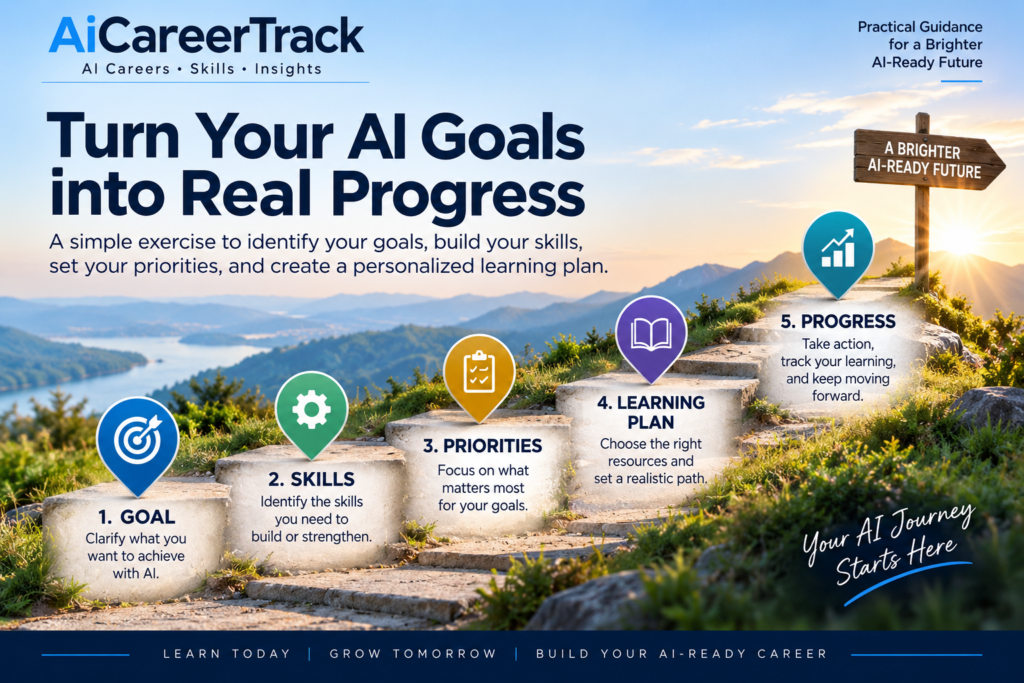
In this practical lesson, you’ll identify the skills that matter for your goal, recognize the gaps between what you know and what you need, and choose a small number of learning priorities you can begin working on now.
By the end of this lesson, you will be able to: identify your most relevant AI skills gaps, choose one to three learning priorities, and turn them into a practical 30-day learning plan.
Time: About 15–20 minutes
Level: Beginner to intermediate
Technical skills required: None
What you’ll need: A few minutes to think about your current skills and one goal you would like AI to help you accomplish.
Step 1: Choose What You Want AI to Help You Accomplish
Before deciding what to learn, decide what you want to accomplish.
A skill that is essential for an AI engineer may be unnecessary for someone who wants to use AI more effectively in marketing, healthcare, finance or everyday business work. Your goal helps determine which skills deserve your attention.
Choose the outcome below that most closely matches what you want to accomplish right now.
1. Use AI Better in My Current Work
You want to become more effective with AI for tasks such as research, writing, analysis, problem-solving, communication and everyday productivity.
2. Automate Work or a Business
You want to turn repetitive processes into reliable AI-assisted workflows and eventually explore automation, integrations or AI agents where they make sense.
3. Work With Data & Analytics
You want to use AI alongside spreadsheets, data analysis, visualization, SQL or related tools to understand information and make better-supported decisions.
4. Build AI Applications & Agents
You want to develop AI-enabled applications, workflows, integrations or agents and are prepared to develop stronger technical skills.
5. Prepare for an AI/ML Career
You want to pursue deeper technical work involving programming, data, machine learning, AI systems or related engineering roles.
You may eventually pursue more than one of these goals. For this exercise, choose one. A narrower goal makes it easier to decide what deserves your attention next.
Step 2: Map the Skills That Matter to Your Goal
Now look at the skills associated with the goal you selected.
For each skill, mark yourself:
Comfortable — I can use or apply this skill with reasonable confidence.
Developing — I understand some of it, but I still need practice or guidance.
Not Yet — I have little experience with this skill or have not started learning it.
Do not worry about having every skill marked Comfortable. The purpose is to identify what matters next—not to create a list of everything you do not know.
Goal 1: Use AI Better in My Current Work
Consider your current ability with:
- AI fundamentals
- Writing effective prompts and instructions
- Providing useful context
- Choosing an appropriate AI tool
- Evaluating and verifying AI-generated information
- Protecting private or sensitive information
- Using AI responsibly
- Applying AI to real work tasks
Goal 2: Automate Work or a Business
Consider the skills above, plus:
- Breaking a process into clear steps
- Designing repeatable workflows
- Creating structured inputs and outputs
- Using automation tools
- Understanding basic integrations and APIs
- Testing and monitoring automated processes
- Understanding when an AI agent is—or is not—appropriate
Goal 3: Work With Data & Analytics
Consider your current ability with:
- AI fundamentals
- Spreadsheets
- Data quality and preparation
- Basic statistics
- Data visualization
- AI-assisted data analysis
- SQL
- Python when appropriate
- Verifying and interpreting analytical results
Goal 4: Build AI Applications & Agents
Consider your current ability with:
- Programming fundamentals
- Python and/or JavaScript
- Git and GitHub
- APIs and integrations
- Large language model fundamentals
- Structured prompting and context
- Tool or function calling
- Retrieval and RAG concepts when appropriate
- AI agents and multi-step systems
- Evaluation and testing
- Security and permissions
- Deployment and monitoring
Goal 5: Prepare for an AI/ML Career
Consider your current ability with:
- Programming fundamentals
- Python
- SQL
- Statistics and probability
- Linear algebra fundamentals
- Data preparation
- Machine learning fundamentals
- Model evaluation
- Deep learning when appropriate
- Git and GitHub
- Cloud and deployment concepts
- MLOps fundamentals
- Building portfolio projects
A Gap Is Not Automatically a Problem
Seeing several Not Yet skills is normal.
A missing skill becomes an important skills gap only when it matters to something you are trying to accomplish.
For example, someone who wants to use AI more effectively in marketing may benefit greatly from better prompting, verification and workflow skills without needing to study linear algebra.
Someone pursuing machine-learning engineering, however, may eventually need considerably deeper mathematics, programming, data and model-development knowledge.
You do not need every AI skill. You need the right skills for the direction you are going.
Step 3: Choose Your Priority Skills
Look again at the skills you marked Developing or Not Yet.
You may have several. That does not mean you should try to learn all of them at once.
For each potential skills gap, ask yourself three questions:
1. Does This Skill Matter to My Goal?
Would improving this skill materially help you accomplish the outcome you selected in Step 1?
If the answer is no, it probably does not deserve your attention right now.
2. Will I Use This Skill Soon?
Will you have a realistic opportunity to practice the skill at work, in school, in a personal project or in a business?
Skills become more useful when you can apply them instead of only reading or watching lessons about them.
3. Does This Skill Unlock Something Else?
Some skills create foundations for other capabilities.
For example, learning how to break a process into clear steps can prepare you for workflow automation. Programming fundamentals can prepare you for APIs and AI application development. Better verification skills can make nearly every kind of AI-assisted work more reliable.
Now place each potential gap into one of three categories:
High Priority — Important to my goal and worth learning now.
Useful Later — Relevant, but something else should come first.
Not Needed Right Now — Interesting perhaps, but not necessary for my current direction.
Choose No More Than Three
Select one to three High Priority skills.
For example, someone whose goal is to automate work or a business might choose:
High Priority: Workflow design, evaluating AI output and basic automation tools.
Useful Later: APIs, AI agents and Python.
Not Needed Right Now: Machine-learning mathematics.
Your priorities will be different. The purpose is not to find a universal list of the best AI skills. It is to decide which skills can move you forward.
The best next AI skill is not necessarily the most advanced skill. It is the skill that moves you closer to your goal and prepares you for what comes next.
Step 4: Build Your 30-Day AI Learning Plan
Take the one to three High Priority skills you selected in Step 3.
Your goal for the next 30 days is not necessarily to master them. Instead, you are going to make measurable progress and create evidence that you can apply what you learn.
Use this four-week cycle:
Week 1 — Understand
Learn the fundamentals.
Ask:
What is this skill? Why does it matter? What concepts do I need to understand before I begin using it?
Use reliable tutorials, documentation, courses or AiCareerTrack learning resources to establish the foundation.
Avoid spending the entire month collecting information. Learn enough to begin practicing.
Week 2 — Practice
Complete small exercises using the skill.
Ask:
Can I use what I learned when I have instructions, examples or guidance?
Practice several times rather than completing one exercise and immediately moving on.
Mistakes are useful here. They help reveal what you understand and what still needs work.
Week 3 — Apply
Use the skill on something realistic.
Ask:
Can I apply this skill to an actual work, career, school, business or personal project?
Move beyond demonstrations and tutorials. Choose a problem that resembles something you might genuinely need to solve.
Week 4 — Prove
Create evidence that you can use the skill.
Ask:
What can I create, demonstrate or repeat that shows I can actually apply what I learned?
Depending on the skill, your evidence might be:
- A completed project
- A repeatable AI-assisted workflow
- A before-and-after work example
- A documented business process
- A small data analysis
- A GitHub project
- A portfolio example
- A short case study explaining the problem, your approach, the result and what you learned
Measure Capability, Not Just Completion
Finishing a course, watching videos or earning a certificate can support learning, but completion alone does not necessarily demonstrate capability.
Whenever possible, finish your 30-day cycle with something you can do, explain, demonstrate or show.
For example, instead of stopping at:
“I completed a course about AI-assisted data analysis.”
Aim for:
“I used AI to analyze a dataset, checked the results, created visualizations and documented my conclusions.”
The second statement provides much stronger evidence of applied learning.
Thirty Days Is a Starting Cycle, Not a Mastery Deadline
Some AI skills can improve substantially in a month. Others—such as programming, statistics, machine learning or production AI development—may require many months or multiple learning cycles.
Do not rush through a complex subject simply to meet an artificial deadline.
The goal is measurable progress and demonstrated capability, not instant mastery.
Step 5: Review Your Progress and Choose What Comes Next
At the end of your 30-day learning cycle, do not automatically move to the next subject.
First, look at what changed.
Ask yourself four questions.
1. What Can I Do Now That I Could Not Do 30 Days Ago?
Focus on capability rather than time spent studying.
Can you write better AI instructions? Evaluate AI-generated information more carefully? Analyze data? Build a workflow? Use an API? Write a useful Python program?
The answer helps you see whether your learning produced practical progress.
2. What Evidence Did I Create?
Look at what you produced during the Prove stage.
This might be a project, workflow, analysis, portfolio example, documented process, case study or another demonstration of your ability.
Keep useful examples of your work. Over time, they can become evidence of your growing capabilities.
3. What Still Feels Difficult?
Difficulty does not necessarily mean you chose the wrong skill.
It may mean you need more practice, a stronger foundation or another learning cycle before moving forward.
Identify the specific part that remains difficult rather than simply deciding that you are “not good at” the subject.
4. Does This Skill Still Support My Goal?
Learning sometimes changes your direction.
You may discover a new interest, realize that another skill is more important, or decide that a particular technical path is not necessary for what you want to accomplish.
That is useful information.
Your learning plan should serve your goal—not trap you in a plan that no longer makes sense.
Decide: Continue, Advance or Redirect
After reviewing your progress, choose one of three actions:
Continue — Stay with the skill for another learning cycle because you need more practice or depth.
Advance — You have enough foundation to begin the next related skill.
Redirect — Your goal, interests or needs have changed, so choose a more relevant priority.
Then repeat the process:
Goal → Skills Map → Priority Gap → 30-Day Plan → Proof → Review → Next Skill
You do not need to map your entire AI future today.
You only need enough direction to choose a useful next step, practice it and keep moving forward.
Turn Your Skills Gap Into a Learning Path
Once you know your priority skills, the next step is finding the right place to learn and practice them.
You may already have a useful starting point within AiCareerTrack.
If Better AI Use Is Your Priority
Start by strengthening the fundamentals of working effectively with AI.
Write Better AI Prompts teaches a practical five-part framework for giving AI clearer instructions.
Give AI Better Context shows how relevant background information can improve the usefulness of AI responses.
If Verification Is Your Priority
Learning to use AI also means learning when not to trust its first answer.
How to Evaluate and Verify AI-Generated Information explains practical ways to check claims, sources and AI-generated conclusions before relying on them.
If Workflows and Automation Are Your Priority
Once you can use AI reliably for individual tasks, you may be ready to connect those tasks into repeatable processes.
Build AI Workflows explains how to identify appropriate processes and design more useful AI-assisted workflows.
For more advanced multi-step systems, AI Agents for Work & Business explains what AI agents are, where they may be useful and where additional oversight and controls are necessary.
If You Are Still Deciding Which Direction Fits You
Use Choose Your AI Learning Path to explore different routes based on what you want to accomplish.
If you want a broader look at your current capabilities first, take the AI Readiness Self-Assessment.
Learn in the Order Your Goal Requires
There is no single AI curriculum that every person needs to follow.
A useful progression is often:
UNDERSTAND → USE → APPLY → AUTOMATE → BUILD → SPECIALIZE
You may not need to reach every stage.
Someone who wants to use AI effectively in an existing profession may gain substantial value from the first three or four stages. Someone who wants to develop AI applications, agents or machine-learning systems may continue much further into technical development and specialization.
The objective is not to collect the largest number of AI skills.
The objective is to build the capabilities that help you do something useful.
You Proved It
If you completed the exercise, you now have more than a list of AI skills you might someday learn.
You have identified:
- A goal you want AI to help you accomplish
- The skills that matter to that goal
- One to three priority skills worth developing next
- A 30-day plan for learning and practicing them
- A way to demonstrate what you can actually do
- A process for deciding what to learn after that
Save your answers. At the end of your 30-day cycle, return to them and compare where you started with what you can now accomplish.
Your AI skills gap will change as your capabilities, career and technology evolve. That is normal.
The goal is not to eliminate every gap.
The goal is to keep choosing the gaps that matter.
Continue Your AI Learning
Your next step depends on what you discovered during this lesson.
If you want to understand your broader strengths and areas for development, take the AI Readiness Self-Assessment.
If you know you want to continue learning but are unsure which direction fits your goals, explore Choose Your AI Learning Path.
If prompting is one of your priorities, continue with Write Better AI Prompts.
If providing better information to AI is a priority, continue with Give AI Better Context.
If evaluating AI output is a priority, continue with How to Evaluate and Verify AI-Generated Information.
You do not need to complete all of these resources.
Choose the one that best matches the next capability you want to build.