How Long Does It Take to Learn AI Skills? A Realistic Guide
Learning AI can take a few hours, several weeks, many months, or years. The difference depends on what you are trying to learn—and what you need to be able to do with it.
Someone who wants to use AI more effectively in an existing job may begin gaining useful skills quickly. Someone preparing for a career in machine learning, data science, AI engineering, or another technical field may need substantial education, practice, and experience.
That is why asking “How long does it take to learn AI?” without defining the goal can produce misleading answers.
A better question is:
What level of AI capability do I need for the work I want to do, and how long might it realistically take me to reach that level?
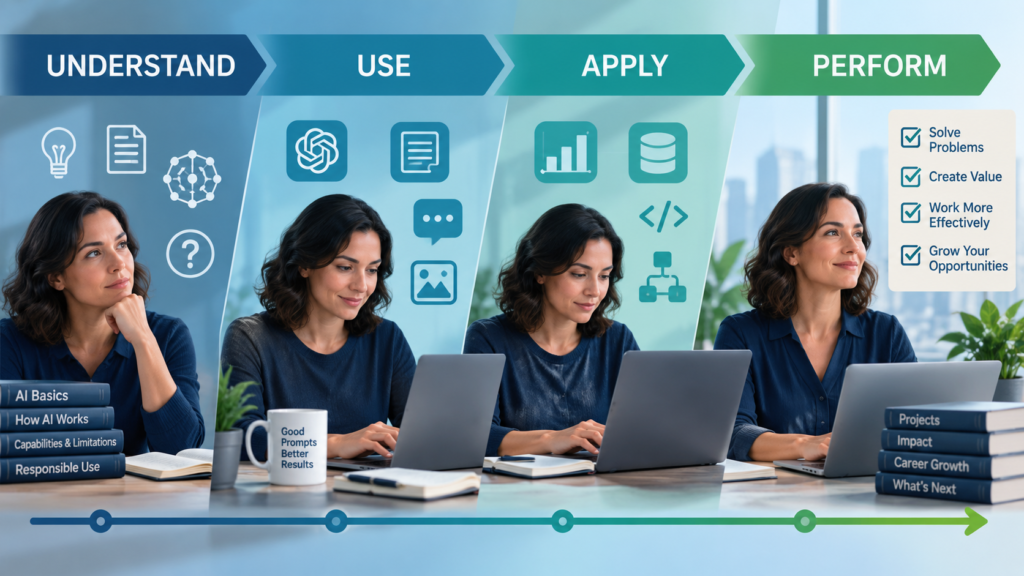
This guide will help you answer that question by separating AI learning into four practical stages:
Understand → Use → Apply → Perform Professionally
You will also learn what can speed up or slow down your progress, how different AI skills compare, and how to decide whether you need a short learning sprint, a structured course, a certification, or a much longer career-development path.
The goal is not to learn “all of AI.” The goal is to learn enough of the right AI skills to accomplish something that matters to you.
Four Levels of Learning AI
There is a major difference between understanding what AI can do and being able to use AI competently in professional work. Treating every level as though it requires the same amount of learning creates unrealistic expectations.
A useful way to think about progress is through four levels.
Understand AI
At this level, your goal is to understand the basic ideas well enough to make informed decisions about AI.
You might learn what generative AI is, what large language models can and cannot do, why AI systems sometimes produce incorrect information, and where AI is already being used in your profession or industry.
You do not need to become a programmer or understand advanced mathematics to develop this level of AI literacy.
Possible timeframe: A few hours to several weeks of focused learning.
The objective is not expertise. It is enough understanding to recognize useful applications, ask better questions, and avoid common misconceptions about AI.
2. Use AI
At this level, you move from understanding AI to using AI tools effectively.
That might include learning how to write useful prompts, compare outputs, verify information, work with documents or data, create repeatable AI-assisted workflows, and decide when human judgment is necessary.
For many professionals, this level can produce meaningful workplace value without requiring a major career change.
Possible timeframe: Several weeks to a few months of regular use and practice.
Simply completing a course is not the same as reaching this level. You need enough practice to use AI reliably when working on real tasks.
3. Apply AI to Real Work
At this level, you can use AI within a particular profession, business, project, or area of expertise.
A marketer might use AI to support research, campaign development, analysis, and content workflows. A financial professional might use it to organize information or assist analysis while maintaining appropriate review and controls. A small-business owner might use AI to improve customer communication or streamline administrative work.
The important change is that you are no longer learning AI in isolation. You are combining AI capabilities with knowledge of actual work.
Possible timeframe: A few months or longer, depending on the complexity of the work and your existing experience.
Someone who already understands an industry may reach useful application faster than someone who is simultaneously learning both AI and an unfamiliar profession.
4. Perform Professionally
This level means being able to perform AI-related work at the standard expected by employers, clients, customers, or your own business.
For some people, that may mean using AI competently within an existing profession. For others, it could mean becoming qualified for a technical occupation such as data science, machine learning engineering, software development, or AI research.
Those paths require very different levels of preparation.
Possible timeframe: Several months to several years.
Technical AI careers may require programming, mathematics, statistics, data skills, cloud platforms, software engineering, formal education, substantial projects, or professional experience. Existing knowledge and previous education can shorten the path, while starting from the beginning can make it considerably longer.
This is why there is no meaningful single answer to “How long does it take to learn AI?” The answer depends on where you are starting, what you want to do, and which of these four levels you actually need to reach.
How Long Do Different AI Skills Take to Learn?
There is another reason AI learning timelines vary: “AI skills” include very different capabilities.
Learning to use a conversational AI assistant effectively is not comparable to learning Python, statistics, machine learning, or software engineering. Even within the same skill, the time required depends on whether you need basic familiarity or professional competence.
The estimates below should therefore be treated as planning ranges, not promises. They assume regular practice and are intended to help you compare the relative size of different learning commitments.
AI Fundamentals and AI Literacy
For many people, this is the best place to begin.
AI literacy includes understanding basic AI concepts, common capabilities and limitations, responsible use, verification, privacy considerations, and how AI may affect your work or industry.
You do not need advanced technical knowledge to begin developing AI literacy.
Typical learning commitment: Several hours to a few weeks for a useful foundation.
You can continue improving this knowledge over time as AI systems and workplace practices change
Prompting and Everyday AI Tools
Basic prompting can be learned quickly. Consistently getting useful results from AI takes longer.
Useful skills include giving clear instructions, providing appropriate context, breaking complex tasks into steps, evaluating outputs, refining prompts, and recognizing when an AI response should not be trusted without verification.
Typical learning commitment: A few days to several weeks for basic competence; continued practice for reliable professional use.
The objective should not be memorizing clever prompt formulas. It should be learning how to communicate tasks clearly and evaluate the resulting work.
AI-Assisted Workflows
A workflow combines AI with a repeatable process rather than using AI for isolated questions.
Examples might include researching and summarizing information, drafting and reviewing documents, analyzing recurring information, preparing reports, organizing customer inquiries, or supporting content production.
Typical learning commitment: Several weeks to a few months to develop and refine useful workflows.
The more important question is not how quickly you can build a workflow, but whether it produces dependable results while preserving appropriate human review.
How Long Do Different AI Skills Take to Learn?
Data Analysis With AI
AI tools can make data analysis more accessible, but learning to analyze data responsibly involves more than asking an AI system to produce a chart or summarize a spreadsheet.
Useful foundations can include working with spreadsheets, understanding basic statistics, cleaning and organizing data, choosing appropriate analyses, interpreting results, and recognizing when the data does not support a conclusion.
Someone who already works regularly with data may progress much faster than someone encountering these concepts for the first time.
Typical learning commitment: Several weeks to a few months for practical foundations; longer for advanced analytical work.
AI can assist with formulas, queries, code, visualization, and interpretation, but you still need enough understanding to recognize errors and judge whether the analysis makes sense.
Programming for AI
You do not need programming skills for every kind of AI work. But programming becomes increasingly important for technical careers and for people who want to build applications, automate more complex processes, work directly with data, or integrate AI services into software.
Python is commonly used in data science and machine learning, but learning programming involves more than learning syntax. You also need practice solving problems, debugging, organizing code, using libraries, and understanding how software behaves.
Typical learning commitment: A few months for useful foundations; six months to a year or longer to develop stronger capability through regular practice.
Someone with previous programming experience may progress considerably faster. Someone learning both programming and AI concepts from the beginning should expect a longer path.
Machine Learning
Machine learning requires a deeper technical foundation than everyday use of generative AI tools.
Depending on your goal, you may need knowledge of Python, data preparation, statistics, probability, model training, evaluation, feature engineering, machine learning libraries, and the limitations of different approaches.
You also need practical experience. Understanding an algorithm in a course is different from being able to work with imperfect data, choose an appropriate method, evaluate results, and explain what the model is doing.
Typical learning commitment: Several months to a year or more for meaningful foundations; considerably longer for professional-level capability.
The timeline can be shorter for someone who already has strong programming, mathematics, statistics, or data-science skills.
Preparing for a Technical AI Career
Becoming employable in a technical AI occupation is different from completing an AI course.
Careers such as Machine Learning Engineer, Data Scientist, AI Software Engineer, and AI Research Scientist can require combinations of:
- programming
- mathematics and statistics
- data structures and algorithms
- databases and data engineering
- machine learning
- software engineering
- cloud platforms
- model evaluation
- deployment and monitoring
- security and responsible AI
- practical projects
- formal education or relevant professional experience
No single course necessarily provides all of these.
Typical learning commitment: Several months to several years, depending on the career, your starting point, and the qualifications employers expect.
Someone with a computer science, engineering, mathematics, or data background may already possess much of the foundation. A person starting without those foundations may need substantially more preparation.
That does not mean everyone interested in AI should pursue a technical AI career.
Many people can create significant value by becoming highly capable users of AI within healthcare, finance, marketing, education, engineering, operations, management, small business, consulting, or another field they already understand.
Learning enough AI to improve the work you already know may take far less time than retraining for an entirely new technical occupation—and may sometimes be the more valuable career strategy.
What Determines How Fast You Can Learn AI?
Two people can follow the same course and make very different amounts of progress in the same period.
The calendar alone does not determine how quickly you learn. Your starting knowledge, available time, practice habits, learning objective, and opportunities to use the skills all matter.
Your Starting Point
Existing knowledge can shorten the learning path considerably.
A programmer learning to work with AI APIs starts with advantages that a new programmer does not have. A financial analyst learning AI-assisted analysis already understands financial concepts and data. A marketer experimenting with AI-supported campaign research already understands customers, messaging, and marketing decisions.
Before deciding how long your learning path will take, identify what you already know.
You may have more of the foundation than you think.
How Much Time You Can Practice
“Three months” can represent very different amounts of learning.
Someone studying two hours each week accumulates roughly 24 hours of practice over three months. Someone studying ten hours each week accumulates roughly 120 hours.
That is why learning timelines expressed only in weeks or months can be misleading.
Consistency matters too. Regular practice usually provides more opportunity to retain and apply skills than occasional intensive sessions separated by long periods without use.
Whether You Practice on Real Problems
Watching lessons and reading explanations can build understanding. Applying the skill builds capability.
Try to use what you learn on problems that resemble the work you actually want to perform.
If your goal is to use AI in marketing, work on marketing problems. If you want to improve business operations, test AI on appropriate operational tasks. If you are learning programming, write programs rather than only watching someone else write them.
Real application reveals gaps that passive learning can hide.
How Narrowly You Define the Goal
A specific objective is usually easier to plan than “learn AI.”
Compare:
“I want to learn AI.”
with:
“I want to learn how to use AI to research, draft, and review routine reports in my current job while verifying important information.”
The second objective gives you something concrete to learn, practice, and evaluate.
You can always expand your skills later.
Whether You Have Feedback
Progress can accelerate when you receive useful feedback.
That feedback might come from an instructor, experienced colleague, mentor, project review, test results, users, clients, or the measurable outcome of a task.
AI itself can sometimes help explain concepts or provide practice, but it should not be your only judge of whether your work is correct.
The fastest learning path is not necessarily the shortest course. It is the path that gets you from your current capabilities to useful, reliable performance with as little unnecessary learning as possible.
How Much AI Do You Actually Need to Learn?
One of the easiest mistakes to make is assuming that becoming more prepared for AI always means learning more technical material.
It does not.
The right amount of AI learning depends on what you want to accomplish. A teacher, manager, accountant, engineer, small-business owner, software developer, and machine learning researcher may all benefit from AI skills, but they do not need the same skills or the same depth of knowledge.
Before committing months or years to training, determine which level of capability would actually improve your work or move you toward your goal.
1. If You Want to Use AI Better in Your Current Job
You may not need a major retraining program.
A practical starting point could include:
- understanding AI capabilities and limitations
- learning to communicate effectively with AI tools
- verifying important outputs
- protecting sensitive information
- identifying tasks where AI can save time or improve quality
- building a few useful AI-assisted workflows
- understanding when human judgment should remain central
For many professionals, the objective is not to become an AI specialist. It is to become better at their existing work by knowing when and how to use AI appropriately.
Your existing professional knowledge remains part of the value you bring. AI capability can strengthen that knowledge rather than replace it.
2. If You Want to Become More Competitive in Your Field
You may need to go beyond general AI literacy and learn how AI is being used specifically within your profession or industry.
That could mean learning AI-assisted data analysis, automation, specialized software, research methods, workflow design, or other capabilities relevant to your work.
You may also need projects or examples that demonstrate what you can do.
The goal is to create a useful combination:
Existing expertise + relevant AI capability + evidence that you can apply both
This can be a more realistic strategy than abandoning years of experience to compete for an entirely different entry-level occupation.
3. If You Want to Change Careers
A career change requires comparing what you already know with what the new career actually requires.
Some transitions may be relatively close to your existing experience. Others may require substantial new technical knowledge, education, credentials, or work experience.
Before buying training, identify:
- the actual work performed in the target career
- the skills employers commonly expect
- which of those skills you already possess
- which gaps you need to close
- whether projects, certificates, certifications, degrees, or experience matter
- how long the transition may realistically take
- whether the likely career outcome justifies the investment
The question is not simply, “How long will this course take?”
The more useful question is, “How long will it take me to become capable of doing the work I am trying to move toward?”
Those are not necessarily the same thing.
4. If You Want a Technical AI Career
If your goal is machine learning engineering, data science, AI software development, AI research, or another highly technical occupation, expect a deeper learning path.
The U.S. Bureau of Labor Statistics illustrates how substantial those preparation requirements can be. It reports that data scientists typically need at least a bachelor’s degree in mathematics, statistics, computer science, or a related field, while computer and information research scientists typically need at least a master’s degree in computer science or a related field, although requirements can vary by employer and position.
You may need to develop several foundations simultaneously, and some cannot be mastered through short courses alone.
Formal education is one route, but it is not the only possible route for every technical role. Existing technical experience, structured self-study, professional training, projects, certifications, and adjacent work experience can all contribute depending on the occupation and employer.
The important point is to evaluate the whole qualification path, not simply the duration of an AI course.
A six-week course may take six weeks to complete. That does not mean six weeks is enough to become professionally qualified for the occupation discussed in the course.
Course completion measures that you finished the course. Job readiness requires evidence that you can perform the work.
Should You Learn AI Quickly or Slowly?
Speed is useful when it helps you begin applying a skill sooner. It becomes a problem when finishing quickly replaces understanding and practice.
For foundational AI literacy or a specific workplace task, a short learning sprint may be appropriate. You can learn something useful, apply it immediately, and then build on it.
More complex capabilities usually benefit from a longer cycle:
Learn → Practice → Apply → Get Feedback → Improve
You do not need to delay using AI until you have completed an enormous curriculum. At the same time, you should not mistake early familiarity for mastery.
A better approach is to learn in stages.
Start with enough knowledge to use AI safely and intelligently. Then add skills when your work, career direction, or goals give you a reason to learn them.
Learning faster is valuable only if you can still use what you learned effectively.
How to Build a Realistic AI Learning Plan
You do not need to predict exactly how many months your AI education will take before you begin.
Instead, build a learning plan around a specific outcome and revise it as you gain experience.
Step 1: Define What You Want AI to Help You Do
Avoid beginning with a course catalog.
Begin with the outcome.
For example:
- use AI more effectively in your current job
- analyze data more confidently
- automate part of a recurring workflow
- prepare for a particular career
- add AI capability to an existing professional specialty
- build a small AI-enabled project
- evaluate whether a technical AI career is realistic for you
A clear objective makes it easier to decide what you need to learn—and what you can ignore for now.
Step 2: Identify What You Already Know
List the knowledge and skills you already bring.
Include professional experience, industry knowledge, communication skills, analytical ability, technical skills, education, software experience, management experience, and other relevant strengths.
Do not automatically assume that learning AI means starting over.
Your existing experience may be the foundation that makes your AI skills useful.
Step 3: Identify the Smallest Useful Skill Gap
Ask what you need to learn next—not everything you might someday learn.
If your immediate goal is improving research and document work, you probably do not need to begin with machine learning mathematics.
If your goal is becoming a machine learning engineer, however, programming, data, mathematics, and software-development foundations may be essential.
The learning path should follow the objective.
Step 4: Choose an Appropriate Way to Learn
Depending on the skill, you might use:
- free tutorials and documentation
- guided practice
- short courses
- structured learning programs
- certificates
- professional certifications
- college or university education
- projects
- mentoring
- supervised workplace experience
More expensive training is not automatically better training.
Choose the level of structure and credential that the goal actually requires.
Step 5: Practice Before Adding More Training
After learning a concept, use it.
Create something. Solve a problem. Improve a workflow. Analyze information. Write code. Test the skill in an appropriate real-world situation.
Practice can reveal whether you understand the material well enough to move forward or need additional learning.
It can also prevent a common problem: accumulating courses without developing usable capability.
Step 6: Reassess Your Direction
After you have practiced for a while, ask:
- Am I becoming more capable?
- Can I use this skill without following a tutorial step by step?
- Does this skill actually help with my goal?
- Do I enjoy this type of work enough to continue?
- What is the next meaningful gap?
- Do I need additional training, or do I need more practice?
You may discover that you need a deeper learning path.
You may also discover that you already know enough AI to accomplish what you originally wanted.
The objective is not to collect the most AI knowledge. It is to build the capability you need for the work and opportunities that matter to you.
How Do You Know When You Are Actually Learning AI?
Completing lessons can feel like progress, but completion alone does not tell you whether you can use what you learned.
A better measure is whether your capability is changing.
You should gradually become less dependent on step-by-step instructions and more able to decide what to do, recognize problems, evaluate results, and apply the skill in new situations.
Here are four useful signs of progress.
1. You Can Explain What You Are Doing
You do not need to know every technical detail, but you should be able to explain the basic purpose of the AI tool, method, or process you are using.
You should also understand important limitations.
If an AI system produces an answer, for example, you should know that a confident response is not necessarily a correct response. If you are using AI to analyze information, you should understand why important results may require verification.
Understanding helps you make better decisions when something does not work as expected.
2. You Can Use the Skill Without Following Exact Instructions
Early in the learning process, tutorials and examples are useful.
Over time, you should become able to approach a new problem without needing someone else to provide every step.
That does not mean working without references. Professionals regularly use documentation, examples, search tools, AI assistants, and other resources.
The difference is that you increasingly understand what you are trying to accomplish and can judge whether the approach makes sense.
3. You Can Recognize When the Result Is Poor
One of the most important AI skills is knowing when not to trust the output.
As your capability improves, you should become better at recognizing incomplete answers, unsupported claims, inappropriate assumptions, poor analysis, weak prompts, unreliable data, and situations where human expertise is necessary.
Being able to produce an AI output is a beginning.
Being able to evaluate that output is a more important sign of competence.
NIST’s AI Risk Management Framework similarly emphasizes evaluating AI systems for trustworthiness and managing risks throughout their use. Its guidance for generative AI also recognizes that different applications may require additional human review, oversight, testing, and evaluation.
4. You Can Apply the Skill to Something That Matters
Eventually, learning should produce useful capability.
That might mean completing a workplace task more effectively, improving a business process, analyzing information, building a project, solving a technical problem, supporting a client, or becoming better prepared for a career opportunity.
The outcome does not have to be dramatic.
A small improvement applied repeatedly can be more valuable than completing another course that you never use.
A useful measure of AI learning is not how much material you have consumed. It is what you are increasingly able to do well.
When Is Free AI Training Enough?
Free learning can be an excellent starting point.
Documentation, tutorials, introductory courses, videos, practice projects, and other free resources can help you understand AI concepts, explore tools, and determine whether you want to go further.
Free training may be enough when:
- you are exploring AI for the first time
- you want basic AI literacy
- you are learning a specific workplace skill
- you can create your own practice opportunities
- you do not need a credential
- you are testing whether a subject is worth pursuing
- high-quality free material exists for what you need to learn
Starting free can also reduce the risk of paying for training before you understand your actual learning needs.
You may discover that free resources provide everything required for your immediate goal.
Or you may discover that you would benefit from more structure.
When Might Structured Training Be Worth It?
Paying for training can make sense when the additional structure provides something useful that you are unlikely to create efficiently on your own.
That could include:
- a well-designed learning sequence
- instructor guidance
- exercises and projects
- feedback
- access to specialized environments or tools
- accountability
- preparation for a recognized certification
- a credential that has a meaningful purpose in your career plan
The decision should not be based simply on whether a course looks impressive.
Ask what the paid program gives you that a lower-cost or free alternative does not.
Also ask whether that difference matters for the outcome you are pursuing.
Pay for structure when structure has value. Pay for a credential when the credential has a purpose.
What About Certificates, Certifications and Degrees?
These terms can represent very different things.
A certificate may show that you completed a particular educational program. A professional certification may require an examination or demonstration of knowledge defined by a certification provider. A college degree represents a much broader formal education.
None should automatically be treated as proof that someone can perform every task associated with an AI-related occupation.
Their value depends on the career, employer, provider, curriculum, assessment, cost, and what else you can demonstrate.
Before making a significant investment, ask:
- Is this credential commonly requested for the work I want?
- Will I gain useful knowledge and practice?
- Will I produce projects or other evidence of capability?
- Is the provider credible?
- Are there lower-cost ways to reach the same goal?
- How much time will the program require?
- What will I realistically be qualified to do when I finish?
The larger the investment of time and money, the more clearly you should be able to explain why the training is necessary for your goal.
Choose Training After You Understand the Goal
AiCareerTrack has a separate guide for evaluating courses, certificates, certifications, free learning, and paid programs.
Rather than choosing a program first and then trying to build a career plan around it, determine what you need to learn and why.
Then evaluate the training options that can help you get there.
For help comparing those choices, see our Where Should I Learn AI? guide.
A training program should be a tool for reaching an objective—not the objective itself.
The question is not “What AI course should I take?” until you can first answer “What do I need to become capable of doing?”
A Better Way to Think About the AI Learning Timeline
There is no universal number of weeks or months required to “learn AI.”
A useful timeline depends on the destination.
You might develop basic AI literacy in hours or weeks. Becoming comfortable with everyday AI tools may take several weeks of regular use. Applying AI reliably within professional work may take months of practice. Developing programming, data, machine learning, or other technical foundations can require much longer. Preparing for some technical AI careers can take years.
That range is not a problem. It reflects the fact that people are pursuing different goals.
Instead of asking only:
“How long will it take me to learn AI?”
Ask:
“What do I want to be able to do?”
“What do I already know?”
“What is the next capability I need?”
“How will I know when I can use it reliably?”
Then build the learning path from those answers.
Understand → Use → Apply → Perform Professionally
You do not have to reach the final stage in every AI skill.
You only need to go as far as your work, career, business, or personal objective requires.
Learn enough to create useful capability. Practice until that capability becomes reliable. Then decide what is worth learning next.
What Should You Do Next?
Knowing how long AI skills may take to learn is useful only if it helps you decide what to do next.
Start with your goal.
If you are still determining which AI capabilities would be most useful, begin with the AI Skills Path. It can help you identify practical skills and decide where to focus your learning.
If you are considering a larger career change, use Explore a New Career to compare your existing experience with possible new directions before committing to extensive retraining.
If you are unsure how prepared you currently are, the AI Readiness Self-Assessment can help you identify strengths and areas where additional learning may be useful.
You do not need to master every AI skill before you can benefit from AI.
Choose a useful destination. Learn the next skill you need. Apply it to something real. Evaluate what happened. Then decide whether going deeper is worth your time and effort.
AI learning is not a race to know everything. It is a process of becoming capable of doing something useful—and continuing to learn when the next step has a purpose.