
Prompt Engineering
Prompt engineering is the skill of giving AI systems clear, useful instructions so they can produce better results. As generative AI becomes part of everyday work, knowing how to structure prompts can improve research, writing, analysis, brainstorming, coding, planning, and many other tasks. You do not need to be a programmer to learn prompt engineering. The most important skills are clarity, context, critical thinking, and knowing how to evaluate the AI’s response.
Table of Contents
- What Is Prompt Engineering?
- The Building Blocks of a Good Prompt
- From Weak Prompt to Better Prompt
- A Simple Prompting Framework
- Improve Results Through Follow-Up Prompts
- Verify Before You Trust
- Prompt Engineering in the Workplace
- Protect Your Information
- Build Your Prompt Engineering Skills
- Where to Go Next
What Is Prompt Engineering?
Prompt engineering is the process of designing and refining instructions for an AI system. A strong prompt explains what you want, provides useful context, sets expectations, and often includes constraints or examples.
Instead of asking an AI system a vague question, prompt engineering helps you communicate your goal more precisely. Better instructions usually lead to more relevant, accurate, and useful results.
The Building Blocks of a Good Prompt
Effective prompts don’t need to be complicated. In many situations, a useful prompt can be built from a few basic elements.
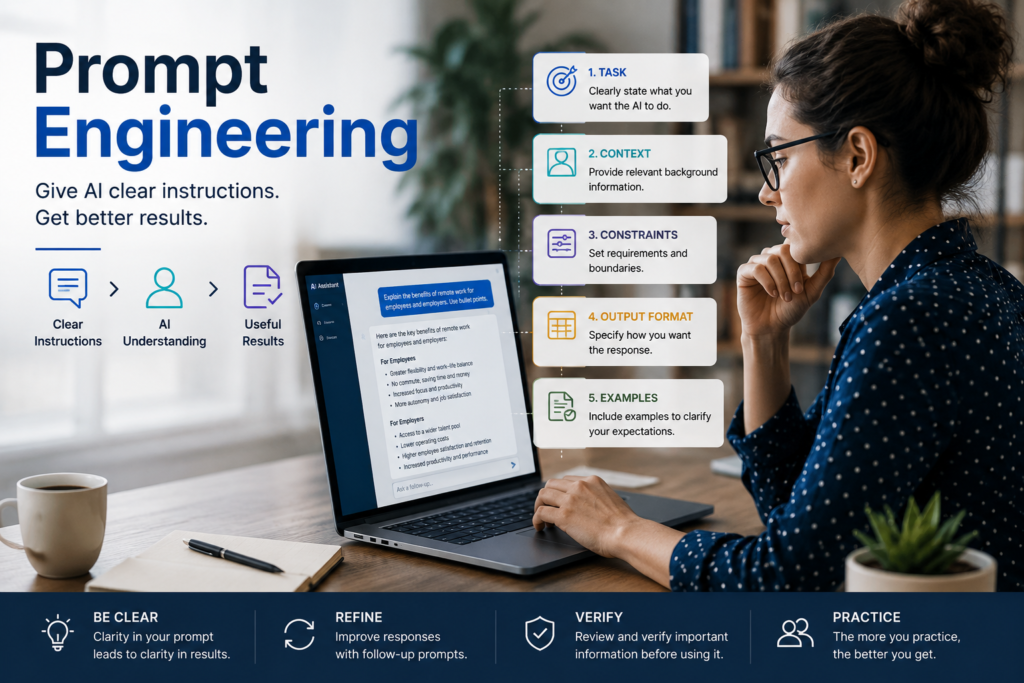
1. Task
Clearly state what you want the AI to do. For example: summarize a document, compare two ideas, create an outline, analyze information, brainstorm solutions, or explain a concept.
2. Context
Give the AI relevant background information. Explain the situation, audience, purpose, or problem so the response can be better tailored to your needs.
3. Constraints
Specify important requirements such as length, tone, format, reading level, topics to include or avoid, or other boundaries the response should follow.
4. Output Format
Tell the AI how you want the answer presented. You might request a bulleted list, table, step-by-step explanation, email, report, checklist, or another useful format.
5. Examples
When appropriate, provide an example of the type of result you want. Examples can help an AI system understand your expectations more clearly.
From Weak Prompt to Better Prompt
Weak prompt:
Explain artificial intelligence.
Better prompt:
Explain artificial intelligence to a professional with no technical background. Use plain language, give three workplace examples, explain one important limitation, and keep the response under 300 words.
The second prompt provides a task, audience, context, constraints, and desired output, giving the AI much clearer direction.
A Simple Prompting Framework
A simple way to build stronger prompts is to remember four elements: Goal + Context + Instructions + Format.
Goal
What do you want the AI to accomplish? State the task or outcome clearly.
Context
What information does the AI need to understand the situation? Include relevant background, audience, purpose, or circumstances.
Instructions
Explain any requirements the AI should follow, such as tone, length, level of detail, information to include, or limitations.
Format
Describe how you want the result presented—for example, as a list, table, email, report, outline, checklist, or step-by-step explanation.
Putting It Together
Goal: Create a professional follow-up email after a job interview.
Context: I interviewed yesterday for a project management position at a technology company.
Instructions: Thank the interviewer, reinforce my interest in the position, mention my experience leading cross-functional teams, and use a warm but professional tone. Keep it concise.
Format: Write a ready-to-send email with a subject line.
You won’t need all four elements in every prompt. For simple tasks, a short instruction may be enough. As a task becomes more important or complex, providing additional context and direction can improve the result.
Improve Results Through Follow-Up Prompts
Effective prompting is often an iterative process. Your first prompt does not have to produce the perfect answer. Review the response, identify what could be improved, and give the AI additional direction
- “Make this explanation easier for a beginner to understand.”
- “Give me three alternatives with different approaches.”
- “Shorten this to 150 words while keeping the main points.”
- “What important information might be missing?”
- “Turn this information into a step-by-step checklist.”
- “Explain why you made these recommendations.”
Follow-up prompts allow you to refine an AI-generated response without starting over. This back-and-forth process can be especially useful for writing, research, planning, brainstorming, analysis, and problem-solving.
Verify Before You Trust
A well-written prompt can improve an AI response, but it cannot guarantee that the response is correct. Generative AI can produce inaccurate information, invented details, outdated claims, or misleading conclusions.
Verify important facts, statistics, quotations, sources, and recommendations before relying on them. The greater the consequences of an AI-assisted decision, the more important careful human review becomes.
Prompt Engineering in the Workplace
Prompt engineering can be useful across many professions and industries. The best prompts combine AI capabilities with your own knowledge of the task, audience, and desired outcome.
Writing and Communication
Use AI to help draft emails, reports, presentations, summaries, proposals, and other workplace communications. Provide the audience, purpose, key information, and desired tone rather than simply asking the AI to “write something.”
Research and Learning
Ask AI to explain unfamiliar concepts, identify questions worth investigating, compare ideas, or organize information. Treat AI-generated research as a starting point and verify important information with reliable sources.
Data and Analysis
AI can help explain data, suggest ways to organize information, identify possible patterns, and assist with analysis. Provide enough context about the data and your objective, and independently verify important conclusions.
Meetings and Productivity
AI can help turn meeting notes into summaries, action items, follow-up messages, or project plans. It can also help organize tasks, create checklists, and identify next steps.
Career Development
AI can help analyze job descriptions, identify skills to develop, practice interview questions, brainstorm portfolio projects, and improve professional writing. Avoid providing unnecessary sensitive or confidential information.
Problem-Solving
Ask AI to examine a problem from several perspectives, identify possible causes, compare potential solutions, or challenge assumptions. Your professional judgment should determine which ideas are practical and appropriate.
Protect Your Information
Think carefully about the information you provide to an AI system. Avoid entering confidential company information, private customer data, passwords, financial records, proprietary material, or other sensitive information unless you are using an approved system and are authorized to do so.
When using AI at work, follow your organization’s policies regarding approved tools, privacy, security, intellectual property, and responsible AI use.
Build Your Prompt Engineering Skills
Prompt engineering improves through practice. Rather than trying to memorize complicated prompt formulas, focus on communicating clearly, evaluating the response, and refining your instructions when necessary.
- Start with everyday tasks. Practice prompting for summaries, emails, brainstorming, explanations, and planning.
- Experiment with context. Compare the results you receive when you provide more useful background information.
- Ask for different formats. Turn the same information into a table, checklist, outline, presentation, or step-by-step guide.
- Refine your prompts. When a response isn’t useful, identify what is missing and provide clearer instructions.
- Compare approaches. Try several versions of a prompt and observe how changes affect the response.
- Evaluate the output. Don’t judge a prompt only by how impressive the answer sounds. Consider accuracy, relevance, usefulness, and whether the result actually accomplishes your goal.
- Save successful prompts. Build a personal collection of prompts and frameworks that work well for tasks you perform regularly.
The goal is not to create the longest or most complicated prompt. The goal is to communicate your objective clearly enough that AI can become a more useful assistant.
Where to Go Next
Prompt engineering is one part of building practical AI skills. Continue developing the combination of AI knowledge, technical abilities, and human skills that best supports your career goals.
- AI Fundamentals — strengthen your understanding of the essential concepts behind artificial intelligence.
- Explore AI Skills — discover additional skills for an AI-powered workplace.
- Explore AI Careers — learn how AI skills connect with emerging and evolving career paths.
- AI Career Resources — find learning resources, tools, courses, and guides.
For additional prompting guidance and examples, see OpenAI’s guide to creating effective prompts for AI models.
How do I create a good prompt for an AI model? | OpenAI Help Center
OpenAI’s guide to creating effective prompts for AI models
You don’t need perfect prompts to benefit from AI. Start with a clear goal, provide useful context, evaluate the response, and improve your instructions through practice.