Programming
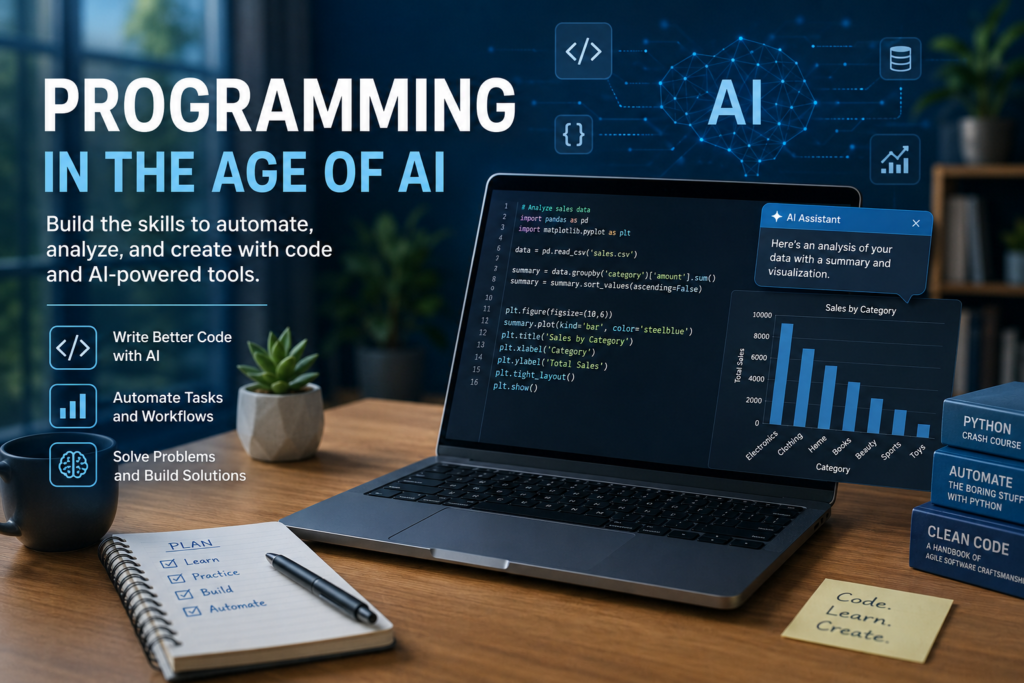
Programming can be a valuable skill in the age of artificial intelligence, but not every AI-ready career requires you to become a software developer. How much programming you need depends on what you want to accomplish and the type of career you plan to pursue. For some professionals, understanding basic programming concepts and learning to work with AI-assisted tools may be enough. For technical careers such as machine learning engineering, data science, software development, and AI systems, stronger programming skills become much more important.
Table of Contents
- Do You Need Programming Skills for AI?
- Why Learn Programming in the Age of AI?
- Programming Skills by Career Goal
- Programming Languages to Consider
- How AI Is Changing Programming
- AI Can Write Code—So Why Learn Programming?
- Core Programming Concepts to Understand
- A Practical Programming Learning Path
- Build Programming Skills Through Practice
- Use AI-Generated Code Responsibly
- Where to Go Next
Do You Need Programming Skills for AI?
Not necessarily. Many people use artificial intelligence effectively without writing software code. Professionals in marketing, education, management, healthcare, finance, human resources, and other fields can benefit from AI tools while relying primarily on their existing professional expertise Programming becomes more valuable when you want to automate tasks, work directly with data, connect systems, build applications, customize AI workflows, or pursue technical AI careers.
Why Learn Programming in the Age of AI?
AI is changing programming itself. Modern AI assistants can help explain code, generate examples, identify errors, suggest improvements, and accelerate development. This can make programming more approachable for beginners —but understanding what the code is doing remains important. Learning programming can also strengthen logical thinking, problem-solving, automation skills, and your ability to understand how technology works. Even basic coding knowledge can make it easier to communicate with technical teams and evaluate AI-generated solutions.
Programming Skills by Career Goal
The amount of programming you need depends on your goals. Rather than assuming everyone needs to become an advanced developer, consider the level of coding that supports the work you actually want to do.
Nontechnical Professionals
If your work focuses on areas such as management, marketing, education, healthcare, sales, human resources, or business operations, you may not need extensive programming skills. Basic knowledge can still help you understand automation, communicate with technical teams, and work more effectively with AI-powered tools.
Business and Data Professionals
Analysts, finance professionals, operations specialists, researchers, and other data-oriented workers may benefit from learning spreadsheet formulas, SQL, basic scripting, and eventually Python. These skills can help automate repetitive work, analyze larger datasets, and connect information across different systems.
Automation and AI Power Users
Professionals who want to build more advanced workflows may benefit from understanding APIs, basic programming logic, scripting, and how different applications exchange information. These skills can expand what you can accomplish with AI beyond individual prompts and manual tasks.
Software and Technical Professionals
Software developers, cloud engineers, data engineers, and other technical professionals generally need stronger programming skills. They may work with multiple languages, development tools, databases, APIs, testing systems, and cloud platforms.
If you work in this field or are considering it, explore our Software & Technology guide for AI career paths, skills, education, and emerging opportunities.
AI and Machine Learning Professionals
Careers such as machine learning engineering, data science, and AI engineering typically require the strongest programming foundation. Python is especially important because of its widespread use in data analysis, machine learning, automation, and AI development.
Programming Languages to Consider
You don’t need to learn every programming language. Choose languages based on the problems you want to solve and the careers you want to pursue.
Python
Python is one of the most useful languages for AI-related work. It is widely used in data analysis, automation, machine learning, artificial intelligence, and software development. Its relatively readable syntax also makes it a practical first programming language for many beginners.
SQL
SQL is used to work with information stored in databases. It is particularly valuable for analysts, data professionals, business intelligence roles, and anyone who needs to retrieve and organize larger amounts of structured data.
JavaScript
JavaScript is widely used in web development and can be useful for professionals interested in building interactive websites, web applications, and AI-powered features that run through a browser.
Other Languages
Depending on your career, you may encounter languages such as Java, C++, C#, R, or Go. There is usually little reason for a beginner to learn several languages at once. Build a solid foundation in one language first, then expand when your projects or career require it.
How AI Is Changing Programming
AI is changing how software is written and learned. AI coding assistants can generate code, explain unfamiliar syntax, suggest solutions, identify possible errors, create documentation, and help programmers work through problems more quickly.
Learning to Code
Beginners can use AI as a learning assistant by asking for explanations, examples, practice exercises, and step-by-step guidance. Instead of simply copying generated code, ask the AI to explain why the code works and what each important part does.
Writing and Improving Code
AI can help generate first drafts of code, suggest alternative approaches, simplify repetitive tasks, and improve existing code. Experienced developers can use these capabilities to accelerate their work while applying their own technical judgment to the results.
Debugging
When code doesn’t work as expected, AI can help interpret error messages, identify possible causes, and suggest fixes. This can make troubleshooting faster, but proposed solutions should still be tested.
Understanding Existing Code
AI can explain unfamiliar code in plain language, summarize what a program is doing, or help someone understand a codebase they did not originally create. This can be useful for both learners and experienced professionals.
AI Can Write Code—So Why Learn Programming?
Because generating code is not the same as understanding it. AI-generated code can contain errors, security problems, inefficient approaches, outdated methods, or solutions that don’t actually meet the requirements of a project. Programming knowledge helps you evaluate whether AI-generated code makes sense, recognize problems, test the results, and give the AI better instructions. As AI coding tools improve, the value of programming may increasingly shift from simply writing every line manually toward understanding systems, defining problems, reviewing solutions, and making sound technical decisions.
Core Programming Concepts to Understand
- Variables and data types — how programs store and work with information.
- Conditions — how programs make decisions based on rules.
- Loops — how programs repeat tasks efficiently.
- Functions — reusable pieces of code designed to perform particular tasks.
- Data structures — ways of organizing and working with collections of information.
- APIs — methods that allow different software systems and services to communicate.
- Debugging and testing — finding problems and verifying that software behaves as expected.
- Version control — tracking changes to code and collaborating with others.
A Practical Programming Learning Path
1. Learn the Basics
Start with fundamental concepts such as variables, conditions, loops, functions, and basic problem-solving. Focus on understanding how programming works, not memorizing every command.
2. Choose One Language
For many people interested in AI, data, or automation, Python is a practical first choice. If your goals are primarily data-oriented, SQL is also highly valuable. Avoid trying to learn several languages at the same time. If you choose Python, the official Python Tutorial provides a comprehensive introduction to the language and its core concepts – official Python Tutorial
3. Practice With Small Projects
Build simple programs that solve useful problems. Examples might include organizing information, analyzing a small dataset, automating a repetitive task, or creating a basic application.
4. Use AI as a Learning Partner
Ask AI to explain concepts, review your code, suggest improvements, create practice exercises, and help troubleshoot errors. When AI generates code, ask it to explain the solution rather than simply copying the result.
5. Learn to Work With Data and APIs
As your skills improve, learn how programs read and organize data and how APIs allow applications to communicate with other services. These abilities are particularly useful for automation and AI-powered applications.
6. Build Career-Relevant Projects
Choose projects connected to the type of work you want to pursue. A useful portfolio demonstrates not only that you can write code, but that you can use programming to solve real problems.
Build Programming Skills Through Practice
Programming is learned by doing. Reading tutorials and watching courses can help, but confidence develops when you write code, encounter problems, troubleshoot them, and gradually build more capable projects.
- Automate a repetitive task you currently perform manually.
- Analyze a small dataset with Python.
- Practice retrieving information with SQL.
- Build a simple program that uses an API.
- Take existing code and modify it to perform a different task.
- Use AI to generate code, then examine and test every important part.
- Keep completed projects as examples of your growing skills.
Use AI-Generated Code Responsibly
Never assume AI-generated code is automatically correct or safe. Review and test code before using it, particularly when it handles sensitive information, financial transactions, customer data, security, or important business processes. Be careful about sharing proprietary source code, credentials, passwords, private data, or confidential company information with AI systems. Follow your organization’s approved tools, security requirements, and AI-use policies.
Where to Go Next
Programming becomes more powerful when combined with data, cloud, and AI skills. Choose your next step based on the type of work you want to pursue.
- AI Fundamentals — understand the concepts behind artificial intelligence.
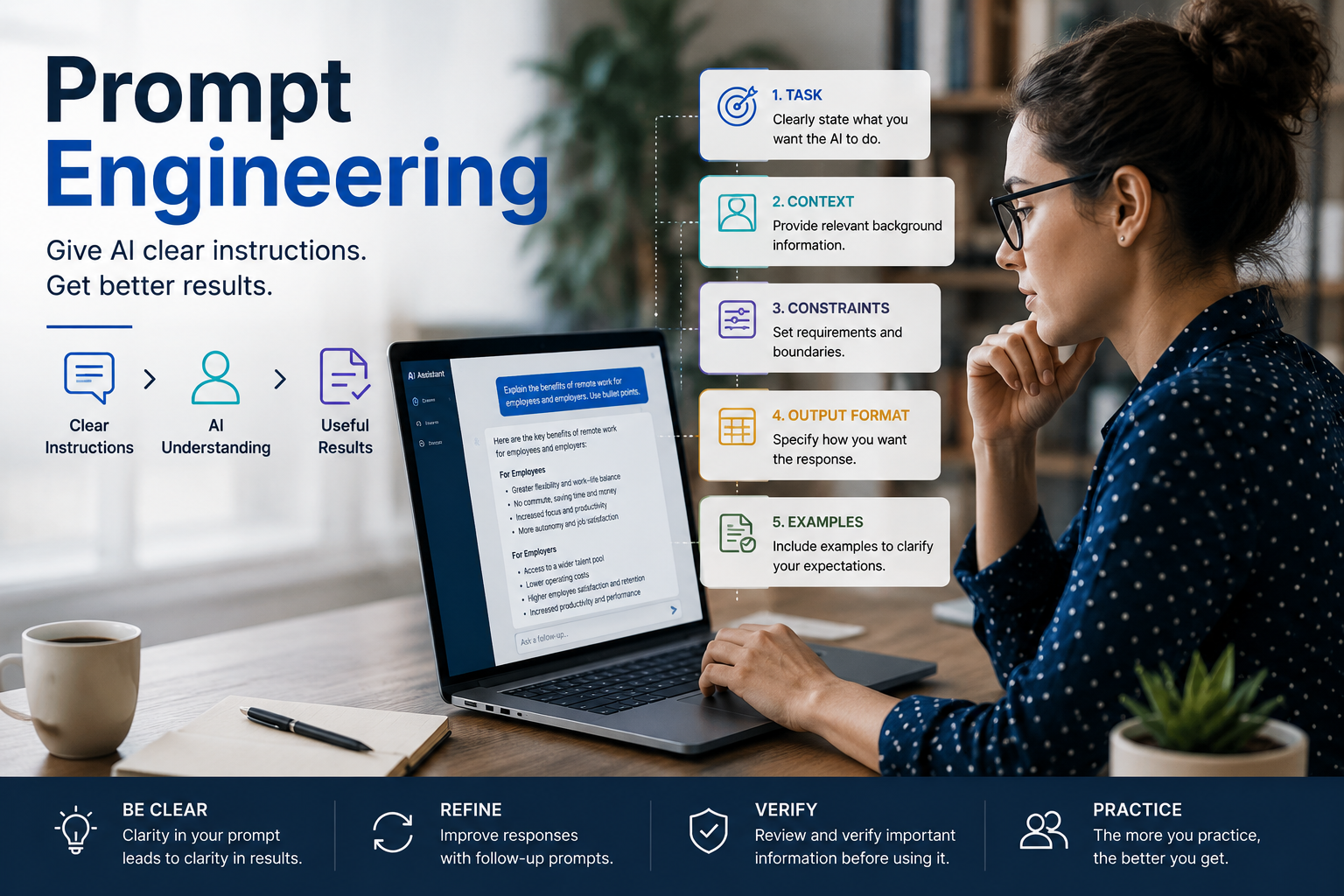
- Prompt Engineering — learn to communicate more effectively with AI systems.
- Data Analysis — build practical skills for working with information and AI-assisted analysis.
- Explore AI Skills — discover additional skills for an AI-powered workplace.
- Explore AI Careers — see which career paths require programming and other technical skills.
You don’t need to become an expert programmer overnight. Start with the fundamentals, build small projects, use AI as a learning assistant, and develop deeper technical skills as your career goals require them.