
Living in an AI-Generated World: What Makes Us Human?

Artificial intelligence is changing more than the way we work. It is transforming the movies we watch, the music we hear, the stories we read, and the information we encounter every day. Images, videos, voices, and written content that once required human creators can now be generated with AI in remarkably little time.
These developments offer exciting possibilities. Individuals can bring creative ideas to life, businesses can communicate in new ways, and people without specialized technical skills can explore forms of expression that once seemed out of reach.
But they also raise important questions. When a video looks real, how can we know whether the events actually happened? When a song or story moves us, does it matter whether a person or an AI system created it? And as technology takes on more creative tasks, what becomes more valuable about human imagination, experience, and judgment?
The future does not have to be a choice between human creativity and artificial intelligence. The greater opportunity may lie in understanding how they can work together—while preserving the trust, relationships, originality, and personal meaning that make our experiences human.
In this article, we’ll explore five ways AI is reshaping creativity and everyday life, how to recognize its limitations, and where people may find meaningful opportunities in an increasingly AI-generated world.
AI and Human Creativity: A New Era for Movies, Music, Writing, and Art
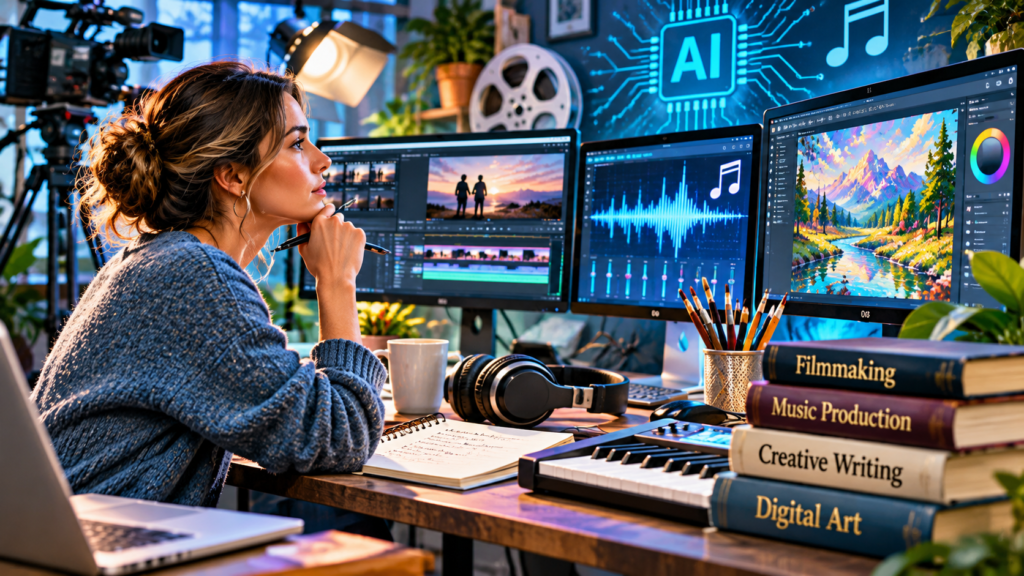
For generations, creative expression has been closely connected to human skill, imagination, and experience. Making a movie required cameras, performers, production crews, and editing equipment. Producing music often meant learning instruments, working with musicians, or using specialized recording tools. Writing books, designing illustrations, and creating animations demanded time, practice, and persistence.
Artificial intelligence is changing how some of these activities can be performed.
Movies and Video: From Imagination to the Screen
AI video-generation tools can create moving images from written descriptions, reference images, and other inputs. A person may be able to visualize a historical setting, imaginary landscape, or short dramatic scene without organizing a traditional film production.
This opens opportunities for educators, independent storytellers, small businesses, and aspiring filmmakers. A teacher might illustrate a historical event, while an entrepreneur could develop a concept video for a product or service.
However, producing a compelling movie involves more than generating attractive scenes. Storytelling, emotional continuity, editing, performance, and artistic direction remain important. AI-generated video can also introduce concerns about consent, copyright, and realistic depictions of events that never happened.
Music: New Ways to Compose and Experiment
AI music tools can help people explore melodies, arrangements, lyrics, and musical styles. Someone who has never played an instrument may be able to experiment with musical ideas or create background audio for an original project.
For experienced musicians, AI may serve as a brainstorming or production assistant.
At the same time, questions remain about how AI systems are trained, whether generated music resembles existing recordings, and how human musicians should be credited or compensated.
The ability to generate a song does not automatically replace the value of a musician’s personal interpretation, live performance, or relationship with an audience.
Writing and Storytelling: More Possibilities, More Responsibility
AI writing tools can help organize ideas, develop outlines, suggest alternative wording, and assist with editing. These capabilities may be especially useful for people who have valuable experiences to share but find writing difficult.
An individual might use AI to organize a family history. A small-business owner could prepare an educational guide. A student could explore different ways to explain a complicated subject.
But AI-generated writing can contain invented details, inaccurate claims, or language that sounds convincing without being reliable.
Human writers still contribute lived experience, personal perspective, fact-checking, and the responsibility to stand behind what they publish.
Art and Design: Expanding Creative Access
AI image-generation tools allow people to experiment with illustrations, design concepts, and visual storytelling using ordinary language.
This can help individuals communicate ideas even when they lack traditional drawing or design skills.
Professional artists may also use AI to explore concepts before creating finished work.
Nevertheless, originality, artistic ownership, permission to use source material, and the economic impact on working artists deserve serious consideration.
The Bigger Question: Who Is the Creator?
As AI becomes more capable, creative work may increasingly involve collaboration between people and software.
The important distinction may not be whether AI was used, but how it was used, what the human contributed, and whether the finished work is presented honestly.
A meaningful creative project still benefits from someone who understands its purpose, evaluates its quality, and takes responsibility for the result.
Can We Trust What We See? Recognizing AI-Generated Information

For much of our lives, seeing a photograph or hearing someone’s recorded voice provided a reasonable starting point for believing that something had actually happened.
Today, artificial intelligence can generate convincing photographs, videos, voices, and written accounts of events that never occurred.
This does not mean that every digital image or recording should be treated with suspicion. It means we need better habits for evaluating what we encounter.
When Seeing Is No Longer Believing
AI-generated images can depict imaginary people, places, and events with remarkable realism. Synthetic voices can imitate patterns of human speech, and AI-generated videos can portray scenes that appear authentic.
These capabilities have legitimate uses in entertainment, education, accessibility, and creative expression.
However, the same technology can also be misused to impersonate individuals, spread misinformation, or manufacture apparent evidence.
For example, a fabricated video might appear to show a public figure making a statement they never made. A synthetic voice could be used in an impersonation scam. An AI-generated photograph might circulate online as supposed evidence of a breaking news event.
The central problem is not simply that AI can create realistic content. It is that realistic appearance alone is no longer sufficient evidence of authenticity.
Can AI Detectors Tell Us What Is Real?
Several tools attempt to identify AI-generated writing, images, or other media.
Some analyze patterns in content. Others look for digital watermarks, provenance information, or signs that a file has been altered.
These approaches can be helpful, but they have limitations.
An AI detector may incorrectly identify human-created content as artificial. It may also fail to recognize content produced or modified with AI.
Editing, compression, screenshots, and other changes can sometimes remove or weaken signals that detection systems rely upon.
A detector’s result should be treated as one piece of evidence, not a final verdict.
Three Practical Ways to Check Questionable Content
1. Investigate the original source.
Ask where the information first appeared. Is it published by an identifiable person, organization, or reputable news source? Can you locate the original recording, document, or announcement?
Be cautious when a dramatic claim appears only in an anonymous post or an account with no clear connection to the event.
2. Look for independent confirmation.
Search for coverage from reliable sources that are not simply repeating the same original post.
For images, a reverse-image search may help identify earlier appearances or reveal that an image has been presented in a misleading context.
Remember that multiple websites repeating the same claim do not necessarily provide independent verification.
3. Examine the context before sharing.
Check the publication date, location, and circumstances surrounding the content.
Ask whether an image is being used to illustrate an idea or is being presented as evidence of a real event.
If the claim is consequential and you cannot verify it, consider waiting before sharing it.
Authenticity Is More Than Detecting AI
A genuine photograph can be presented with a misleading caption. A human-written article can contain inaccurate information. Conversely, an AI-generated illustration can be useful and entirely appropriate when clearly identified.
The larger goal is not to reject AI-created material.
It is to distinguish creative expression from factual evidence, understand how information was produced, and make thoughtful decisions about what deserves our trust.
As synthetic media becomes more common, critical thinking, source verification, and responsible communication may become some of our most valuable everyday skills.
Want to become more confident about evaluating AI-generated claims and online information? Explore our practical guide, Evaluate & Verify AI Information, for additional ways to check accuracy and reliability.
What Makes Human Creativity Valuable in an AI-Generated World?

Imagine two paintings hanging side by side. Both are beautiful. One was created by an artist who spent years developing a personal style. The other was generated by artificial intelligence in less than a minute.
If we cannot tell which is which, does the difference matter?
For some people, the visual experience may be enough. Others may place additional value on knowing the artist’s story, understanding the creative process, or recognizing the effort involved.
Neither reaction is necessarily wrong. But the comparison raises an important question: As AI makes creative output easier to produce, what gives human creativity its value?
Human Experience Gives Creativity Meaning
People create from experiences that are uniquely their own.
A songwriter may draw upon a difficult period in life. A photographer may capture a moment involving someone they love. A writer may describe an event that changed their understanding of the world.
AI can generate convincing descriptions of such experiences, but it does not possess a human life history or personal memories in the way people do.
The value of human creativity often comes from more than the finished product. It also comes from the experience, intention, and perspective behind it.
Personal Connections Matter
Consider attending a concert performed by a musician you admire.
The experience involves more than hearing musical notes. It includes the audience, the atmosphere, the performer’s presence, and the knowledge that people are sharing a particular moment.
Similarly, a handwritten letter from a family member may carry emotional significance that a polished AI-generated message cannot automatically reproduce.
AI may help people communicate, but meaningful relationships still depend on human attention, sincerity, and participation.
Craftsmanship and the Satisfaction of Making Something
Many people enjoy creating things even when faster alternatives are available.
Someone may spend hours woodworking, gardening, painting, cooking, or restoring an old piece of furniture.
The value lies partly in the finished result, but also in learning, improving, solving problems, and experiencing the satisfaction of accomplishment.
AI can assist with planning and instruction. It does not eliminate the personal rewards of developing a skill or making something with our own hands.
As automated production becomes more common, some people may place greater value on handmade products, live performances, and experiences that reflect individual effort.
Judgment, Responsibility, and Trust
AI can produce recommendations, explanations, and creative material, but people remain responsible for deciding how those outputs should be used.
A teacher must consider what students need to learn. A journalist must evaluate evidence. A healthcare professional must consider the individual circumstances of a patient. A business owner must decide whether a recommendation is fair and appropriate.
These responsibilities involve context, ethics, accountability, and relationships with other people.
AI may support those decisions, but generating an answer is not the same as accepting responsibility for its consequences.
Human Creativity and AI Can Coexist
We do not have to assume that every improvement in AI diminishes the importance of human abilities.
Photography did not eliminate painting. Recorded music did not eliminate live concerts. Digital communication did not eliminate the value of personal conversation.
New technologies can change how creative work is produced and valued without removing the reasons people create.
AI may make certain tasks faster and more accessible. People can still contribute the purpose, experience, imagination, and judgment that give those tasks meaning.
Perhaps the most important question is not whether AI can create something impressive, but whether what we create—alone or with AI—adds meaning, understanding, or value to human life.
AI as a Creative Partner: Helping People Learn, Create, and Build Opportunities
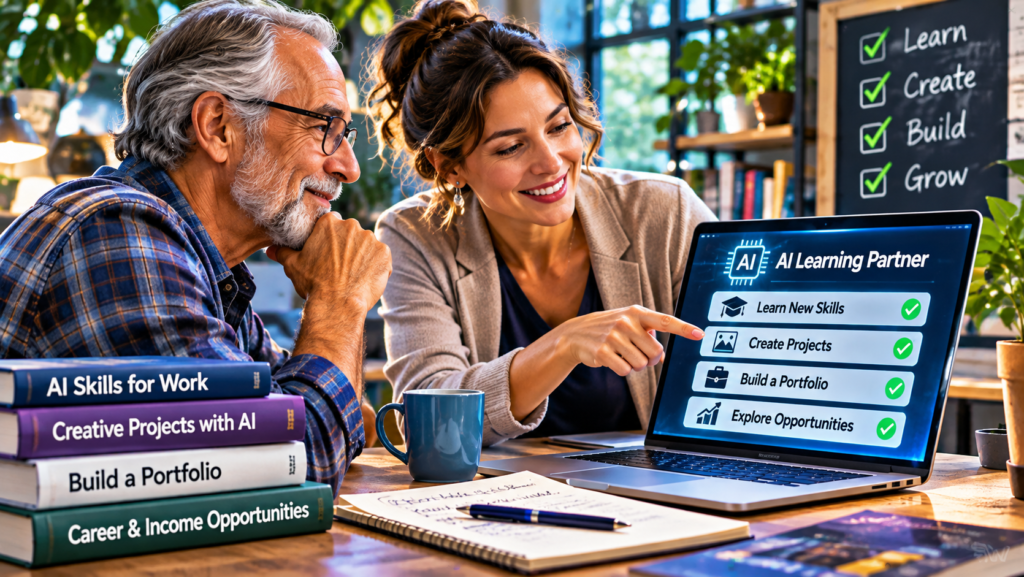
Much of the public discussion about artificial intelligence focuses on what machines may eventually do instead of people.
But another possibility deserves attention: What can people accomplish with AI that might previously have been difficult, expensive, or beyond their technical abilities?
For many individuals, the most useful role of AI may be as a creative assistant—a tool that helps turn ideas into projects while leaving people responsible for the decisions and final results.
Helping People Tell Their Stories
Everyone has experiences worth remembering or sharing.
A parent might want to preserve family memories. A retired worker may have decades of knowledge that could benefit younger generations. Someone interested in local history might want to document how a community has changed.
AI can help organize notes, develop
questions, suggest chapter outlines, or turn rough descriptions into more readable drafts.
For example, a person could collect family photographs, record conversations with relatives, and use AI to help develop a family-history booklet.
The memories, photographs, and personal experiences remain the human contribution. AI assists with organizing and presenting them.
When working with personal material, users should also consider privacy and obtain permission before uploading sensitive information or someone else’s recordings or photographs.
Making Learning More Accessible
AI can help explain unfamiliar subjects, create practice questions, summarize complex material, and suggest different approaches to learning.
Someone interested in photography could ask for a beginner’s learning plan. A small-business owner might request explanations of unfamiliar financial terminology. A student could practice describing a scientific concept in their own words.
AI may also help people who face language barriers or difficulties with conventional learning materials.
However, AI explanations can be inaccurate. Important information should be checked against reliable educational resources, and AI should complement rather than replace qualified instruction when expertise matters.
Supporting Small Businesses and Independent Creators
Starting a creative project or small business often requires skills that extend beyond a person’s main area of expertise.
A craftsperson may need help writing product descriptions. An independent consultant might want to organize a training workshop. A community organization may need illustrations or educational materials.
AI can assist with brainstorming, drafting, organizing, and preparing early versions of these materials.
For example, a knowledgeable professional could use AI to outline a short educational course, develop practice activities, aninitial presentation.
The person would still need to verify the material, make it useful for the intended audience, and determine whether it meets appropriate quality and legal standards.
AI can lower some barriers to getting started, but it does not guarantee that a project will attract customers or generate income.
Interested in exploring how AI might help you develop a small business, independent project, or additional source of income? Read our Explore Additional Income With AI guide for a practical approach to evaluating opportunities before investing time or money.
Helping People Explore New Creative Skills
AI may also provide an approachable starting point for people who have always wanted to experiment with writing, art, music, or video.
Someone who has never created a short film could begin by developing a story outline and visual concepts. A beginner interested in graphic design might explore different layouts before learning more advanced design techniques.
These experiments can encourage curiosity and confidence.
They may also motivate people to develop traditional skills, such as photography, editing, drawing, storytelling, or music composition.
Using AI does not have to mean abandoning the learning process. It can sometimes become the beginning of that process.
A Practical Way to Begin
Readers interested in experimenting with AI can start with a small project that has personal value.
Step 1: Choose something meaningful. Select a family story, learning goal, creative idea, or everyday problem that you genuinely care about.
Step 2: Ask AI to help with one manageable task. Request an outline, a list of questions, a simple explanation, or several possible approaches rather than expecting a complete finished product immediately.
Step 3: Review and improve the result. Check accuracy, add personal knowledge, correct weaknesses, and decide what should be changed or removed.
The goal is not simply to produce more material faster.
It is to use technology in ways that expand human ability, encourage learning, and help people accomplish something worthwhile.
Interested in developing practical AI skills of your own? Visit our AI Skills page to explore AI fundamentals, prompt engineering, data analysis, and other useful skills for work and everyday projects.
AI in Everyday Life: Where Technology Can Make a Human Difference
Artificial intelligence is often discussed in terms of jobs, business productivity, or advanced technology. But some of its most meaningful effects may be found much closer to home.
AI is increasingly appearing in devices, services, and applications that people use to manage everyday activities. From household robotics to accessibility tools and personalized learning, the potential benefits extend beyond saving time.
The more important question may be whether these technologies help people live more comfortably, independently, safely, and meaningfully.
Smarter Homes and Household Robotics
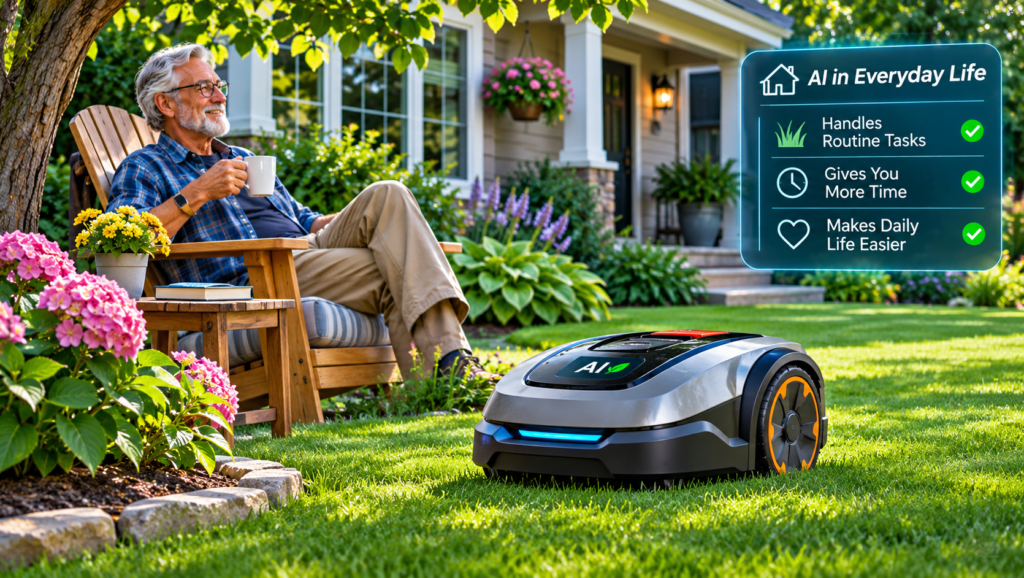
Robotic vacuum cleaners, automated lawn mowers, and other smart-home devices illustrate how technology can take over certain repetitive household tasks.
Some systems use sensors, cameras, mapping software, or AI-based object recognition to navigate their surroundings and respond to changing conditions.
For homeowners, these tools may reduce the physical effort involved in routine maintenance. They may be especially appealing to people who have limited mobility, demanding schedules, or difficulty performing certain outdoor tasks.
However, these products vary considerably in price, reliability, maintenance needs, and suitability for different homes.
A robotic lawn mower, for example, may work well in one yard but struggle with steep slopes, complicated boundaries, obstacles, or other conditions.
The value of automation should be measured by how well it solves a real problem—not simply by how advanced the technology appears.
Accessibility and Greater Independence
Some of AI’s most promising applications involve helping people overcome barriers to communication, information, and daily activities.
Speech recognition can turn spoken words into text. Text-to-speech tools can read written information aloud. AI-assisted image descriptions may help people understand visual content.
Translation and communication tools can also make information more accessible across languages.
For individuals with disabilities or age-related limitations, these capabilities may support greater independence and participation.
Yet accessibility tools are not always accurate or appropriate for every situation. Their usefulness depends on thoughtful design, affordability, reliability, and the needs of the individual.
Learning That Adapts to the Individual
Traditional learning materials often present the same explanation to everyone.
AI-assisted educational tools can offer alternative explanations, generate practice exercises, and adjust some learning activities based on a user’s responses.
An adult returning to school might use AI to review unfamiliar mathematics. Someone learning a new language could practice conversations. A worker preparing for a career change might explore terminology used in a different industry.
These tools may help people learn at their own pace.
However, effective education involves more than receiving immediate answers. Teachers, mentors, and learners still need to evaluate understanding, correct mistakes, and develop independent thinking.
Healthcare and Personal Well-Being
AI is being explored and used in various healthcare settings, including medical imaging, administrative support, research, and tools that help organize health information.
Some consumer technologies also use automated analysis to identify patterns in activity, sleep, or other measurements.
These applications may help professionals work more efficiently and give individuals additional information about their well-being.
But health-related AI requires particular caution. Incorrect or incomplete information can have serious consequences.
AI-generated health guidance should not replace qualified medical evaluation, and people should understand the privacy implications of sharing sensitive health information with digital services.
Helping Communities and Public Services
AI may also support activities that benefit entire communities.
Examples include analyzing traffic patterns, helping utilities anticipate equipment problems, improving access to public information, and supporting emergency planning.
Local organizations may use AI-assisted tools to translate materials, organize community resources, or make information easier to understand.
These applications have potential, but they also raise questions about fairness, data protection, public accountability, and the reliability of automated decisions.
Technology should serve the people affected by it, with appropriate human oversight.
Measuring AI by Its Human Benefits
Not every household needs a robot, and not every task becomes better when automated.
Sometimes a simple tool, a trusted professional, or a personal conversation is the better solution.
Before adopting an AI-powered product or service, it helps to ask:
- What problem does this solve?
- Does it save meaningful time, effort, or expense?
- Is it reliable and safe for the intended use?
- What information does it collect, and how is that information protected?
- Can a person understand, correct, or override its decisions?
- Is the benefit worth the purchase price, subscription cost, or ongoing maintenance?
These questions shift our attention away from technological novelty and toward practical value.
The most worthwhile applications of AI may not be those that make technology more impressive, but those that make everyday life better for the people using it.
The Future of AI Should Be About People
We are entering a period in which artificial intelligence can help create movies, compose music, write stories, generate realistic images, and perform tasks that once required considerable human effort.
These capabilities will continue to influence how we work, learn, communicate, and spend our time.
But technological capability alone does not tell us whether a change is beneficial.
An AI-generated movie may be visually impressive, but a meaningful story still needs a purpose. An automated household device may save time, but its value depends on whether it genuinely improves someone’s daily life. An AI-generated explanation may sound convincing, but its usefulness depends on accuracy, context, and the judgment of the person using it.
As AI becomes more capable, we may find ourselves placing even greater importance on qualities that are deeply connected to human experience: creativity, relationships, trust, responsibility, craftsmanship, and the satisfaction of learning something ourselves.
The challenge is not simply to determine what AI can do.
It is to decide what we want AI to help us accomplish.
A Question Worth Asking
The next time you encounter an impressive AI-generated image, video, song, or automated service, consider asking:
Does this technology help people create, understand, connect, learn, or live better?
That question may be more useful than asking whether AI can replace another human activity.
Artificial intelligence offers remarkable possibilities, but people still have an essential role in deciding which possibilities are worth pursuing.
The future of AI should not be measured only by what machines can produce. It should also be measured by what people can achieve, experience, and enjoy because of them.
Sources and Further Reading
1. NIST — AI Risk Management Framework
Guidance on trustworthy and responsible AI, including reliability, transparency, and accountability.
Practical considerations for identifying, measuring, and managing AI risks.
3. Coalition for Content Provenance and Authenticity (C2PA)
Information about content provenance and technologies designed to help establish the origins and history of digital media.
4. U.S. Copyright Office — Copyright and Artificial Intelligence
Official resources about copyright questions involving AI-generated material.
5. Federal Trade Commission — Artificial Intelligence
Consumer protection and business guidance involving artificial intelligence.
Last reviewed: November 1, 2026.