Choose Your AI Learning Path
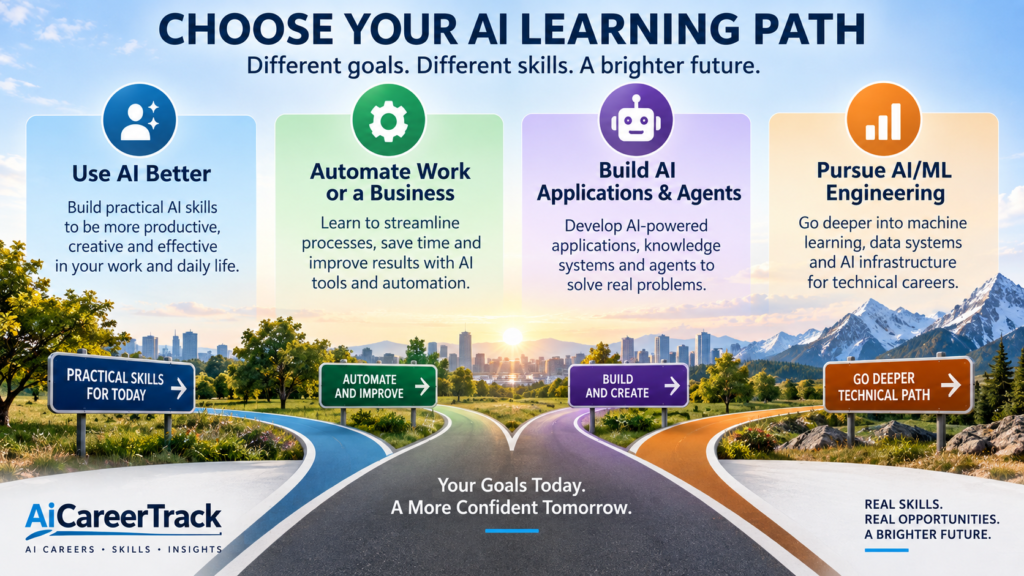
AI learning paths are not one-size-fits-all. What you need to learn depends on what you want to accomplish and how deeply you need to develop your AI skills.
You may want to use AI more effectively in your current work, automate repetitive processes, build AI applications and agents, or develop the deeper technical skills used in AI and machine learning engineering.
Choose the path that best matches your goal. You can start with the fundamentals, build practical skills step by step, and go deeper when your goals require it.
Which of These AI Learning Paths Matches Your Goal?
Your learning path should begin with your goal. Choose the direction that most closely matches what you want to accomplish today. You can always move into a more advanced path as your skills and goals develop.
Use AI Better
Best for: Professionals, students, career changers and anyone who wants practical AI skills without becoming a programmer.
- AI Fundamentals
- Better Prompts
- Better Context
- Research & Verification
- Documents & Information
- Responsible AI Use
- Practical Workplace Applications
Technical requirement: None to begin.
Where this can take you: More effective, informed and responsible use of AI in your work and everyday tasks.
Automate Work or a Business
Best for: Professionals, managers, small-business owners and people who want AI to improve repeatable work and processes.
- AI Fundamentals
- Prompting & Context
- Identify Repetitive Processes
- AI Workflows
- Automation Tools
- APIs When Needed
- Tool-Using AI
- AI Agents
- Testing, Security & Human Approval
Technical requirement: You can start without programming. Basic technical skills become more useful as your automation becomes more sophisticated.
Where this can take you: Better workflows, useful automations and carefully controlled AI agents.
Build AI Applications & Agents
Best for: People who want to move beyond using AI tools and begin building AI-powered applications, knowledge systems and agents.
- AI & LLM Fundamentals
- Python
- Git & GitHub
- Structured Data
- APIs & Model APIs
- Structured Outputs & Tool Calling
- Embeddings & Vector Search
- RAG
- AI Agents
- Evaluation & Testing
- Security & Prompt-Injection Awareness
- Deployment
- Portfolio Projects
Technical requirement: Programming becomes important on this path. You can begin without advanced computer science knowledge, but software-engineering skills become increasingly important as the systems you build become more complex.
Where this can take you: AI-powered applications, RAG systems, tool-using agents and portfolio projects.
Pursue AI/ML Engineering
Best for: Learners who want deeper technical careers involving machine learning, model development, data systems or production AI infrastructure.
- Programming Foundations
- Mathematics & Statistics
- Data & SQL
- Machine Learning Fundamentals
- Deep Learning
- Model Development & Evaluation
- Data & ML Pipelines
- Cloud Infrastructure
- MLOps
- Security & Responsible AI
- Specialized Projects
Technical requirement: This path requires considerably greater technical depth. Education and degree requirements vary by role and employer.
Where this can take you: Deeper work in machine learning, AI engineering, data systems and production AI.
You Don’t Need to Learn Everything
AI can quickly become overwhelming because new tools, frameworks and technical terms appear constantly. You do not need to master all of them before you can make useful progress.
Your goal determines what you need to learn, how deeply you need to learn it, and what can wait until later.
A professional using AI at work may never need to build a vector database. An AI application developer may need working knowledge of RAG and APIs without becoming a machine-learning researcher. An AI/ML engineer may need substantially deeper programming, mathematics, data and production-system knowledge.
Learn what your destination requires—and build from there.
Build AI Skills and Judgment Together
As AI systems gain access to more information, tools and autonomy, security and trust become increasingly important.
Learning AI should include more than learning what the technology can do. It should also include how to verify AI-generated information, protect sensitive data, recognize untrusted content, understand risks such as prompt injection, control tool permissions, test AI behavior and keep appropriate human oversight.
AiCareerTrack treats security, verification and responsible AI use as part of the learning process—not as subjects to consider only after something has been built.
More Capability Requires More Control
- AI Answers → Verify important information
- External Knowledge & RAG → Validate sources and retrieved information
- Tools & APIs → Control permissions and protect credentials
- AI Agents → Limit autonomy and use human approval where appropriate
- Production Systems → Test, monitor and govern
Build capability and control together.
Don’t Just Complete Courses. Build Evidence.
Completing a course can help you learn a skill, but practical evidence can help you determine whether you can actually use what you learned.
As you progress, create small projects, practice with realistic problems, test your work and document what you learned. These examples can also give you something concrete to discuss with employers, clients or collaborators.
Turn Learning Into Proof
- Learn → Understand the concept or skill
- Practice → Use it in a guided exercise
- Build → Apply it to something useful
- Verify → Test the result and identify weaknesses
- Prove → Save or document something that demonstrates what you can do
Start Where You Are
You do not need to have your entire AI learning journey planned before you begin. Start with your current goal, build one useful skill at a time, and go deeper when your work, interests or career direction require it.
If you are unsure where to begin, use the AiCareerTrack resources below to understand your current readiness, practice a useful AI skill or explore how AI may fit into your career.
Want to Use AI to Explore Additional Income?
AI skills can also help you explore ways to earn additional income using knowledge, experience, or abilities you already have. The goal is not to chase promises of easy money, but to identify something useful you can provide, evaluate whether people need it, and test the idea without taking unnecessary risks. Explore Additional Income With AI →