
Give AI Better Context—and Get Better Answers
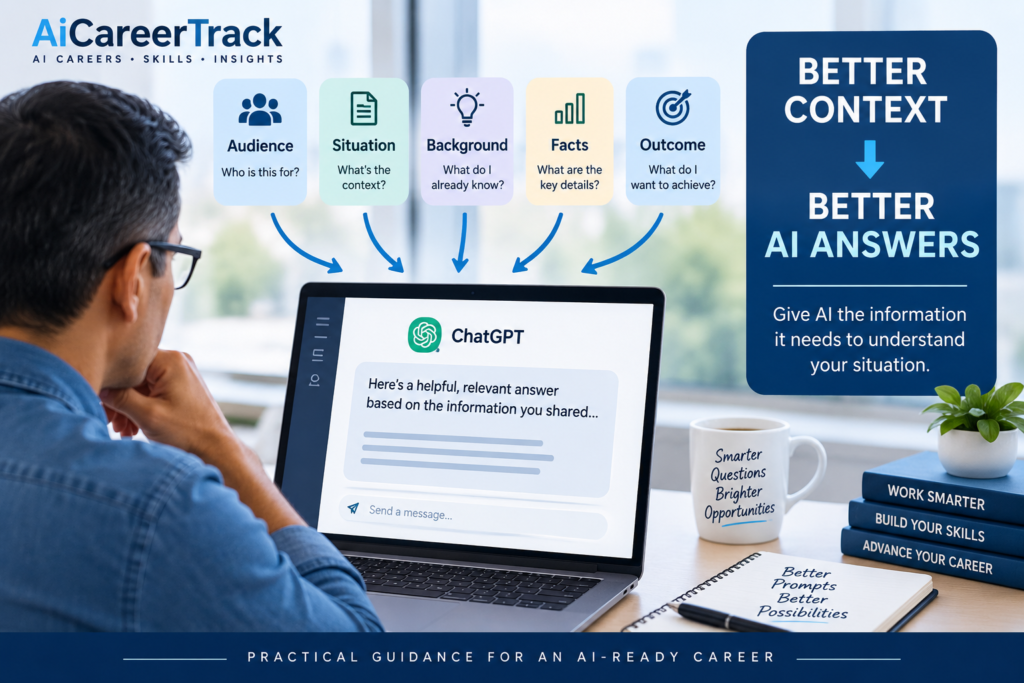
Learn how to give AI the background information it needs to understand your situation and produce a more relevant response—without sharing information it does not need.
Time: About 10–15 minutes
Level: Beginner
Technical skills required: None
You can complete this lesson using a general-purpose AI assistant such as ChatGPT, Gemini, Microsoft Copilot or another comparable tool. You do not need to purchase a new AI subscription to complete this lesson.
What You’ll Learn
By the end of this lesson, you will be able to distinguish between instructions and context, identify the background information an AI assistant actually needs, improve a request by adding useful context, and recognize information that may be unnecessary or inappropriate to share.
Instructions and Context Are Different
When you ask an AI assistant for help, two kinds of information can make a major difference in the response: instructions and context.
Instructions tell the AI what you want it to do.
Context gives the AI background information that helps it understand your situation.
For example, imagine entering this request:
Write an email asking for a meeting.
The instruction is clear: write an email. But the AI knows very little about the situation. Who is receiving the email? Why do you want the meeting? What relationship do you have with the person? Is the subject routine, sensitive or urgent?
Now compare it with:
Write a short email to my manager asking for a 30-minute meeting next week. I want to discuss taking responsibility for a new project that our department is starting. My manager already knows I am interested in project management, but we have not discussed this particular opportunity. Keep the tone professional and confident without sounding entitled.
The task is still simple, but the AI now has enough background to produce a response that is more appropriate to the situation.
Better context helps AI respond to your situation instead of merely responding to your words.
What Context Does AI Need?
Useful context depends on the task. You do not need to provide every detail you know. Instead, ask yourself what background information could materially change the AI’s response.
For many everyday tasks, useful context may include:
- Audience: Who will read, receive or use the result?
- Situation: What is happening, and why does the task matter?
- Relevant background: What has already happened or been decided?
- Your role: What is your relationship to the situation or people involved?
- Important facts: What information should the AI use rather than guess?
- Desired outcome: What are you hoping the response will help accomplish?
Not every request needs all six. A simple task may require only one or two pieces of context. A more complicated decision, document or workplace situation may require more.
The goal is not to make every prompt longer. The goal is to give the AI the relevant background it needs and no more than it needs.
See the Difference Context Makes
Imagine that you are preparing for a meeting and ask an AI assistant:
Give me some questions to ask during a meeting about a new software system.
The AI can produce questions, but it has to guess what matters to you.
Now add useful context:
I manage an operations team of 20 people. Our company is considering replacing the software we use to schedule work and track assignments. My team uses the current system every day, and several employees are concerned that a replacement could make scheduling more complicated. I am attending a meeting with the software vendor and our IT department. Give me 10 questions I should ask about usability, training, implementation, data migration and support.
The second request gives the AI important information about the user, situation, audience, concerns and desired outcome. That makes it easier for the AI to generate questions that fit the actual meeting rather than producing a generic software checklist.
But notice what the request does not include. It does not provide employee names, passwords, account numbers, confidential customer information or other details the AI does not need to complete the task.
Good context is relevant context—not every piece of information available to you.
Try It Yourself
Start with this simple request:
Help me prepare for a presentation.
Before asking AI to improve the request, think about what it does not know.
Who is the audience? What is the presentation about? Why are you giving it? How much time do you have? What does the audience already know? What do you want them to understand or do afterward?
Now imagine the situation is this:
- You are giving a 10-minute presentation to coworkers.
- Most of them have little experience using AI.
- Your topic is using AI to help with everyday workplace tasks.
- You want to give practical examples without making AI sound more capable than it is.
- You want the audience to leave with one simple idea they can try.
Rewrite the original request using the context above. You do not need to use every detail if it does not help the AI complete the task.
Then compare your new request with the original:
Help me prepare for a presentation.
Ask yourself: Would the AI now understand my situation well enough to give me a more useful response?
Apply It to Something Real
Choose a real task where you might ask AI for help. It could involve writing an email, preparing for a meeting, researching a topic, comparing options, planning a project, learning something new or solving a workplace problem.
Write the request you would normally give the AI.
Then review it and ask:
- Who or what is involved?
- What situation does the AI need to understand?
- What relevant background would change the response?
- What important facts should the AI know rather than guess?
- What outcome am I trying to achieve?
- What information does the AI not need?
Add only the context that helps the AI understand the task.
Then try both versions—the original request and your improved request—and compare the responses.
Look for differences in relevance, specificity and usefulness. Did the added context reduce unnecessary assumptions? Did it make the response better suited to your actual situation?
The purpose of context is not to create the longest prompt. It is to reduce the amount of important information the AI has to guess.
Give AI Better Context—Without Sharing Sensitive Information
Adding context can improve an AI response, but that does not mean you should provide every detail available to you.
Before sharing information with an AI tool, consider whether the information is actually necessary for the task and whether it is appropriate to share.
Be especially careful with information such as:
- Passwords, API keys or login credentials
- Financial account or payment information
- Private customer or employee information
- Confidential business information
- Personal health or other sensitive personal information
- Proprietary documents or data you are not authorized to share
In many situations, you can provide useful context without revealing sensitive details.
For example, instead of providing a customer’s name, account number and complete transaction history, you may be able to describe the relevant situation without identifying the customer.
Before adding context, ask yourself two questions:
What does the AI need to know to help me?
What information should I avoid sharing?
The rules and privacy protections of AI tools, workplaces and organizations can differ. When using AI for work, follow your organization’s policies and any requirements that apply to the information you handle.
Give AI enough context to understand the task—but keep unnecessary sensitive information out of the conversation.
Check the AI’s Response
Better context can make an AI response more relevant, but it does not guarantee that the response is correct.
After receiving an answer, check whether the AI used your context appropriately.
Ask yourself:
- Did the AI understand the situation correctly?
- Did it use the important facts I provided?
- Did it make assumptions about information I did not provide?
- Did it overlook an important constraint or detail?
- Does the response actually fit my audience and purpose?
- Are there factual claims I should verify before using them?
If the response misses something important, you do not always need to start over. You can continue the conversation by correcting an assumption, adding a missing piece of context or explaining what needs to change.
For example:
You assumed the audience already understands AI terminology. Most of them are beginners. Revise the explanation using plain language and briefly explain any technical terms you need to use.
This is one of the advantages of working with AI conversationally. Your first prompt does not have to contain everything. You can add useful context as you discover what the AI needs to understand.
Better context improves the conversation, but your judgment still determines whether the result is useful and trustworthy.
You Proved It
If you completed the exercises in this lesson, you practiced an important AI skill: deciding what an AI assistant needs to know before asking it to help.
You learned how to:
- Distinguish between instructions and context
- Identify background information that can improve an AI response
- Add useful context without making every prompt unnecessarily long
- Reduce the assumptions an AI has to make
- Avoid sharing information the AI does not need
- Review whether the AI understood and used your context appropriately
- Continue the conversation when the AI needs clarification or correction
You can use this skill when writing, researching, planning, learning, analyzing information or working through everyday problems with AI.
Good AI use is not only about giving better instructions. It is also about giving AI enough understanding of the situation to respond appropriately.
Continue Your AI Learning
Better context is one part of communicating effectively with AI. Continue building your skills with these AiCareerTrack resources.
Write Better AI Prompts
Learn how Goal, Context, Information, Constraints and Output can turn a vague request into a clearer, more useful AI prompt.
Evaluate and Verify AI-Generated Information
Learn practical ways to check AI-generated information before relying on it for important work, research or decisions.
Choose Your AI Learning Path
Decide whether your next steps should focus on practical AI use, workplace or business automation, AI application and agent development, or deeper AI/ML engineering skills.
Check Your AI Readiness
Assess your current AI capabilities and identify areas you may want to strengthen next.
Watch: Give AI Better Context—and Get Better Answers
Prefer to watch? This short AiCareerTrack video shows how adding useful context can help AI understand your situation, reduce unnecessary assumptions and produce more relevant answers.