Essential AI Skills for Professionals in 2026
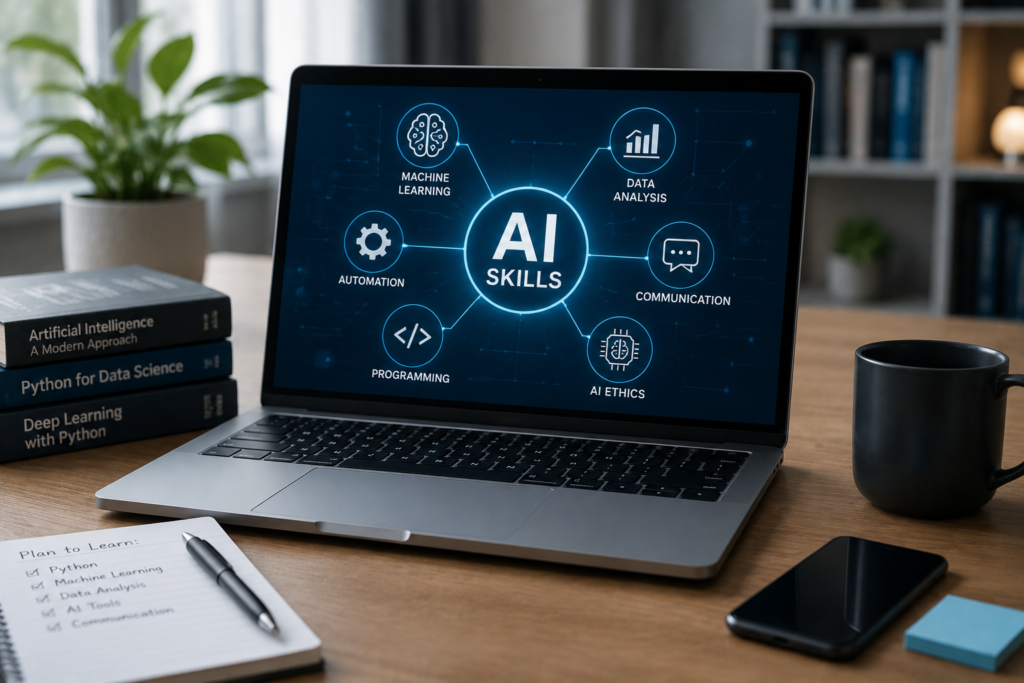
Build the Skills That Will Shape Your Future
Artificial Intelligence is rapidly becoming an essential part of the modern workplace. Whether you’re a student preparing for your first job, an experienced professional adapting to new technologies, or someone considering a career change, developing AI skills can help you remain competitive and open new career opportunities.
The good news is that most professionals do not need to become computer programmers or AI researchers. Employers increasingly value individuals who understand how to use AI effectively, solve problems creatively, and work alongside intelligent technologies.
This guide highlights ten of the most valuable AI skills professionals should begin developing in 2026 and beyond.
Why AI Skills for Professionals Matter
Artificial Intelligence is changing nearly every profession by automating routine tasks, improving decision-making, increasing productivity, and creating entirely new career paths.
The World Economic Forum’s Future of Jobs Report 2025 identifies AI and big data among the fastest-growing skills while also emphasizing analytical thinking, technological literacy, resilience, leadership, and lifelong learning. This reinforces an important point: preparing for AI-enabled work requires a combination of technical capability and durable human skills.
Employers are increasingly looking for people who can:
- Work effectively with AI tools
- Evaluate AI-generated information
- Improve business processes
- Adapt to rapidly changing technology
- Continue learning throughout their careers
Developing AI skills today can help prepare you for opportunities that will continue growing throughout the coming decade.
1. AI Literacy
Understanding what Artificial Intelligence is—and what it is not—is the foundation of every AI career.
AI literacy means understanding concepts such as machine learning, large language models, automation, generative AI, and responsible AI without necessarily knowing how to build them.
Why it matters
Professionals who understand AI can make better decisions, communicate more effectively with technical teams, and identify opportunities to improve their work.
Best for
Everyone working in today’s technology-driven workplace.
2. Prompt Engineering
Prompt engineering is the ability to communicate effectively with AI systems by asking clear, detailed, and purposeful questions.
Better prompts often produce significantly better results.
Professionals who learn prompt engineering can improve writing, research, brainstorming, programming assistance, data analysis, and creative work.
Why it matters
As AI assistants become common workplace tools, prompt engineering is quickly becoming an essential professional skill.
Build this skill: Learn a simple five-part framework for giving AI clearer instructions and getting more useful results.
Next step: Write Better AI Prompts →
3. Critical Thinking
AI can generate answers quickly—but not always accurately.
Professionals must learn to evaluate information, recognize mistakes, verify sources, and apply human judgment before relying on AI-generated content.
Why it matters
Critical thinking remains one of the most valuable skills AI cannot replace.
4. Data Literacy
Data drives Artificial Intelligence.
Understanding how to read charts, interpret reports, recognize trends, and make data-informed decisions is becoming increasingly valuable across nearly every profession.
You don’t need to become a data scientist, but basic data literacy can dramatically improve workplace effectiveness.
5. Digital Communication
AI is changing how teams collaborate.
Professionals should become comfortable communicating through digital platforms, collaborating with AI tools, documenting processes, and sharing information efficiently.
Clear communication remains one of the strongest career advantages.
6. AI Tool Proficiency
Learning how to use popular AI applications responsibly is becoming an important workplace skill.
Examples include AI assistants, image generation tools, research tools, productivity assistants, and business automation software.
Technology will continue changing, but learning how to evaluate and adopt new tools is a lasting skill.
7. Adaptability
Perhaps the most important AI skill isn’t technical at all.
Technology changes rapidly.
Professionals who remain curious, flexible, and willing to learn continuously will often outperform those with outdated technical knowledge.
Successful careers increasingly belong to lifelong learners.
8. Ethical AI Awareness
Understanding responsible AI use is becoming essential.
Professionals should recognize issues involving privacy, bias, transparency, copyright, and appropriate use of AI-generated content.
Ethical decision-making builds trust with employers, customers, and colleagues.
9. Problem Solving
AI is most valuable when applied to real-world challenges.
Professionals who can identify problems, evaluate solutions, and combine human creativity with AI capabilities will remain highly valuable.
AI supports problem solving—it doesn’t replace it.
10. Continuous Learning
The AI landscape evolves constantly.
New tools, certifications, and techniques appear every month.
Professionals who develop strong learning habits will remain competitive throughout their careers.
Continuous learning is no longer optional—it’s becoming a defining characteristic of long-term career success.
How to Start Building These Skills
You don’t need to master everything at once.
Start with a simple plan:
- Learn the fundamentals of AI.
- Practice using AI tools every week.
- Improve your prompting techniques.
- Read about how AI is changing your industry.
- Complete one online course or certification.
- Apply what you learn in real projects.
Small, consistent progress often produces better long-term results than trying to learn everything immediately.
Final Thoughts
Artificial Intelligence is changing the future of work, but successful careers will continue to depend on human curiosity, creativity, judgment, and adaptability.
Technology will keep evolving, but professionals who combine strong AI skills with critical thinking and continuous learning will be well-positioned to thrive in almost any industry.
The best time to begin building AI skills is today.
Continue Your AI Career Journey
Explore more articles, practical guides, and resources to help you build the skills and knowledge needed to thrive in an AI-driven workplace.
➡️ AI’s Impact on Healthcare Careers
See how AI is transforming one of the world’s fastest-growing industries.
➡️ Continue Your AI Career Journey
10 In-Demand AI Careers to Watch in 2026
Explore ten exciting AI careers and discover where your interests may fit best.
➡️ Resources
Explore AI tools, certifications, learning platforms, and career resources to continue building your knowledge.