Cloud & AI Platforms
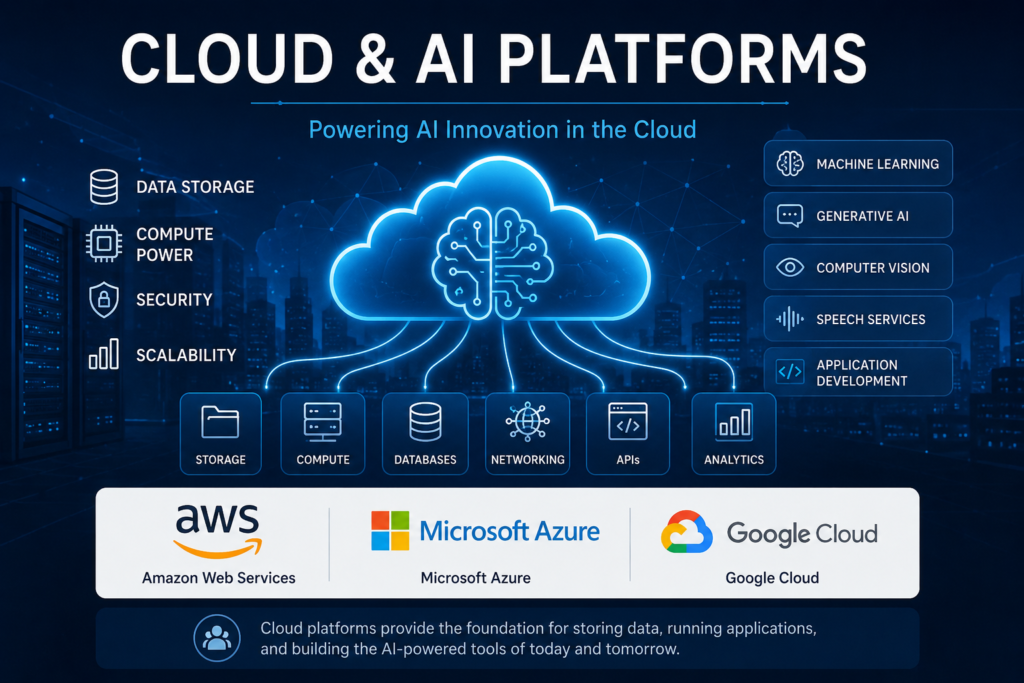
Cloud computing provides much of the infrastructure behind today’s artificial intelligence systems. From storing data and running applications to training AI models and deploying AI-powered services, cloud platforms make advanced computing resources available without requiring organizations to build and maintain everything themselves. Learning about Cloud & AI Platforms doesn’t mean you need to become a cloud engineer. A basic knowledge of how these systems work can help professionals use AI tools more effectively, communicate with technical teams, evaluate technology options, and prepare for increasingly cloud-based workplaces.
Table of Contents
- What Is Cloud Computing?
- What Are AI Platforms?
- Why Cloud Skills Matter for AI Careers
- Major Cloud and AI Platforms
- Cloud Concepts Every Professional Should Understand
- How AI Uses the Cloud
- Cloud and AI Skills to Build
- Should You Earn a Cloud or AI Certification?
- Build Cloud Skills Through Practice
- Where to Go Next
What Is Cloud Computing?
Cloud computing provides computing resources—such as storage, databases, software, networking, and processing power—over the internet. Instead of relying entirely on computers and servers located inside an organization, businesses can access resources from cloud providers as they need them. This approach allows organizations to scale resources up or down, deploy applications more quickly, work with large amounts of data, and access technologies that might otherwise require significant hardware and technical infrastructure.
For a more detailed technical definition, see NIST’s official guidance on cloud computing and its core characteristics and service models.
NIST’s official guidance on cloud computing
What Are AI Platforms?
AI platforms provide tools and services for building, using, managing, and deploying artificial intelligence. Depending on the platform, these services may include generative AI models, machine learning tools, data processing, computer vision, speech recognition, language services, automation, and AI application development. Major cloud providers increasingly combine cloud infrastructure with AI services, allowing organizations to build AI capabilities using the same environments where they store data, run applications, and manage other technology.
Why Cloud Skills Matter for AI Careers
Cloud skills are becoming increasingly relevant because many AI tools, applications, and data systems operate through cloud infrastructure. Understanding the basics can help professionals recognize how AI services are delivered, where data is stored and processed, and how organizations scale AI capabilities.
Business and Nontechnical Professionals
Managers, business leaders, marketers, healthcare professionals, educators, and other nontechnical workers generally don’t need deep cloud engineering skills. However, understanding basic cloud concepts can make it easier to evaluate AI tools, participate in technology decisions, and communicate with technical teams.
Data and Analytics Professionals
Analysts and data professionals often work with information stored in cloud databases, data warehouses, and business intelligence systems. Familiarity with cloud-based data services can help them access, analyze, and manage larger amounts of information.
Developers and Software Professionals
Developers increasingly build applications using cloud services, APIs, databases, and AI models. Cloud knowledge can help them create applications that scale, integrate AI capabilities, and operate reliably across different environments.
AI and Machine Learning Professionals
AI engineers, machine learning engineers, and data scientists may use cloud platforms to access computing resources, train and deploy models, manage datasets, monitor AI systems, and build production AI applications.
Cloud and Infrastructure Professionals
Cloud engineers, solutions architects, DevOps professionals, and related technical roles generally require the deepest understanding of cloud infrastructure, networking, security, deployment, reliability, and cost management.
Major Cloud and AI Platforms
Three major providers dominate much of the enterprise cloud market: Amazon Web Services (AWS), Microsoft Azure, and Google Cloud. Each provides broad cloud infrastructure along with services for data, machine learning, generative AI, and application development.
Amazon Web Services (AWS)
AWS provides cloud computing, storage, databases, analytics, machine learning, and generative AI services. Professionals may encounter AWS in organizations ranging from startups to large enterprises.
Microsoft Azure
Microsoft Azure provides cloud infrastructure, data services, AI capabilities, and integration with Microsoft’s broader business technology ecosystem. It is widely used by organizations that rely on Microsoft products and enterprise systems.
Google Cloud
Google Cloud provides infrastructure, data analytics, machine learning, and generative AI services. Its technologies are commonly used for data-intensive applications, AI development, and cloud-based business systems. You do not need to learn all three platforms at once. The best starting point may depend on the technologies used by your employer, the requirements of the career you’re pursuing, or the type of projects you want to build.
Cloud Concepts Every Professional Should Understand
You don’t need to understand every technical detail of cloud computing to develop useful cloud literacy. Start with the concepts that help explain how modern applications, data systems, and AI services operate
Computing
Cloud platforms provide computing power that organizations can use to run applications, process data, and perform AI workloads. Resources can often be increased or reduced depending on demand rather than requiring permanent physical hardware.
Storage
Cloud storage allows organizations to store and access files, application data, backups, and large datasets through internet-connected infrastructure. AI systems often depend on cloud storage when working with substantial amounts of information.
Databases
Cloud databases organize and manage information used by applications and analytics systems. Understanding basic database concepts can be especially valuable for analysts, developers, and professionals who work with business data.
APIs
APIs (Application Programming Interfaces) allow software systems and services to communicate with one another. Many AI capabilities can be incorporated into applications through APIs rather than requiring an organization to build an AI model from scratch.
Scalability
Cloud resources can often expand as demand increases and decrease when fewer resources are needed. This scalability can help organizations support growing applications, changing workloads, and computationally demanding AI services.
Security and Access
Cloud systems require careful management of who can access data, applications, and other resources. Identity management, permissions, encryption, privacy, and security policies are important parts of responsible cloud use.
Cost Management
Cloud services are often priced according to usage. This provides flexibility, but poorly managed resources can also create unexpected costs. Understanding the relationship between technology choices, usage, and cost is increasingly valuable for both technical teams and business leaders.
How AI Uses the Cloud
Many AI systems depend on cloud infrastructure because artificial intelligence can require substantial computing power, storage, data processing, and specialized services. Cloud platforms allow organizations to access these capabilities without building all of the underlying infrastructure themselves.
- Access AI models and services through cloud platforms and APIs.
- Store and process data used by AI applications.
- Train and test machine learning models using scalable computing resources.
- Deploy AI applications so employees or customers can access them.
- Connect AI with business systems such as databases, applications, and workflows.
- Monitor and manage AI systems after they are deployed.
For many professionals, the important skill is not knowing how to build the underlying cloud infrastructure. It is understanding how cloud services, data, applications, and AI fit together.
Cloud and AI Skills to Build
The right cloud skills depend on your career goals. Most professionals can begin with cloud literacy and gradually develop more technical skills as their work requires them
Cloud Fundamentals
Learn the basic concepts behind cloud computing, including computing, storage, databases, networking, security, scalability, and pricing. This foundation can help you understand how modern applications and AI services operate.
Working With Cloud-Based AI Tools
Become familiar with AI services delivered through cloud platforms. Depending on your role, this might involve using generative AI tools, analyzing cloud-based data, connecting AI services to workflows, or understanding how an organization deploys AI applications.
Data and Databases
Learn how information is stored, accessed, and managed in cloud environments. Data skills become increasingly important for professionals working in analytics, AI, software development, and business intelligence.
APIs and Integration
Understanding how APIs connect applications and services can help you see how AI capabilities become part of larger business systems. Developers and automation professionals may eventually learn to work with APIs directly.
Security and Responsible Use
Develop an awareness of access controls, data privacy, security, and organizational policies. Cloud and AI systems often handle valuable or sensitive information, making responsible use an important skill at every level.
Hands-On Projects
Technical learners should practice by building small projects in a cloud environment. Examples might include storing and analyzing data, deploying a simple application, connecting to an AI service through an API, or creating an automated workflow
Should You Earn a Cloud or AI Certification?
Certifications can provide a structured way to learn cloud and AI concepts, but they should support your career goals rather than become a goal by themselves. A certification can help demonstrate foundational knowledge, while hands-on projects and practical experience show that you can apply what you’ve learned.
If you’re new to cloud technology, consider starting with a foundational certification before moving into specialized AI, data, developer, or architecture credentials.
- Microsoft AI Certification Guide — explore Microsoft’s AI and Azure certification options.
- AWS AI Certification Guide — learn about AWS certifications related to AI and cloud skills.
- Google AI Certification Guide — explore Google Cloud learning and certification pathways.
Build Cloud Skills Through Practice
Cloud skills become easier to understand when you use them. Start small and focus on learning how the pieces connect rather than trying to master an entire cloud platform at once.
- Explore the interface of one major cloud platform.
- Learn how cloud storage and databases are organized.
- Experiment with a beginner-friendly AI or data service.
- Follow a guided project that creates a simple cloud resource.
- Learn how permissions and access controls protect information.
- Practice using an API if your career goals involve development or automation.
- Build a small project that combines data, cloud services, and AI.
Where to Go Next
Cloud and AI platforms connect many of the skills used in modern technology careers. Your next step should depend on whether you want to become a more informed AI user, work with data and automation, build applications, or pursue a technical cloud or AI career.
- AI Fundamentals — strengthen your understanding of the concepts behind artificial intelligence.
- Prompt Engineering — learn how to communicate more effectively with generative AI systems.
- Data Analysis — develop practical skills for working with data and AI-assisted analysis.
- Programming — build coding skills for automation, applications, data, and AI.
- Explore AI Skills — discover additional skills for an AI-powered workplace.
- Explore AI Careers — see how cloud, data, programming, and AI skills connect with different career paths.
You don’t need to master an entire cloud platform to become more AI-ready. Start with the fundamentals, choose the technologies most relevant to your goals, and build practical experience one project at a time.