Google AI Certifications: A Practical Guide for 2026
Google offers several certification and learning options for people who want to understand artificial intelligence, generative AI, cloud technology, and machine learning. But choosing among certifications, courses, learning paths, and skill badges can be confusing—especially if you are trying to decide which credential actually fits your career goals.
The right choice depends largely on what you want to do with AI. A business professional who wants to understand generative AI does not need the same training as someone preparing to design and deploy machine learning systems. Likewise, someone exploring an AI career may benefit from foundational learning before committing to an advanced technical certification.
This guide explains the major Google certification options related to AI, who they are designed for, and how they can fit into a practical AI learning or career path. It also explains the difference between Google Cloud certifications and other Google learning credentials so you can make a more informed decision about where to invest your time and money.
Google AI Certifications: What Are Your Options?
Google does not offer just one certification called a “Google AI Certification.” Instead, Google Cloud offers certifications at different levels, while Google Skills provides courses, learning paths, labs, and skill badges that can help you develop or demonstrate specific capabilities.
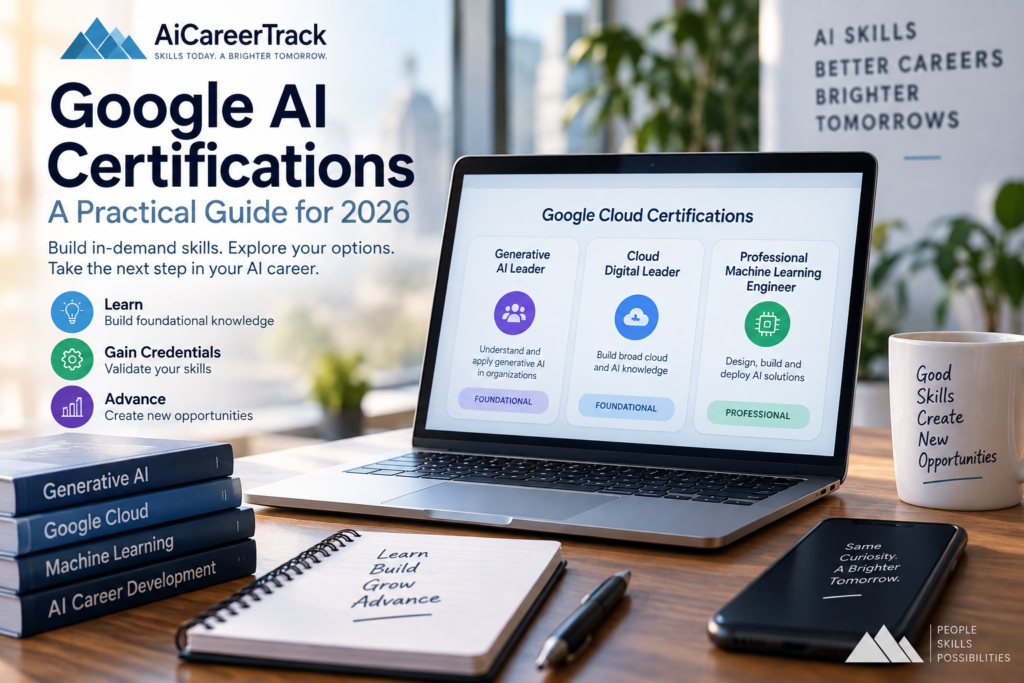
For someone primarily interested in artificial intelligence, three Google Cloud certifications are especially relevant: Generative AI Leader, Cloud Digital Leader, and Professional Machine Learning Engineer.
They serve very different audiences. Generative AI Leader focuses on understanding generative AI and how organizations can use it. Cloud Digital Leader covers broader cloud concepts, including how cloud technology supports data and AI initiatives. Professional Machine Learning Engineer is an advanced technical certification for people who design, build, productionize, and optimize AI and machine learning solutions.
This distinction matters because the most advanced certification is not automatically the best certification for you. Your starting point should reflect the kind of work you want to perform, your existing experience, and how deeply you need to understand the underlying technology.
Generative AI Leader: A Starting Point for Many Professionals
Google Cloud’s Generative AI Leader certification is designed for people who want to demonstrate an understanding of generative AI concepts and how generative AI can be used in organizations. Unlike Google’s advanced technical certifications, it does not require you to be a software developer, data scientist, or machine learning engineer.
That makes it particularly relevant for business professionals, managers, consultants, marketers, educators, project leaders, career changers, and others who increasingly encounter AI in their work.
According to Google Cloud, there are no prerequisites for the certification. The exam currently consists of 50–60 multiple-choice questions, lasts 90 minutes, costs $99 plus applicable tax, and the certification is valid for three years. Because certification details can change, always verify current requirements and pricing with Google before registering.
The certification covers more than simply knowing how to use an AI chatbot. Google’s exam guide includes foundational generative AI concepts, Google Cloud’s generative AI offerings, techniques for improving model output, and business strategies for implementing generative AI.
For many professionals who want a recognized Google credential but do not intend to become machine learning engineers, this can provide a more appropriate starting point than jumping directly into an advanced technical certification.
If you are still deciding how deeply you need to learn AI, AiCareerTrack’s Choose Your AI Learning Path guide can help you compare practical, automation, application-building, and technical learning paths.
Cloud Digital Leader: Broader Cloud and AI Foundations
Google Cloud’s Cloud Digital Leader certification takes a broader approach than Generative AI Leader. Rather than concentrating primarily on generative AI, it is designed to demonstrate an understanding of cloud technology and how Google Cloud capabilities can support an organization’s goals.
This can be useful because AI systems rarely operate in isolation. Modern AI applications often depend on cloud infrastructure, data, security, analytics, and other services. Understanding those connections can help professionals participate more effectively in conversations about how AI and cloud technologies are used within an organization.
Google positions Cloud Digital Leader as a foundational certification. Google lists no technical prerequisites for its foundational certifications, making Cloud Digital Leader accessible to people in business, management, sales, operations, project management, and other roles that work alongside technology without necessarily building the underlying systems.
The exam covers areas including digital transformation with Google Cloud, data transformation, AI, infrastructure and application modernization, trust and security, and cloud operations. Because Google periodically updates its certification exams, candidates should review the current exam guide before beginning a study plan.
Cloud Digital Leader may make sense if you want to:
- Build a broad understanding of Google Cloud rather than focus exclusively on AI.
- Understand how cloud, data, and AI technologies work together in organizations.
- Communicate more effectively with technical teams.
- Prepare for work involving cloud-based digital transformation.
- Establish foundational knowledge before pursuing more specialized technical training.
For someone primarily interested in generative AI strategy and use cases, Generative AI Leader may be more directly aligned with that goal. For someone who wants broader knowledge of the Google Cloud ecosystem, Cloud Digital Leader covers more territory.
Professional Machine Learning Engineer: The Advanced Technical Path
At the other end of the spectrum is Google’s Professional Machine Learning Engineer certification. This is substantially more technical than either Generative AI Leader or Cloud Digital Leader and should not be viewed simply as the “next certification” that everyone needs to earn.
Google describes a Professional Machine Learning Engineer as someone who builds, evaluates, productionizes, and optimizes AI solutions using Google Cloud technologies and knowledge of machine learning techniques.
The certification now encompasses both traditional machine learning and generative AI. Google’s current exam guide includes areas such as designing AI solutions, managing and scaling models, serving and scaling models, automating and orchestrating machine learning pipelines, monitoring AI solutions, and working with generative AI technologies.
Google recommends three or more years of industry experience, including at least one year designing and managing solutions using Google Cloud, before taking the exam. That recommendation provides an important reality check for career changers: this is an advanced professional certification rather than an introductory way to learn AI.
This certification is most relevant for people pursuing work such as:
- Machine learning engineering
- AI engineering
- Data science and advanced analytics
- MLOps and machine learning infrastructure
- AI solution development
- Technical cloud and AI architecture
You do not need this level of certification simply to become more effective with AI in a nontechnical career. Someone working in marketing, operations, education, management, consulting, or another business function may receive more immediate value from developing practical AI skills and understanding how to apply AI responsibly in real workflows.
If your goal is a deeply technical AI or machine learning career, however, Professional Machine Learning Engineer represents a much more advanced demonstration of Google Cloud AI knowledge than the foundational certifications.
If a technical AI path interests you, start by reviewing AiCareerTrack’s Programming and Cloud & AI Platforms guides to see the broader skills that support technical AI careers.
Other Google Credentials and Learning Options for AI
Google offers AI learning opportunities beyond its formal Google Cloud certifications. Depending on your goals, these alternatives may be more useful than preparing for a certification exam—particularly if your priority is developing a specific skill rather than earning a broad professional credential.
When evaluating Google learning options, pay attention to the type of credential being offered. The terms certification, certificate, course completion, and skill badge can sound similar, but they do not necessarily represent the same level of assessment or experience.
Google Cloud Certifications
Google Cloud certifications are exam-based credentials designed to validate knowledge or professional capabilities across specific Google Cloud domains. The certifications discussed above—Generative AI Leader, Cloud Digital Leader, and Professional Machine Learning Engineer—fall into this category.
Google currently organizes its cloud certifications across foundational, associate, and professional levels. The appropriate level depends on the certification and the experience expected of the candidate.
Google Skills Learning Paths and Courses
Google Skills provides courses and structured learning paths covering Google Cloud technologies, generative AI, machine learning, data, security, and other subjects. These resources can be useful whether or not you ultimately pursue a certification.
A learning path can be particularly valuable when you need structure. Instead of jumping between unrelated tutorials, you can follow a sequence designed to develop knowledge progressively. For career development, however, completing a course should be viewed as one part of learning rather than proof that you can independently perform every skill covered.
Skill Badges
Google also offers skill badges that can demonstrate completion of hands-on learning and assessments in more focused areas. These may cover specific Google Cloud technologies or tasks rather than the broad body of knowledge associated with a certification exam.
Skill badges can be useful for documenting focused learning, but they should not be described as equivalent to a Google Cloud professional certification. When listing any credential on a résumé or professional profile, use its official name so employers can understand exactly what you completed.
Which Google AI Certification Should You Choose?
Rather than choosing the certification with the most advanced title, start with the kind of work you want to perform. A simple way to compare the major options is:
- Consider Generative AI Leader if you want to understand generative AI, its business applications, Google Cloud’s generative AI offerings, and how organizations can adopt the technology.
- Consider Cloud Digital Leader if you want broader knowledge of cloud computing, data, AI, security, and digital transformation within the Google Cloud ecosystem.
- Consider Professional Machine Learning Engineer if you already have substantial technical experience and want to design, build, deploy, monitor, and improve AI and machine learning solutions on Google Cloud.
- Consider courses, learning paths, or skill badges first if you are still exploring AI, need to develop specific skills, or are not yet ready to invest in a certification exam.
You may also decide that you do not need a Google certification at all. Certifications can provide structure and a way to document knowledge, but they should support a larger learning or career goal rather than become the goal by themselves.
If you are changing careers, first identify the skills required for the type of work you want to pursue. Then decide whether a Google credential helps you develop or demonstrate those skills. This approach can prevent you from accumulating credentials without developing enough practical experience to use what you have learned.
How Much Do Google AI Certifications Cost?
Certification costs vary depending on the credential. Google’s foundational exams generally cost less than its professional-level certification exams, and prices can change over time.
Before registering, check Google’s official certification page for the current exam price, testing requirements, retake policies, and renewal requirements. Also consider the total cost of preparation. Although some learning resources may be available at no cost, other courses, labs, practice environments, or training subscriptions may involve additional fees.
Cost should not be the only factor in deciding whether to pursue a certification. Consider whether the credential supports a specific career or learning objective and whether you are prepared to use the knowledge in practical projects or workplace situations.
How to Prepare for a Google AI Certification
The amount of preparation you need will depend on both the certification and your existing experience. Someone who already works with Google Cloud may approach an exam very differently from someone encountering cloud and AI concepts for the first time.
A practical preparation process can include the following steps:
- Read the official exam guide. Start with Google’s current exam objectives rather than relying solely on third-party study materials.
- Identify your knowledge gaps. Separate topics you already understand from those that require additional study or practice.
- Use Google’s recommended learning resources. Relevant courses, learning paths, documentation, and hands-on labs can help you prepare for the subjects covered by the exam.
- Practice using the technology when appropriate. For technical certifications especially, practical experience is more valuable than simply memorizing terminology.
- Review unfamiliar concepts. Return to areas where practice questions, labs, or projects reveal weaknesses.
- Check the exam requirements again before registering. Verify the current price, format, policies, and testing requirements directly with Google.
Avoid treating exam preparation as a memorization exercise. The long-term value comes from understanding concepts well enough to apply them after the exam is over.
Are Google AI Certifications Worth It for Your Career?
A Google certification can be useful when it aligns with the skills required for the work you want to do. It can provide a structured learning goal, document knowledge of Google Cloud technologies, and give you a credential that can be included on a résumé or professional profile.
But certification alone does not guarantee a job, promotion, or career change. Employers may also consider relevant experience, practical skills, projects, communication abilities, industry knowledge, and your ability to solve real problems.
This is especially important for people entering AI from another field. Your existing professional experience may remain valuable. A marketer who learns generative AI, for example, can combine AI skills with knowledge of customers and campaigns. A healthcare professional can combine AI literacy with domain knowledge. An engineer can combine AI capabilities with an understanding of physical systems and manufacturing.
Instead of asking only, “Which certification should I earn?”, consider asking, “What combination of AI knowledge, practical experience, and existing expertise would make me more capable in the work I want to do?”
A certification can then become one component of that larger development plan.
Build Skills Alongside Credentials
If you decide to pursue a Google AI certification, try to build practical skills at the same time. Use what you learn in small projects, experiments, workplace tasks, or portfolio examples where appropriate.
For example, a professional studying generative AI might practice improving prompts, evaluating AI-generated information, building repeatable AI-assisted workflows, and learning when human review is necessary. Someone pursuing a technical cloud or machine learning path may need substantially more hands-on work with programming, data, models, cloud services, deployment, and monitoring.
Credentials can help demonstrate learning. Practical experience helps demonstrate what you can do.
Continue Your AI Learning
There is no single Google AI certification that is right for everyone. The best starting point depends on your current knowledge, the work you want to perform, and how technical you want your AI skills to become.
If you are beginning with generative AI and its organizational applications, Generative AI Leader may provide an accessible certification path. If you want broader knowledge of cloud technology and digital transformation, Cloud Digital Leader may be more appropriate. If you already have substantial technical experience and intend to build and manage production AI systems, Professional Machine Learning Engineer represents a much more advanced path.
You can also begin with courses, learning paths, and practical projects before deciding whether certification is necessary. Learning first and choosing the credential later can be a sensible approach when you are still exploring where AI fits into your career.
To continue building your foundation, explore AiCareerTrack’s AI Skills resources for practical guides covering AI fundamentals, prompt engineering, data analysis, programming, cloud and AI platforms, and professional skills.
Sources and Further Reading
Last reviewed: September 2026
- Google Cloud Certifications — Official Google Cloud certification catalog and certification levels.
- Google Cloud Generative AI Leader Certification — Official exam information, requirements, and preparation resources.
- Google Cloud Digital Leader Certification — Official exam information, content areas, and preparation resources.
- Google Cloud Professional Machine Learning Engineer Certification — Official exam information, recommended experience, and preparation resources.
- Google Cloud Credentials: Certificates, Skill Badges and Certifications — Official explanation of Google’s different credential types.
- Google Skills Learning Paths — Google’s learning paths, courses, skill development, and certification preparation resources.
Google itself distinguishes these categories: certificates are structured learning credentials, skill badges demonstrate focused practical/technical skills, and Google Cloud certifications involve passing a proctored certification exam. That supports the distinction we made in the article.