Healthcare
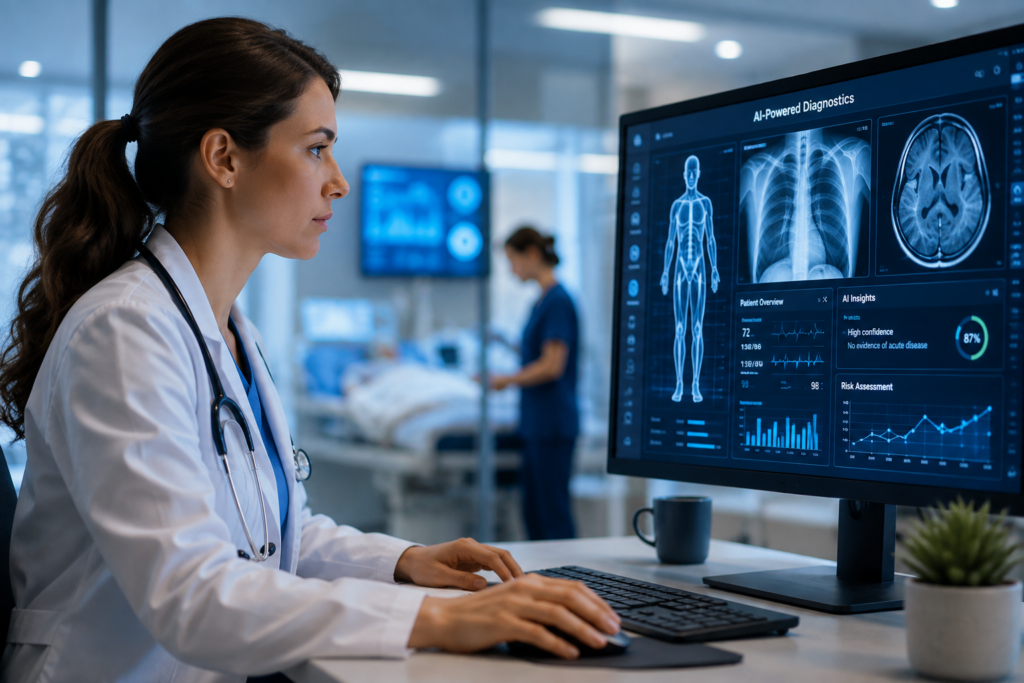
Artificial intelligence is changing how healthcare organizations diagnose disease, analyze medical information, manage operations, develop treatments, support patients, and conduct research. AI is increasingly being used alongside clinicians, researchers, administrators, and other healthcare professionals.
For healthcare workers, AI may create opportunities to combine clinical knowledge, scientific expertise, data skills, technology, and human-centered care. Many professionals will not need to become AI developers, but understanding how AI systems work—and where their limitations lie—may become increasingly valuable.
Healthcare decisions can directly affect people’s lives, making accuracy, privacy, safety, fairness, and human oversight especially important. AI can support healthcare professionals, but responsible use requires careful evaluation and appropriate clinical or professional judgment.
Table of Contents
- How AI Is Changing Healthcare
- Where AI Is Being Used in Healthcare
- AI Careers and Emerging Roles in Healthcare
- AI Skills for Healthcare Professionals
- Education and Certifications for AI in Healthcare
- Opportunities for Healthcare Professionals
- Challenges and Responsible AI Use in Healthcare
- How to Prepare for an AI-Enabled Healthcare Career
- Explore Related AI Careers and Skills
How AI Is Changing Healthcare
AI is becoming part of healthcare in ways that range from clinical decision support and medical imaging to administrative automation and drug discovery. Rather than affecting only physicians or technical specialists, these changes can influence careers throughout hospitals, clinics, laboratories, pharmaceutical companies, insurance organizations, public health, and health technology.
Where AI Is Being Used in Healthcare
AI is being applied across clinical care, medical research, healthcare administration, pharmaceuticals, insurance, and patient services. Some applications help healthcare professionals interpret complex information, while others automate routine processes or help identify patterns in large amounts of health data.
Medical Imaging and Diagnostics
AI can help analyze X-rays, CT scans, MRIs, pathology images, and other medical information. These systems may help clinicians identify patterns or abnormalities, but trained healthcare professionals remain responsible for interpreting results within the broader clinical context.
Clinical Decision Support
AI systems can assist healthcare professionals by organizing patient information, identifying potential risks, and providing information that may support diagnosis or treatment decisions. These tools are intended to support—not replace—appropriate professional judgment.
Patient Monitoring and Predictive Analytics
Hospitals and healthcare organizations can use AI to analyze patient data and identify changes that may require attention. Predictive systems may help clinicians recognize risks earlier, prioritize care, or monitor patients with chronic conditions.
Medical Documentation and Administrative Work
Generative AI and automation can assist with clinical notes, scheduling, coding, billing, communications, and other administrative tasks. Reducing repetitive work may allow healthcare professionals to devote more time to patients and complex responsibilities.
Drug Discovery and Medical Research
Researchers and pharmaceutical companies use AI to analyze biological information, identify possible drug candidates, explore relationships in large datasets, and accelerate portions of the research process. Scientific testing and human expertise remain essential before discoveries can become safe and effective treatments.
Personalized and Precision Medicine
AI can help researchers and clinicians analyze combinations of medical history, laboratory results, genetics, and other information. The long-term goal of precision medicine is to better tailor prevention and treatment approaches to individual patients.
Virtual Care and Patient Support
AI-powered assistants may help patients navigate healthcare information, prepare for appointments, receive reminders, or find appropriate services. Healthcare organizations need to ensure that patients understand the limitations of automated systems and know when professional medical care is necessary.
Healthcare Operations
Hospitals and health systems can use AI for staffing, scheduling, supply management, capacity planning, workflow optimization, and other operational activities. These applications can create opportunities for professionals who understand both healthcare operations and data-driven technology.
AI Careers and Emerging Roles in Healthcare
As healthcare organizations adopt artificial intelligence, career opportunities are developing for people who can combine healthcare knowledge with data, technology, research, operations, and responsible AI use. Some roles require advanced technical or clinical training, while others allow existing healthcare professionals to add AI skills to experience they already have.
Healthcare Data Analyst
Healthcare data analysts examine clinical, operational, financial, and patient-related information to identify trends and support decision-making. AI and advanced analytics can help these professionals work with increasingly large and complex healthcare datasets.
Clinical AI Specialist
Clinical AI specialists can help healthcare organizations evaluate, implement, and monitor AI tools used in clinical environments. These roles may require an understanding of healthcare workflows, patient safety, data, and the limitations of AI systems.
Health Informatics Specialist
Health informatics professionals work at the intersection of healthcare, information systems, and data. As AI becomes integrated into electronic health records and other clinical technologies, informatics specialists may play an important role in implementation, workflow design, training, and evaluation.
AI Medical Imaging Specialist
Professionals working with radiology, pathology, and other imaging fields may increasingly use AI-assisted systems to identify patterns and prioritize information for review. Opportunities can exist for both clinical professionals and technical specialists who develop or support these systems.
AI Healthcare Product Specialist
Health technology companies need professionals who understand patient, clinician, and organizational needs. Product specialists and product managers can help design and improve AI-enabled healthcare software, clinical tools, patient applications, and administrative systems.
AI Research and Drug Discovery Specialist
Researchers can use machine learning and other AI techniques to analyze biological information, investigate disease, identify potential treatments, and support pharmaceutical development. These careers may require advanced backgrounds in biology, medicine, chemistry, data science, or related disciplines.
Healthcare AI Governance and Compliance Specialist
Healthcare organizations need professionals who can help evaluate privacy, safety, fairness, regulatory requirements, documentation, and appropriate oversight of AI systems. Existing experience in healthcare compliance, quality, risk management, or privacy can provide a useful foundation.
AI Education and Training for Healthcare
As healthcare organizations introduce AI, employees need training on how to use new systems safely and effectively. Professionals who understand both healthcare and education may help develop training programs, policies, demonstrations, and continuing professional education.
AI Skills for Healthcare Professionals
Healthcare professionals do not necessarily need advanced technical training to begin developing useful AI skills. The right combination depends on the role, but AI literacy, data skills, communication, critical thinking, and an understanding of privacy and responsible AI can provide a strong foundation.
AI Fundamentals
Understanding how artificial intelligence works at a practical level can help healthcare professionals evaluate when AI may be useful and recognize when its limitations require additional human review.
Data Analysis
Healthcare generates enormous amounts of clinical, operational, research, and financial data. Professionals who can analyze and interpret information may be better prepared to work with AI-enabled healthcare systems.
Prompt Engineering
Generative AI can assist with research, summaries, communications, training materials, and other appropriate tasks. Clear prompting can improve results, but healthcare professionals should never assume that AI-generated information is medically accurate without appropriate verification.
Make Prompt Engineering an internal link to our completed guide.
Programming
Programming can be particularly valuable for professionals pursuing healthcare analytics, informatics, research, AI development, or other technical roles. Python and SQL are commonly useful for working with data and analytical systems.
Cloud & AI Platforms
Healthcare organizations increasingly use cloud technologies for data storage, analytics, applications, and AI services. Knowledge of cloud and AI platforms can be valuable for health informatics, technology, data, and implementation roles.
Communication & Leadership
Successful AI adoption requires healthcare professionals who can explain technology clearly, listen to concerns, coordinate across clinical and technical teams, and help organizations manage change responsibly.
Clinical and Professional Judgment
AI output should be interpreted within the appropriate healthcare context. Domain expertise helps professionals recognize when a recommendation is incomplete, inappropriate, inconsistent with other information, or requires additional investigation.
Privacy, Security, and Responsible AI
Healthcare information can be highly sensitive. Professionals working with AI should understand organizational policies, privacy and security requirements, appropriate data handling, bias, patient safety, and the need for meaningful human oversight.
Education and Certifications for AI in Healthcare
There is no single educational path into an AI-enabled healthcare career. The appropriate preparation depends heavily on the role. Clinical positions may require professional degrees, licenses, or specialized healthcare training, while technical positions may emphasize data science, computer science, engineering, statistics, or health informatics.
Education
Healthcare professionals who already have clinical, administrative, research, or operational experience may not need another degree simply to begin using AI effectively. Targeted training in AI fundamentals, data analysis, informatics, or digital health may complement expertise they already possess.
More technical careers in healthcare AI may require stronger preparation in programming, mathematics, statistics, machine learning, computer science, or biomedical data. Professionals should evaluate the requirements of the specific roles they are considering before committing to additional education.
Certifications
Certifications can help professionals develop specialized skills, but there is no universal “AI healthcare certification” required across the industry. Useful credentials may involve health informatics, data analytics, cloud technologies, cybersecurity, privacy, project management, or artificial intelligence, depending on the career path.
When evaluating a certification or training program, consider:
- Whether employers in your target role recognize or value it.
- Whether the curriculum reflects current healthcare and AI practices.
- Whether the program includes practical, hands-on work.
- Whether privacy, security, ethics, and responsible AI are addressed.
- Whether the skills complement your existing healthcare experience.
- The total cost and time commitment.
- Whether professional licensing or continuing-education requirements also apply to your occupation.
What Matters More Than a Certificate?
A credential can demonstrate that you completed training, but healthcare employers also need evidence that you can apply new skills responsibly in realistic situations.
Useful projects or work samples might demonstrate your ability to:
- Analyze a healthcare-related dataset using appropriately de-identified or public data.
- Evaluate an AI tool for a specific healthcare workflow.
- Create a dashboard that communicates healthcare information clearly.
- Develop an AI training program for healthcare employees.
- Identify potential privacy, safety, bias, or workflow concerns with an AI application.
- Improve an administrative process using automation.
- Explain an AI system or analytical result to a nontechnical healthcare audience.
- Document the limitations and appropriate human oversight of an AI-assisted process.
Career Tip: Build on the healthcare expertise you already have. A professional who understands healthcare workflows, patient needs, safety, and regulation—and can also work effectively with AI—may offer a combination of skills that purely technical training cannot provide.
Opportunities for Healthcare Professionals
AI does not necessarily mean healthcare professionals need to leave their current careers. In many cases, clinical knowledge, patient-care experience, operational expertise, or understanding of healthcare regulations can become even more valuable when combined with practical AI skills.
Enhance Your Current Role
Healthcare professionals can learn how AI may support appropriate parts of their existing work, such as research, documentation, data analysis, communications, education, scheduling, or administrative processes. The goal should be to use technology where it adds value while maintaining professional standards and human oversight.
Become an AI Resource for Your Team
Professionals who develop practical AI knowledge can help colleagues understand new tools, identify appropriate uses, recognize limitations, and follow organizational policies. This can create leadership opportunities even without moving into a formal technical position.
Move Into Health Informatics
Healthcare professionals who enjoy working with technology, data, and systems may consider health informatics. Experience with clinical workflows can be especially valuable when organizations implement electronic health records, analytics platforms, decision-support systems, and AI applications.
Develop Healthcare Data and Analytics Skills
Professionals with healthcare experience can add skills in data analysis, visualization, statistics, databases, or programming. Understanding what healthcare data actually represents can provide important context when interpreting analytical results.
Explore Health Technology Companies
Health technology companies need people who understand healthcare users and workflows as well as technology. Opportunities may exist in product management, implementation, customer success, training, clinical strategy, analytics, quality, and other areas.
Specialize in AI Governance, Quality, or Compliance
Professionals with backgrounds in healthcare compliance, privacy, patient safety, quality improvement, audit, or risk management may be able to extend their expertise into AI governance. Organizations need people who can help evaluate whether AI systems are being used safely, appropriately, and responsibly.
Apply AI to Healthcare Education and Training
Nurses, physicians, educators, trainers, and other healthcare professionals can help colleagues learn how to use AI tools effectively. Opportunities may include staff training, continuing education, simulation, instructional design, and development of responsible-AI guidance.
Build AI Skills Before They Become Required
Healthcare professionals do not have to wait until AI becomes mandatory in their workplace. Learning the fundamentals and experimenting with appropriate, non-sensitive applications can provide useful experience while the technology continues to evolve.
Challenges and Responsible AI Use in Healthcare
AI can provide valuable support in healthcare, but errors or inappropriate use can directly affect patients and healthcare organizations. Responsible adoption requires careful attention to safety, accuracy, privacy, security, fairness, regulation, transparency, and meaningful human oversight.
Patient Safety
Healthcare AI should be evaluated with patient safety as a primary consideration. An AI system that performs well in one environment or population may not perform equally well in another, so organizations need appropriate testing, monitoring, and professional oversight.
Accuracy and AI-Generated Information
Generative AI can produce incorrect, incomplete, outdated, or fabricated information. Healthcare professionals should verify important AI-generated claims against reliable sources and established clinical or professional guidance.
Patient Privacy and Confidentiality
Healthcare professionals routinely work with sensitive information. Patient information should not be entered into AI systems unless the technology and its use have been approved by the organization and comply with applicable privacy, security, and professional requirements.
Bias and Fairness
AI systems can reflect biases in their training data, design, or implementation. If certain patient populations are poorly represented in the underlying data, an AI system may perform differently across groups. Healthcare organizations need to evaluate these risks carefully.
Cybersecurity
Connected healthcare systems can contain valuable and sensitive information. As organizations introduce AI, they also need to consider cybersecurity risks involving patient data, medical systems, AI applications, and the technologies connecting them.
Transparency and Explainability
Healthcare professionals may need to understand why an AI system produced a recommendation, particularly when that recommendation could influence patient care. Systems that cannot be adequately evaluated or explained can create challenges for clinical trust and accountability.
Regulation and Compliance
Healthcare AI can be subject to different regulatory requirements depending on how a technology is designed and used. Organizations need qualified professionals who can determine which healthcare, privacy, medical-device, and other requirements apply to a particular system.
Professionals working with AI in Healthcare can also review resources from the U.S. Food and Drug Administration to better understand the evolving regulatory landscape for artificial intelligence-enabled medical devices.
Human Oversight and Accountability
AI can support healthcare professionals, but responsibility for important decisions cannot simply be transferred to an algorithm. Organizations need clear policies defining when human review is required and who remains accountable for consequential decisions.
How to Prepare for an AI-Enabled Healthcare Career
You do not need to become an AI engineer to begin preparing for changes in healthcare. A practical approach is to build on the healthcare, scientific, administrative, or technical knowledge you already have while developing AI skills relevant to the work you want to pursue.
- Build AI literacy. Learn the fundamentals of generative AI, machine learning, automation, and common healthcare applications.
- Strengthen your healthcare expertise. Continue developing the clinical, administrative, scientific, operational, or regulatory knowledge relevant to your career.
- Develop data skills. Learn how healthcare information is collected, analyzed, interpreted, and communicated.
- Experiment responsibly. Practice with AI using appropriate public, synthetic, or non-sensitive information rather than confidential patient data.
- Understand the risks. Learn about privacy, security, bias, hallucinations, patient safety, regulation, and human oversight.
- Create practical projects. Develop examples showing how AI or data tools might improve a healthcare workflow, training program, analysis, or administrative process.
- Strengthen human skills. Communication, empathy, critical thinking, teamwork, and professional judgment remain particularly important in healthcare.
- Choose a direction. Decide whether you want to strengthen your existing healthcare role or move toward informatics, analytics, health technology, research, AI governance, or another specialization.
Explore Related AI Careers and Skills
AI opportunities in healthcare connect with careers and skills across AiCareerTrack. Continue exploring the areas that best match your healthcare experience, technical interests, and career goals.
- AI Fundamentals — build a practical understanding of artificial intelligence and how it is being used in the workplace.
- Data Analysis — develop skills for analyzing information, identifying patterns, and communicating useful insights.
- Prompt Engineering — learn techniques for working more effectively with generative AI systems.
- Programming — develop technical skills that can support healthcare analytics, informatics, research, automation, and AI development.
- Cloud & AI Platforms — learn how cloud technologies support healthcare data, applications, analytics, and artificial intelligence.
- Communication & Leadership — strengthen the human skills needed to explain technology, work across clinical and technical teams, and guide organizational change.
- Explore AI Careers — discover additional career paths being created or transformed by artificial intelligence.
Make all seven destination names clickable to their existing completed pages.
AI is likely to continue changing how healthcare is delivered, researched, managed, and supported. Professionals who combine healthcare expertise with practical AI skills, responsible judgment, and strong human-centered capabilities can help shape how these technologies are used.