Engineering & Manufacturing
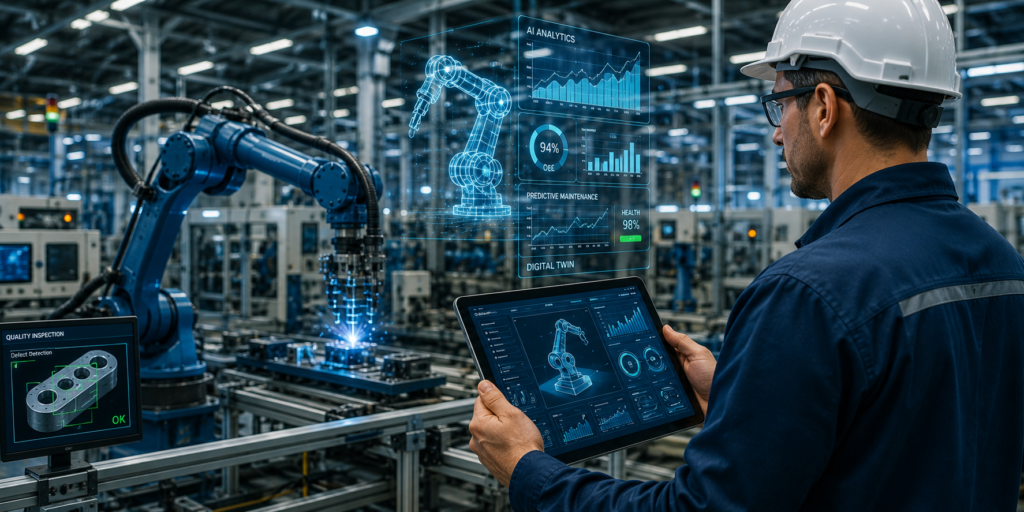
AI in Engineering and Manufacturing is changing how products are designed, engineered, manufactured, inspected, maintained, and improved. AI is increasingly being used alongside robotics, automation, simulation, sensors, computer vision, and advanced data analytics throughout engineering and manufacturing.
For engineers and manufacturing professionals, AI creates opportunities to combine technical and industry expertise with new capabilities in data analysis, automation, predictive systems, intelligent design, and process improvement. Mechanical, electrical, industrial, manufacturing, quality, maintenance, and other professionals may increasingly work with AI even when developing AI itself is not their primary job.
AI can automate portions of technical work, but engineering and manufacturing still require people who understand physical systems, safety, materials, production constraints, quality, cost, and real-world operating conditions. Professionals who combine that expertise with practical AI skills may be especially valuable as organizations modernize their operations.
Table of Contents
- How AI Is Changing Engineering and Manufacturing
- Where AI Is Being Used in Engineering and Manufacturing
- AI Careers and Emerging Roles in Engineering and Manufacturing
- AI Skills for Engineering and Manufacturing Professionals
- Education and Certifications for AI Engineering Careers
- Opportunities for Engineering and Manufacturing Professionals
- Challenges and Responsible AI Use in Engineering and Manufacturing
- How to Prepare for an AI-Enabled Engineering or Manufacturing Career
- Explore Related AI Careers and Skills
How AI in Engineering and Manufacturing Is Changing the Industry
AI is becoming part of the digital tools engineers and manufacturers use to design products, operate equipment, improve production, monitor quality, and solve technical problems. Rather than functioning as a separate technology, AI is increasingly being integrated with computer-aided design, robotics, industrial automation, sensors, simulation, and manufacturing data.
Where AI Is Being Used in Engineering and Manufacturing
AI is being applied across product development, factories, industrial equipment, quality control, maintenance, supply chains, and engineering operations. Some applications help professionals analyze complex information and improve decisions, while others combine AI with robotics, sensors, computer vision, and automation to improve physical processes.
Product Design and Engineering
AI can help engineers explore design alternatives, analyze requirements, optimize components, and evaluate possible solutions. Generative design and AI-assisted engineering tools can accelerate portions of the design process, while engineers remain responsible for determining whether a design is safe, practical, manufacturable, and appropriate for its intended use.
Predictive Maintenance
Manufacturers can use data from sensors and equipment to identify patterns that may indicate wear, deterioration, or potential failure. Predictive maintenance can help organizations schedule service before equipment breaks down, reduce unexpected downtime, and use maintenance resources more effectively.
Robotics and Industrial Automation
AI can expand what industrial robots and automated systems are able to do. Machine vision, intelligent controls, and adaptive systems can help robots perform tasks involving assembly, material handling, inspection, packaging, and other production activities.
Computer Vision and Quality Inspection
Computer vision systems can analyze images or video to identify defects, measure components, verify assembly, and monitor production. These systems can inspect large numbers of products quickly, while quality professionals remain important for establishing standards, investigating problems, and determining corrective actions.
Digital Twins and Simulation
Digital twins are virtual representations of physical products, equipment, or processes. Engineers can combine simulation, sensor data, and AI to explore how systems may behave, evaluate possible changes, and identify problems before making costly modifications to physical equipment.
Process Optimization
AI can analyze production data to help identify bottlenecks, reduce waste, improve throughput, optimize energy use, and make manufacturing processes more efficient. Industrial and manufacturing professionals provide the operational knowledge needed to determine whether proposed improvements are realistic.
Supply Chain and Production Planning
Manufacturers can use AI to assist with demand forecasting, inventory management, production scheduling, logistics, and supplier analysis. Unexpected events can still disrupt even sophisticated forecasts, making experienced human judgment important.
Workplace Safety and Equipment Monitoring
AI-enabled sensors, cameras, and analytical systems can help identify hazardous conditions, equipment abnormalities, or patterns associated with workplace incidents. These technologies should support—not replace—strong engineering controls, safety procedures, training, and professional oversight.
AI Careers and Emerging Roles in Engineering and Manufacturing
As engineering and manufacturing organizations adopt artificial intelligence, career opportunities are developing for professionals who can combine engineering knowledge, industrial experience, data, automation, and AI. Some roles focus directly on developing intelligent systems, while others apply AI to equipment, production, quality, maintenance, and engineering processes.
AI and Machine Learning Engineer
AI and Machine Learning Engineers develop models and applications that can analyze industrial data, identify patterns, make predictions, or support automated systems. In engineering environments, their work may involve equipment data, manufacturing processes, computer vision, robotics, or predictive maintenance.
Robotics Engineer
Robotics Engineers design, develop, integrate, and improve robotic systems used in manufacturing and other physical environments. AI can expand the capabilities of robots by helping them interpret sensor information, recognize objects, adapt to changing conditions, and perform increasingly complex tasks.
Automation and Controls Engineer
Automation and Controls Engineers develop and maintain systems that control machinery and industrial processes. As AI becomes integrated with traditional automation, these professionals may work with intelligent monitoring, adaptive controls, robotics, sensors, and data-driven optimization.
Manufacturing Data Analyst
Manufacturing Data Analysts examine production, quality, equipment, maintenance, and operational information to identify trends and opportunities for improvement. Knowledge of manufacturing processes can be especially valuable when determining what the data actually means.
Computer Vision Engineer
Computer Vision Engineers develop systems that interpret images and video. Manufacturing applications can include defect detection, measurement, assembly verification, equipment monitoring, robotic vision, and workplace-safety applications.
Predictive Maintenance Specialist
Predictive Maintenance Specialists use equipment data, sensors, analytics, and increasingly AI to identify patterns that may indicate developing problems. These roles can combine mechanical or electrical knowledge with reliability engineering, data analysis, and industrial technology.
Digital Twin and Simulation Specialist
These professionals develop and use virtual models of products, equipment, factories, or industrial processes. AI can enhance digital twins by analyzing real-world data, identifying patterns, and helping engineers evaluate possible changes or future conditions.
Smart Manufacturing Specialist
Smart Manufacturing Specialists help integrate automation, connected equipment, sensors, data platforms, robotics, and AI across production environments. These roles often require an understanding of both operational technology and modern digital systems.
AI Engineering Consultant
AI Engineering Consultants can help organizations identify useful applications for AI, evaluate technology, redesign workflows, and integrate intelligent systems with existing engineering and manufacturing operations. Strong technical knowledge and communication skills are both valuable in this type of work.
AI Skills for Engineering and Manufacturing Professionals
Engineering and manufacturing professionals do not necessarily need to become AI developers to benefit from artificial intelligence. The most useful combination of skills depends on the role, but engineering knowledge paired with AI literacy, data analysis, programming, automation, and strong problem-solving can provide a valuable foundation.
AI Fundamentals
Understanding how artificial intelligence, machine learning, generative AI, and automation work at a practical level can help engineering professionals identify useful applications and recognize where AI-generated results require additional verification.
Data Analysis
Modern engineering and manufacturing systems generate large amounts of information from sensors, equipment, production processes, quality systems, and maintenance activities. Professionals who can analyze and interpret this data can use AI tools more effectively and make better-informed decisions.
Programming
Programming can be particularly valuable for engineers working with automation, robotics, simulation, data analysis, machine learning, or connected industrial systems. Python is widely useful for data and AI applications, while other languages may be important depending on the equipment and systems involved.
Prompt Engineering
Generative AI can assist engineers with research, technical explanations, documentation, brainstorming, coding, troubleshooting, and exploring design alternatives. Clear instructions and relevant context can improve results, but technical output should still be independently evaluated.
Cloud & AI Platforms
Cloud platforms can support industrial data storage, analytics, machine learning, digital twins, connected equipment, and AI applications. Familiarity with cloud and AI platforms can be useful for engineers involved in modern manufacturing and industrial technology.
Communication & Leadership
Engineering and manufacturing projects often involve people from design, production, maintenance, quality, operations, management, and technology. Professionals who can explain AI clearly and coordinate across these groups can help organizations introduce new technology more effectively.
Robotics, Automation, and Industrial Systems
Professionals working in advanced manufacturing may benefit from understanding robotics, programmable control systems, sensors, industrial networks, machine vision, and automation. AI increasingly complements these technologies rather than replacing the need to understand them.
Engineering Judgment and Problem-Solving
AI can suggest designs, identify patterns, or recommend actions, but engineers still need to evaluate whether results make sense in the physical world. Safety, materials, tolerances, operating conditions, cost, reliability, and manufacturability require engineering judgment that cannot simply be delegated to an AI system.
Education and Certifications for AI Engineering Careers
There is no single educational path into an AI-enabled engineering or manufacturing career. The appropriate preparation depends on the role. Some positions require formal engineering education and professional credentials, while others emphasize manufacturing experience, automation, data analysis, programming, robotics, or industrial technology.
Education
Degrees in mechanical, electrical, industrial, manufacturing, computer, systems, or other engineering disciplines can provide strong foundations for many AI-enabled engineering careers. Technical programs in robotics, automation, mechatronics, manufacturing technology, computer science, data science, or related fields can also lead to relevant opportunities.
Professionals who already have engineering or manufacturing experience may not need another degree simply to begin working with AI. Targeted education in data analysis, programming, machine learning, automation, robotics, or cloud technology may complement expertise they already possess.
Certifications
Certifications can be useful when they demonstrate skills relevant to a particular engineering or manufacturing role. Depending on the career path, useful credentials may involve automation, robotics, industrial technology, cloud platforms, data analytics, cybersecurity, project management, quality, or artificial intelligence.
When evaluating a certification, consider:
- Whether employers in your target field recognize it.
- Whether it supports the equipment, software, or technology used in your industry.
- Whether the training includes practical hands-on work.
- Whether the skills complement your existing engineering or manufacturing experience.
- Whether the technology is widely used or highly specialized.
- The total time and financial commitment.
- Whether professional licensing or continuing-education requirements apply to your occupation.
What Matters More Than a Certificate?
Credentials can demonstrate training, but engineering and manufacturing employers also need evidence that professionals can solve practical problems and apply technology safely and effectively.
Useful projects or work samples might demonstrate your ability to:
- Analyze production or equipment data.
- Develop a predictive-maintenance example using public or simulated data.
- Create a computer-vision demonstration for quality inspection.
- Automate a repetitive engineering or manufacturing task.
- Develop a simple robotics or control-system project.
- Create a digital model or simulation of a physical process.
- Use AI to assist with an engineering workflow while independently validating the results.
- Identify opportunities to reduce waste, downtime, or process variability.
- Document technical assumptions, limitations, safety considerations, and results.
- Explain a technical project clearly to both technical and nontechnical audiences.
Career Tip: Build on the engineering or manufacturing knowledge you already have. AI skills become especially valuable when combined with an understanding of how physical products, equipment, and production processes actually work.
Opportunities for Engineering and Manufacturing Professionals
AI does not necessarily mean engineering and manufacturing professionals need to leave their current careers. For many people, the strongest opportunity may be to combine years of technical, operational, or production experience with new capabilities in AI, data, automation, and intelligent systems.
Enhance Your Current Engineering Role
Engineers can use AI to assist with research, technical documentation, data analysis, coding, troubleshooting, design exploration, simulation, and other appropriate tasks. Professionals who understand both engineering fundamentals and AI limitations can determine where these tools genuinely improve their work.
Become the AI Resource on Your Team
Engineers and manufacturing professionals who develop practical AI knowledge can help colleagues evaluate tools, identify useful applications, develop workflows, and recognize technical or operational risks. This can create leadership opportunities without requiring a move into a dedicated AI position.
Move Into Robotics and Automation
Professionals with experience in mechanical systems, electrical systems, controls, maintenance, or manufacturing can build skills in robotics, sensors, machine vision, programming, and AI. Existing knowledge of physical equipment can provide an important advantage when working with intelligent automation.
Develop Manufacturing Data and Analytics Skills
Manufacturing professionals can strengthen their careers by learning how to analyze production, quality, maintenance, and equipment data. Domain expertise helps professionals recognize which patterns matter and whether an analytical result makes sense within actual operations.
Specialize in Predictive Maintenance and Reliability
Maintenance technicians, reliability engineers, and equipment specialists can combine knowledge of machinery with sensors, condition monitoring, data analysis, and AI. These skills can help organizations identify developing problems and improve equipment reliability.
Explore Smart Manufacturing
Smart factories integrate connected equipment, automation, robotics, industrial data, cloud technologies, and AI. Professionals who understand how these systems interact may find opportunities in implementation, integration, operations, engineering, and technology leadership.
Apply AI to Quality and Process Improvement
Quality engineers, industrial engineers, and continuous-improvement professionals can use AI and advanced analytics to investigate defects, identify process variation, analyze production information, and explore opportunities for greater efficiency.
Help Bridge Engineering and Technology Teams
Manufacturing AI projects often require cooperation among engineers, operators, IT professionals, data specialists, vendors, and management. Professionals who understand both physical operations and digital technology can help translate requirements and coordinate implementation.
Challenges and Responsible AI Use in Engineering and Manufacturing
AI can improve engineering and manufacturing processes, but errors in physical systems can have serious consequences. Organizations need to consider safety, reliability, cybersecurity, data quality, system limitations, and human accountability when AI influences equipment, products, or production decisions.
Safety
AI-enabled systems should be evaluated within established engineering and workplace-safety practices. An automated recommendation should not override appropriate safety procedures, engineering controls, equipment limits, or professional judgment.
Reliability and System Failure
AI systems can produce incorrect predictions or behave differently when operating conditions change. Engineering organizations need appropriate testing, monitoring, maintenance, fallback procedures, and methods for responding when an AI-enabled system does not perform as expected.
AI-Generated Engineering Information
Generative AI can produce calculations, specifications, code, technical explanations, or design suggestions that appear convincing but contain errors. Engineers should independently verify important technical information before using it in designs, equipment, or production processes.
Cybersecurity and Connected Equipment
Modern manufacturing environments increasingly connect industrial equipment, sensors, robots, computers, and cloud systems. These connections can improve operations but can also create cybersecurity risks. Organizations need to protect both traditional information technology and operational technology.
Data Quality
AI systems depend on the information used to develop and operate them. Inaccurate sensor readings, incomplete maintenance records, inconsistent production data, or poorly labeled information can lead to unreliable conclusions.
Workforce and Automation
AI and automation may change the tasks performed by engineers, technicians, operators, inspectors, and other manufacturing employees. Organizations can benefit from helping workers develop new skills and understand how their responsibilities may evolve alongside increasingly automated systems.
Intellectual Property and Confidential Information
Engineering organizations often work with proprietary designs, processes, specifications, software, and customer information. Professionals should understand organizational policies before entering confidential technical information into external AI systems.
Human Oversight and Accountability
Organizations need clear responsibility for AI-enabled engineering and manufacturing systems. Engineers and other qualified professionals should remain involved when decisions affect product safety, equipment operation, worker safety, quality, or other consequential outcomes.
Professionals exploring AI in Engineering and Manufacturing can also use resources from the National Institute of Standards and Technology to learn about advanced manufacturing technologies, cybersecurity, productivity, and manufacturing innovation.
How to Prepare for an AI-Enabled Engineering or Manufacturing Career
You do not need to master every area of artificial intelligence to prepare for changes in engineering and manufacturing. A practical approach is to build on your existing technical or operational expertise while developing the AI, data, and automation skills most relevant to your career goals.
- Strengthen your technical foundation. Continue developing the engineering, manufacturing, maintenance, quality, automation, or other domain knowledge relevant to your work.
- Build AI literacy. Learn the fundamentals of machine learning, generative AI, computer vision, automation, and common industrial AI applications.
- Develop data skills. Practice analyzing equipment, production, quality, or engineering information and communicating useful findings.
- Learn relevant automation technologies. Depending on your career, this may include robotics, sensors, industrial controls, machine vision, simulation, or connected equipment.
- Experiment with practical projects. Use public, simulated, or appropriate non-confidential data to explore predictive maintenance, quality analysis, process optimization, or other industrial applications.
- Understand safety and security. Learn how reliability, cybersecurity, data quality, and human oversight affect AI-enabled physical systems.
- Strengthen communication and teamwork. Practice explaining technical ideas and working across engineering, operations, IT, data, and management teams.
- Choose a direction. Decide whether you want to strengthen your current role or move toward robotics, automation, manufacturing analytics, predictive maintenance, computer vision, smart manufacturing, or another specialization.
Explore Related AI Careers and Skills
AI opportunities in engineering and manufacturing connect with careers and skills across AiCareerTrack. Continue exploring the areas that best match your engineering experience, technical interests, and career goals.
- Machine Learning Engineer — explore a career focused on building, deploying, and maintaining machine learning systems.
- AI Solutions Architect — learn how professionals design AI solutions that connect applications, data, cloud platforms, and organizational systems.
- Data Scientist — explore careers that use data, statistics, programming, and machine learning to identify patterns and develop useful insights.
- AI Fundamentals — build a practical understanding of artificial intelligence and how it is being used in the workplace.
- Data Analysis — develop skills for analyzing information, identifying patterns, and communicating useful insights.
- Programming — strengthen coding skills that can support automation, robotics, data analysis, simulation, and AI development.
- Prompt Engineering — learn techniques for working more effectively with generative AI systems.
- Cloud & AI Platforms — learn how cloud technologies support industrial data, analytics, connected systems, and artificial intelligence.
- Communication & Leadership — strengthen the human skills needed to explain technology, coordinate across teams, and guide organizational change.
For Machine Learning Engineer, AI Solutions Architect, and Data Scientist, link them only if their full career destination pages are already developed and live. Otherwise leave the name as plain text for now.
AI is likely to continue changing how products are designed, manufactured, maintained, and improved. Professionals who combine engineering or manufacturing expertise with practical AI skills, strong technical judgment, and an understanding of real-world systems can help shape how these technologies are applied safely and effectively.